Ownership
Income can be earned.
Capital can be deployed.
Businesses can be built.
Assets can appreciate.
But lasting wealth is created through ownership.
The most important question is not simply how much economic value is being created.
It is:
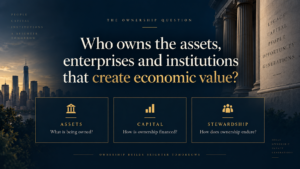
Who owns the assets, enterprises and institutions that create it?
Generational Wealth studies that question.
We examine how ownership is created, structured, financed, strengthened, transferred and preserved—and how ownership determines who participates in the long-term compounding of economic value.
Building What Generations Can Own.
The Ownership Question
Much of the conversation about wealth focuses on income.
How much do people earn?
How much capital do they accumulate?
How successful is a business?
How much does an asset appreciate?
These questions matter.
But they do not fully answer the wealth question.
The deeper question is:
Who owns what produces the value?
Two people can participate in the same economy and experience dramatically different economic outcomes.
One may earn income from an enterprise.
Another may own the enterprise.
One may work in an industry experiencing extraordinary growth.
Another may own the assets, infrastructure, intellectual property, platforms or businesses capturing that growth.
One may generate revenue.
Another may own the asset that generates recurring revenue.
The difference is not simply income.
It is ownership.
Ownership Creates Participation in Value
Ownership gives an individual, organization or institution a continuing economic claim on an asset or enterprise.
That claim may produce:
- Cash flow
- Appreciation
- Equity
- Control
- Strategic influence
- Optionality
- Information
- Future economic opportunity
Ownership can therefore create a fundamentally different relationship with economic value.
Income is generally received for work, expertise, capital or services provided.
Ownership allows value created by an asset or enterprise to continue accruing to its owners.
This distinction is central to the work of Generational Wealth.
We are interested not only in how value is created, but in who captures it, who controls it and whether that ownership can endure.
From Income to Ownership

Income is important.
It provides the resources through which capital can eventually be accumulated and deployed.
But income alone does not necessarily create lasting wealth.
A person can earn substantial income without building a meaningful ownership position.
A business can generate substantial revenue without creating durable enterprise value.
An investor can hold exposure to an economic trend without owning the underlying productive assets that capture its value.
This is why we distinguish between:
EARNING
Generating income through labor, expertise, entrepreneurship or other economic activity.
SAVING
Preserving a portion of income or capital.
INVESTING
Deploying capital with the expectation of generating a return.
OWNING
Holding a continuing economic interest in an asset, enterprise or productive system.
STEWARDING
Protecting, strengthening and transferring that ownership over time.
Each plays a role.
But ownership is where participation in long-term economic value becomes particularly powerful.
What Do We Mean by Ownership?
Ownership is broader than simply holding a title, stock certificate or deed.
We study ownership as an economic and institutional relationship.
Ownership can involve:
Economic ownership
The right to participate in the economic value generated by an asset or enterprise.
Control
The ability to influence important decisions concerning an asset, enterprise or institution.
Equity
A residual claim on value after obligations and liabilities are satisfied.
Intellectual property
Ownership of ideas, technologies, brands, systems and other forms of intangible value.
Enterprise ownership
Ownership of businesses capable of generating recurring economic value.
Real-asset ownership
Ownership of land, real estate, infrastructure and other productive physical assets.
Institutional ownership
Ownership structures designed to survive beyond individual founders or current leadership.
Intergenerational ownership
Ownership intentionally structured to preserve and compound value across generations.
The form may change.
The underlying question remains:
Who has the durable economic claim?
Ownership is Not the Same as Exposure
This distinction matters.
Someone can benefit from the growth of an industry without owning the assets that create that growth.
Someone can work for a highly valuable company without owning a meaningful share of the enterprise.
Someone can live in a rapidly appreciating market without owning property in it.
Someone can participate in technological change without owning the intellectual property, infrastructure or enterprises capturing the economic value.
Exposure can create opportunity.
Ownership creates a claim.
Generational Wealth studies the difference.
The Economics of Ownership
Ownership becomes particularly powerful when the underlying asset or enterprise is capable of compounding.
A productive asset can generate income.
That income can strengthen the asset.
The asset can appreciate.
Capital can be reinvested.
Operations can improve.
Enterprise value can increase.
The resulting value can provide additional capital for future opportunities.
This creates the possibility of a compounding ownership system.
PRODUCTIVE ASSET
↓
CASH FLOW
↓
REINVESTMENT
↓
GREATER PRODUCTIVITY / VALUE
↓
APPRECIATION + CASH FLOW
↓
ADDITIONAL CAPITAL
↓
ADDITIONAL OWNERSHIP
The objective is not simply to accumulate more things.
It is to build ownership of productive assets capable of creating additional economic value over time.
Ownership and Capital
Capital and ownership are inseparable.
Capital makes certain forms of ownership possible.
Ownership determines where capital ultimately resides.
The important questions therefore include:
- Where is capital being deployed?
- Who provides it?
- What does the capital acquire?
- Who controls the resulting asset?
- Who receives the cash flow?
- Who captures appreciation?
- What happens when the asset grows in value?
- What happens when additional capital is required?
- Who bears the risk?
- Who retains the upside?
This is why Generational Wealth does not view capital simply as money to be invested.
We view capital as a mechanism through which productive ownership can be created and strengthened.
Capital should follow intelligence and conviction—not the other way around.
Ownership and Enterprise
A business can be many things.
It can be a source of income.
It can provide employment.
It can solve important problems.
It can generate revenue.
But an enduring enterprise can also become a significant economic asset.
That raises another set of questions:
- Does the business generate durable cash flow?
- Does it possess a competitive advantage?
- Is its value dependent entirely on its founder?
- Does it have transferable systems?
- Does it possess intellectual property?
- Does it have recurring customer relationships?
- Can it attract and retain talent?
- Can it survive leadership transitions?
- Can ownership eventually become institutional?
A business becomes particularly interesting from a generational perspective when its economic value can survive the individuals who created it.
The goal is not simply to build a successful company.
It is to build an enterprise capable of enduring ownership.
Ownership and Real Assets
Real assets occupy an important place in our work because certain physical assets can possess characteristics that support long-duration ownership.
Land.
Real estate.
Infrastructure.
Industrial assets.
Energy-related assets.
Other productive physical assets.
Their economic characteristics can include scarcity, utility, location, replacement cost, durable demand and the potential to generate recurring cash flow.
But our interest is not real estate for its own sake.
We ask:
What makes an asset worth owning for the long term?
And:
What can an owner do to make that asset more productive, more valuable and more durable?
This is the beginning of the Generational Wealth approach to real assets.
Ownership and Time
Ownership becomes increasingly meaningful as the time horizon expands.
A transaction is measured in months or years.
An investment may be measured over several years.
Institutional ownership can be measured over decades.
Generational ownership asks an even longer question:
What happens if we are not planning to sell?
That changes how an asset may be evaluated.
Instead of asking only:
What can this asset be sold for?
we can ask:
What can this asset become?
Instead of:
What is the short-term return?
we can ask:
What is the long-term compounding potential?
Instead of:
How quickly can we exit?
we can ask:
How durable is the ownership opportunity?
Long-duration ownership changes the decision framework.
Ownership and Stewardship
Ownership without stewardship can destroy value.
An asset can be neglected.
A business can become dependent on one individual.
Capital can be misallocated.
Governance can deteriorate.
Leadership can fail.
An institution can lose its institutional memory.
This is why ownership and stewardship cannot be separated.
The question is not simply:
Who owns it?
It is also:
Can the owner preserve and strengthen what is owned?
And ultimately:
Can the ownership survive its current owners?
That is where governance, decision-making and succession become economic questions—not merely administrative ones.
Generational Ownership
We use the term generational ownership to describe ownership designed to create, preserve and compound value across long periods of time.
It does not mean simply passing an asset from parent to child.
It means creating ownership structures, assets, enterprises and institutions capable of enduring beyond the individuals who initially created them.
Generational ownership requires attention to:
- Asset quality
- Capital structure
- Governance
- Decision-making
- Leadership
- Succession
- Institutional memory
- Risk
- Reinvestment
- Long-term strategy
The objective is continuity with improvement.
Not merely preservation.
The Ownership Cycle
We see productive ownership as a continuing process:
CREATE
Build or identify something capable of producing economic value.
↓
CAPITALIZE
Provide the capital necessary to acquire, develop or strengthen it.
↓
OWN
Establish a durable economic claim.
↓
IMPROVE
Increase productivity, quality, efficiency or strategic value.
↓
COMPOUND
Reinvest cash flow, capital and knowledge to create additional value.
↓
STEWARD
Protect the asset, enterprise and ownership structure.
↓
TRANSFER
Pass ownership, knowledge and institutional capability forward.
↓
RECREATE
Use accumulated capital and intelligence to create the next generation of ownership.
This is the architecture of long-term compounding.
The Ownership Advantage
Ownership can provide advantages that income alone cannot.
PARTICIPATION
Owners participate in the economic value created by what they own.
CONTROL
Ownership can provide influence over important decisions.
COMPOUNDING
Productive assets can create additional value over time.
OPTIONALITY
Owners can determine whether to hold, improve, finance, expand, transfer or eventually sell.
INSTITUTIONAL MEMORY
Long-term owners accumulate knowledge about the assets and enterprises they control.
STRATEGIC POSITION
Ownership can create access, influence and capabilities that are difficult to replicate through short-term participation.
These advantages compound when ownership itself becomes institutional.
The Ownership Gap
Economic value does not distribute itself equally simply because people participate equally in an economy.
Different individuals and institutions occupy different positions in the ownership structure.
Some own:
- Land
- Businesses
- Infrastructure
- Intellectual property
- Financial assets
- Data
- Platforms
- Technology
- Networks
Others primarily participate through:
- Labor
- Consumption
- Rent
- Fees
- Wages
- Contractual relationships
Neither role is without value.
But the economic outcomes can be profoundly different.
This creates what we describe as the ownership question:
As new forms of economic value emerge, who will own them?
That question becomes increasingly important during periods of technological, demographic and economic transformation.
Who Will Own the Future?
Every major economic transformation creates new forms of value.
The question is not simply:
What will change?
It is:
Who will own what the change creates?
Who will own the infrastructure?
Who will own the enterprises?
Who will own the land?
Who will own the technology?
Who will own the intellectual property?
Who will own the platforms?
Who will control the capital?
Who will capture the resulting economic value?
And perhaps most importantly:
Will today’s ownership structures remain relevant tomorrow?
These questions form the foundation of our broader research agenda.
From Research to Ownership
Generational Wealth approaches ownership through five connected capabilities.
RESEARCH
We study structural changes in ownership, capital, assets, enterprise and economic value.
INTELLIGENCE
We interpret those changes and identify their implications.
CAPITAL
We determine where disciplined capital may create the greatest long-term ownership opportunity.
ASSETS
We identify, acquire, develop and build productive assets and enterprises.
STEWARDSHIP
We develop the governance, decision-making and continuity required to make ownership endure.
This creates a continuous institutional cycle:
Research → Intelligence → Capital → Assets → Stewardship → Generations
The Generational Wealth Ownership Framework
When we examine an ownership opportunity, we ask:
01 — WHAT IS BEING OWNED?
What is the underlying asset, enterprise, intellectual property, infrastructure or productive system?
02 — WHO OWNS IT?
What is the current ownership structure?
03 — HOW IS OWNERSHIP CREATED?
What capital, capability, relationships or strategy are required?
04 — WHAT CREATES VALUE?
What economic forces make the asset or enterprise valuable?
05 — WHAT CAN DESTROY VALUE?
What risks, decisions, structural changes or governance failures could undermine it?
06 — CAN VALUE COMPOUND?
Can the asset generate cash flow, appreciation, strategic value or additional opportunities over time?
07 — CAN OWNERSHIP ENDURE?
Can the ownership structure survive changes in leadership, markets, capital conditions and generations?
These questions form part of the intellectual foundation of Generational Wealth.
Our Research Agenda
Our work in ownership extends across several areas:
Ownership Structures
How ownership is created, divided, financed and controlled.
Productive Assets
What makes an asset economically valuable and capable of long-term compounding.
Enterprise Ownership
How businesses become durable economic assets.
Capital & Ownership
How capital allocation affects who ultimately owns economic value.
Governance & Control
How decision rights and governance affect economic outcomes.
Succession & Continuity
How ownership survives leadership and generational transitions.
Institutional Ownership
How ownership evolves from individuals and founders into durable institutions.
Emerging Ownership
How technological, demographic and structural changes create new ownership opportunities.
Signature Research
Our ownership research will increasingly produce proprietary institutional intelligence, including:
GENERATIONAL OWNERSHIP INDEX™
A framework for examining ownership patterns, concentration, participation and structural changes in productive economic assets.
STATE OF OWNERSHIP REPORT™
An annual examination of the changing architecture of ownership, capital and economic value.
GENERATIONAL ASSET OUTLOOK™
A forward-looking assessment of asset classes and structural opportunities with potential long-term ownership significance.
These research initiatives are designed to do more than describe the economy.
They are intended to help answer:
Where is economic value moving—and who is positioned to own it?
Ownership is the Question
The world’s most important economic questions often become clearer when viewed through ownership.
Where is capital moving?
Ask who will own what that capital creates.
Where is technology transforming an industry?
Ask who will own the resulting infrastructure, enterprises and intellectual property.
Where are demographic changes creating new demand?
Ask who will own the assets serving that demand.
Where is economic value increasing?
Ask who captures it.
Where is an industry being disrupted?
Ask who gains ownership of the next economic model.
The question is remarkably simple:
Who owns the value?
And then:
Who will own the future?
Building What Generations Can Own
Generational Wealth is ultimately concerned with more than accumulation.
We are interested in productive ownership.
Ownership that creates.
Ownership that compounds.
Ownership that strengthens institutions.
Ownership that survives transitions.
Ownership that can be stewarded over time.
Ownership that creates opportunity for those who come next.
We believe the most consequential wealth question is not simply:
How much wealth can be created?
It is:
What can be owned, strengthened and preserved so that value continues to compound across generations?
That is the work of Generational Wealth.
Ownership

Who owns the assets that create economic value?
Who will own the future?
How can that ownership endure?
Generational Wealth
Building What Generations Can Own.
Research what matters.
Build what lasts.
Own what compounds.
Steward what endures.
[ EXPLORE RESEARCH ] [ PARTNER WITH US ]