Capital Makes Ownership Possible.
Ownership does not happen by accident.
Assets must be acquired. Enterprises must be built. Infrastructure must be developed. Opportunities must be financed. Institutions must be strengthened.
Capital is what makes those things possible.
Generational Wealth studies how capital is created, allocated, structured, deployed and preserved—and how intelligent capital decisions can create greater capacity for long-term ownership.
The question is not simply how much capital exists. The question is what that capital makes possible—and who ultimately owns what it creates.
The Capital Question
Capital is more than money.
It is the resource that allows ideas to become enterprises, enterprises to become assets, and assets to become durable stores of value.
We study capital through the lens of ownership:
Where should capital go?
What should it create?
How should it be structured?
Who should control it?
What return should it produce?
How can it compound over time?
How can capital strengthen long-term ownership?
Capital and Ownership
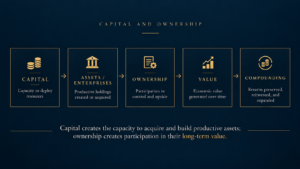
Capital and ownership are inseparable.
Capital can purchase an asset.
Capital can build an enterprise.
Capital can fund expansion.
Capital can acquire productive infrastructure.
Capital can improve an existing asset.
But the deployment of capital also determines who participates in the value that follows.
The structure of financing can influence control, economics, risk, liquidity, governance and ultimately ownership.
For that reason, Generational Wealth does not study capital independently of ownership.
We study the relationship between the two.
Capital determines what can be built. Ownership determines who participates in what is built.
The Economics of Capital
Capital has an opportunity cost.
Every dollar deployed toward one opportunity is a dollar not deployed toward another.
Strong capital allocation therefore requires more than identifying attractive investments. It requires understanding:
- expected return
- risk
- duration
- liquidity
- leverage
- downside protection
- cash flow
- appreciation potential
- control
- governance
- strategic value
- long-term ownership potential
The objective is not simply to maximize financial return.
It is to allocate capital toward opportunities capable of producing durable economic value.
Types of Capital
Capital takes many forms.
Financial Capital
Equity, debt, retained earnings and other forms of financial capital provide the resources required to acquire, build and expand productive assets.
Human Capital
Knowledge, expertise, leadership and specialized capability can determine whether financial capital is converted into durable value.
Intellectual Capital
Proprietary research, intellectual property, systems, data, technology and institutional knowledge can create competitive advantage.
Relationship Capital
Trusted relationships with investors, operators, institutions, partners and communities can create access to opportunities that capital alone cannot purchase.
Institutional Capital
Governance, reputation, systems, culture and organizational capability allow capital to be deployed repeatedly and responsibly over time.
Generational wealth depends on the interaction of all of these forms of capital.
Capital Allocation
Capital allocation is one of the most consequential decisions an owner can make.
The central challenge is not finding somewhere to put capital.
It is determining where capital has the greatest potential to create durable value relative to the risks being assumed.
We examine questions such as:
What deserves additional capital?
What should be acquired?
What should be built?
What should be avoided?
When should capital be deployed?
How much capital should be committed?
What structure best aligns capital with ownership?
Capital allocation is therefore both a financial discipline and an ownership discipline.
The Capital Structure
How an asset or enterprise is financed can materially affect its economics and its ownership.
Debt and equity each have different implications for:
- control
- cash flow
- risk
- flexibility
- dilution
- return on equity
- governance
- resilience
A sophisticated ownership strategy therefore considers not only what to own, but how the ownership should be financed.
The right capital structure can strengthen an asset.
The wrong one can weaken it.
Capital and Compounding
Compounding does not begin with a spreadsheet.
It begins with a productive asset, enterprise or institution capable of creating value over time.
Capital can accelerate that process.
Well-deployed capital can:
- acquire productive assets
- improve operations
- expand capacity
- strengthen competitive position
- develop new opportunities
- reduce constraints
- support long-term resilience
The objective is to build a system in which capital produces value, value produces additional capital capacity, and additional capital creates further ownership.
Capital should not merely circulate. It should compound.
The Capital Cycle
Generational Wealth views capital as part of a longer cycle:
Capital → Assets → Cash Flow → Appreciation → Reinvestment → Greater Capital Capacity → Greater Ownership
The cycle becomes increasingly powerful when the underlying assets and enterprises are productive, well governed and capable of compounding over long periods.
Capital and Enterprise
Enterprises are among the most important vehicles through which capital becomes productive.
Capital can help an enterprise:
- establish itself
- acquire other businesses
- expand into new markets
- develop intellectual property
- invest in people and infrastructure
- improve operations
- strengthen its balance sheet
But capital alone does not create enterprise value.
Value depends on the quality of the underlying business, its economics, its leadership, its competitive position and its ability to generate durable returns.
We therefore study capital together with enterprise value, decision-making and stewardship.
Capital and Real Assets
Real assets can provide another important pathway from capital to ownership.
Land, real estate, infrastructure and other productive physical assets can generate cash flow, appreciate over time and provide durable utility.
Our interest is not simply in acquiring assets.
It is in understanding:
Which assets deserve capital?
Why do they create value?
What inefficiencies can be improved?
What ownership structures are appropriate?
How can the assets compound over time?
This is the foundation of our work in Generational Real Assets.
Capital Discipline
More capital does not necessarily create more wealth.
Poorly allocated capital can destroy value.
Excessive leverage can increase fragility.
Overpaying can impair returns.
Weak governance can undermine good assets.
Short-term thinking can prevent long-term compounding.
Capital discipline means knowing when to deploy capital, when to preserve it and when to walk away.
The best investment decision is sometimes not to invest.
Capital and Time
Capital behaves differently across time horizons.
Some opportunities are designed for liquidity and near-term returns.
Others require years of development, operational improvement or patient ownership before their full value emerges.
Generational Wealth is particularly interested in opportunities where patience is an advantage.
Long-duration capital can support:
- development
- infrastructure
- operating businesses
- real assets
- strategic acquisitions
- institutional capacity
The longer the horizon, the more important governance, resilience and stewardship become.
Capital and Stewardship
Capital can create ownership.
But ownership must eventually be governed.
Capital decisions influence the institution that follows:
Who has authority?
What risks can be taken?
How are returns distributed?
How is reinvestment determined?
What happens when leadership changes?
What happens when an owner exits?
What happens across generations?
Capital strategy therefore cannot be separated from stewardThe Generational Capital Framework
Our work examines capital through six connected questions:
1. Source
Where does the capital come from?
2. Structure
How is the capital organized?
3. Allocation
Where should the capital be deployed?
4. Ownership
Who owns the resulting asset or enterprise?
5. Compounding
How can value grow over time?
6. Stewardship
How can the resulting ownership endure?
This creates a continuous relationship between:
Capital → Ownership → Value → Compounding → Stewardship
What We Study
Our capital research includes:
Capital allocation
How owners and institutions decide where capital should go.
Investment strategy
How investment decisions can align capital with long-term objectives.
Capital structures
How debt, equity and other financing arrangements affect ownership and value.
Private capital
How entrepreneurs, family offices, institutions and strategic investors deploy capital.
Real asset capital
How capital can be deployed into real estate, infrastructure and other productive physical assets.
Enterprise capital
How businesses can use capital to create and compound enterprise value.
Long-duration capital
How patient capital can support assets and enterprises that require time to mature.
Institutional capital
How organizations build the systems and governance required to allocate capital repeatedly and responsibly.
From Capital to Ownership
Our perspective ultimately returns to one question:
What does capital make possible?
The strongest capital strategies do more than produce financial returns.
They create the capacity to own productive assets, build enduring enterprises and establish institutions capable of compounding value over time.
That is the relationship we study.
Capital enables ownership.
Ownership captures value.
Compounding creates capacity.
Stewardship makes it endure.
Our Capital Research Agenda
Generational Wealth investigates the relationship between capital, ownership and long-term value creation.
Our research examines:
Capital allocation
Ownership structures
Investment strategy
Capital formation
Enterprise finance
Real asset finance
Acquisition strategy
Leverage and risk
Long-duration capital
Institutional investing
Capital preservation
Intergenerational capital strategy
The objective is not to predict every market movement.
It is to develop a deeper understanding of how capital can be used to create durable ownership.
From Research to Capital
Our broader institutional model connects research to action:
Research → Intelligence → Capital → Assets → Stewardship → Generations
Research identifies what is changing.
Intelligence helps determine what it means.
Capital provides the capacity to act.
Assets and enterprises convert capital into productive ownership.
Stewardship protects and compounds what has been built.
Capital Is a Means. Ownership Is the Objective.
Capital is powerful because of what it makes possible.
It can acquire.
It can build.
It can expand.
It can protect.
It can compound.
But the ultimate question remains:
Who owns what the capital creates?
That question sits at the center of Generational Wealth.
Building What Generations Can Own.
Research what matters. Build what lasts. Own what compounds. Steward what endures.