
Building With Institutions Built to Last.
Important opportunities rarely exist in isolation.
Creating productive assets, financing enterprises, developing infrastructure, and building enduring ownership structures can require different forms of capital, expertise, access, and institutional capability.
Generational Wealth develops relationships with institutions whose capabilities and interests can align around long-term value creation, productive ownership, and stewardship.
The right partnership can create capabilities that neither institution could build as effectively alone.
What Is an Institutional Partnership?
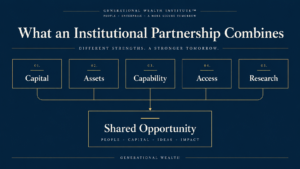
An institutional partnership is a strategic relationship between organizations that combine complementary capabilities, resources or access around a shared objective.
Depending on the opportunity, a partnership may involve:
capital
assets
research
market access
development capability
operating expertise
technology
institutional relationships
distribution
governance
strategic knowledge
The structure should follow the opportunity.
The objective is not to create partnerships for their own sake.
It is to create relationships capable of producing durable economic and institutional value.
Why Institutional Partnerships Matter
Complex opportunities often require more than one capability.
An acquisition may require:
capital + operating expertise + industry knowledge
A development project may require:
land + capital + development capability
An infrastructure opportunity may require:
capital + technical expertise + long-duration ownership
An operating enterprise may require:
capital + management + strategic relationships
A research initiative may require:
data + subject expertise + institutional access
Partnerships can bring those capabilities together.
The Partnership Question
We begin with a straightforward question:
What could we build, own, finance or understand more effectively together than either institution could independently?
That question helps determine whether a partnership is warranted.
We then examine:
What is the opportunity?
What capabilities are required?
What does each partner contribute?
What does each partner receive?
How should ownership be structured?
How should decisions be made?
What risks are being assumed?
What is the appropriate time horizon?
How does the relationship support long-term value creation?
Types of Institutional Partners
Generational Wealth may engage with different types of institutions depending on the opportunity.
Family Offices
Organizations seeking long-term ownership, investment opportunities, strategic relationships or access to differentiated assets and enterprises.
Institutional Investors
Investment organizations seeking opportunities, co-investment relationships, research, asset exposure or strategic partnerships.
Financial Institutions
Banks, lenders, and other financial organizations that can provide financing, structuring capability, market access, or institutional relationships.
Developers and Asset Owners
Organizations with assets, development capabilities, or acquisition opportunities that may align with our real-asset thesis.
Operating Companies
Businesses seeking capital, strategic ownership, acquisitions, growth partnerships, or long-term institutional relationships.
Research and Academic Institutions
Organizations whose research, data, expertise, or intellectual capabilities can contribute to understanding ownership, capital, assets, and long-term value.
Strategic Organizations
Institutions whose networks, technology, infrastructure, capabilities, or market position may create meaningful strategic value.
The appropriate partnership depends on the opportunity rather than the category of institution alone.
Capital Partnerships vs. Institutional Partnerships
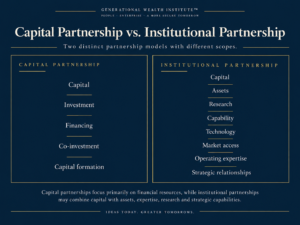
Capital partnerships focus primarily on:
capital
investment opportunities
financing
co-investment
capital formation
Institutional partnerships can be broader.
They may involve:
capital
research
assets
development
operations
technology
market access
institutional knowledge
strategic relationships
This distinction matters because not every valuable institutional relationship is fundamentally a capital relationship.
Partnership and Ownership
Ownership is central to our partnership framework.
A partnership should create clarity around:
who owns what
Who contributes what
Who controls what
How economics are shared
How decisions are made
How additional capital is introduced
How ownership can change
How the relationship ends
How value is protected
The objective is not simply to establish collaboration.
It is to establish a clear and durable relationship around the underlying economic opportunity.
Partnership and Capital
Capital is often one component of a broader institutional relationship.
A partner may contribute:
equity
debt
development capital
operating capital
strategic capital
intellectual capital
relationship capital
Capital contributions should be aligned with the role they play in creating value.
The structure should make the economics, responsibilities, and risks understandable to all participating parties.
Partnership and Assets
Institutional partnerships can expand access to productive assets.
A partner may have:
an acquisition opportunity
land
development rights
operating infrastructure
industrial capacity
specialized real estate
an established operating platform
or another productive asset
The question is not simply whether the asset is available.
It is whether the asset fits the broader ownership thesis.
Partnership and Enterprise
The same principle applies to enterprises.
A business may have:
strong economics
experienced leadership
valuable customers
proprietary capabilities
growth potential
strategic assets
succession considerations
capital requirements
A partnership may provide the capabilities required to strengthen the enterprise while preserving alignment around long-term ownership.
Partnership and Research
Generational Wealth is also building an institutional research platform.
Partnerships can contribute to that work through:
data access
research collaboration
subject expertise
field knowledge
academic relationships
industry perspectives
case evidence
Research partnerships should preserve intellectual independence and clearly distinguish institutional research from commercial interests.
Partnership and Intelligence
Institutional relationships can also strengthen the Intelligence platform.
Different institutions observe different parts of the economy.
An investor may see capital movements.
An operator may see customer behavior.
A developer may see changes in land and development markets.
A financial institution may see financing conditions.
A researcher may see long-term structural trends.
Combining these perspectives can create a richer understanding of ownership and opportunity.
The objective is not to collect relationships.
It is to develop better institutional intelligence.
Partnership and Governance
Successful partnerships require clear governance.
Questions may include:
Who makes decisions?
What requires joint approval?
Who has authority over capital?
How are conflicts addressed?
How are performance and progress evaluated?
What happens when partners disagree?
What happens if circumstances change?
What happens when additional capital is required?
What happens at the end of the partnership?
Clarity at the beginning can reduce complexity later.
Alignment
We look for alignment across several dimensions.
Economic Alignment
Do the economic incentives support the desired outcome?
Strategic Alignment
Are the institutions pursuing compatible objectives?
Time-Horizon Alignment
Are the partners comfortable with the required duration?
Governance Alignment
Can consequential decisions be made effectively?
Ownership Alignment
Is there agreement about who should own and control the resulting value?
Stewardship Alignment
Do the partners share a commitment to protecting and developing long-term value?
Strong partnerships often depend as much on alignment as on capability.
Partnership Structures
The appropriate relationship may take different forms.
Potential structures can include:
Joint ventures
Combining capital and capabilities around a defined opportunity.
Co-investments
Participating together in a specific asset or enterprise.
Strategic alliances
Cooperating around a defined strategic objective without necessarily creating shared ownership.
Development partnerships
Combining assets, capital, and development capability.
Acquisition partnerships
Combining resources and capabilities around an acquisition.
Research partnerships
Collaborating around a defined research question or body of work.
Operating partnerships
Combining ownership with specialized operational capability.
The structure should reflect the underlying objective.
Long-Term Partnerships
Some opportunities require relationships that extend well beyond a transaction.
Long-term institutional relationships may create:
shared knowledge
trust
operating familiarity
capital access
market intelligence
future opportunities
institutional memory
These benefits can compound over time.
A successful partnership can therefore become a platform for future ownership rather than simply a single transaction.
From Partnership to Institutional Capability
Every meaningful partnership can expand an institution’s capabilities.
A relationship may provide:
market knowledge
capital access
development expertise
operating experience
technology
data
institutional relationships
new opportunities
Over time, those capabilities can become part of the institution’s accumulated knowledge and network.
This creates a potential cycle:
Partnership → Capability → Opportunity → Ownership → Experience → Stronger Partnership
Partnership Evaluation
Before entering a significant institutional relationship, we consider:
Opportunity
Is there a clearly defined opportunity or objective?
Fit
Does the relationship align with our ownership and capital thesis?
Capability
Does each partner contribute something meaningful?
Economics
Are the economics sufficiently compelling and understandable?
Governance
Can important decisions be made effectively?
Risk
Are the major risks identifiable and appropriately allocated?
Duration
Is the expected time horizon compatible with both parties?
Ownership
Is there clarity around the resulting economic interests?
Stewardship
Can the relationship support long-term value?
What We Look For in Partners
We are particularly interested in institutions that bring one or more of the following:
Capital
Ability to provide aligned financial resources.
Assets
Access to productive assets or enterprises.
Capability
Specialized expertise or operating experience.
Access
Relationships, markets, data, or opportunities.
Research
Knowledge, evidence, or intellectual capability.
Scale
Infrastructure or institutional capacity.
Long-Term Orientation
Willingness to build relationships around durable value rather than short-term transactions.
No single characteristic is sufficient.
The quality of the overall fit matters most.
What We Bring
Generational Wealth brings a developing institutional platform centered on:
ownership research
capital strategy
ownership intelligence
decision intelligence
asset strategy
institutional strategy
long-term stewardship
Our role within a partnership may therefore vary.
We may bring:
research
strategic perspective
capital strategy
ownership analysis
investment thesis development
institutional relationships
opportunity identification
governance perspective
The specific role should be defined by the opportunity.
The Institutional Partnership Framework
Our approach can be summarized as:
Opportunity → Fit → Capability → Structure → Governance → Capital → Ownership → Stewardship
The sequence begins with the opportunity.
Only after understanding the opportunity do we determine the appropriate relationship and structure.
Institutional Partnerships and the Generational Wealth Model
Institutional partnerships connect directly to the broader Generational Wealth architecture:
Research → Intelligence → Capital → Assets → Ownership → Stewardship
Research can identify an opportunity.
Intelligence can help determine what it means.
Capital can provide financial capacity.
Partners can provide additional capabilities.
Assets and enterprises create productive value.
Ownership captures participation in that value.
Stewardship protects and develops what has been built.
Building an Institutional Network
Over time, Generational Wealth intends to develop relationships across a broad institutional network.
The objective is not to accumulate contacts.
It is to develop trusted relationships with organizations whose capabilities can contribute to meaningful opportunities.
Those relationships may eventually create:
capital opportunities
acquisition opportunities
development opportunities
research opportunities
strategic opportunities
operating opportunities
The network itself becomes part of institutional capacity.
Build Together. Own With Purpose.
The most valuable partnerships are not simply transactions.
They are relationships in which capital, capability, knowledge, and ownership come together around an opportunity capable of creating durable value.
The right partner does more than provide a resource. The right partner expands what becomes possible.
That is the foundation of Institutional Partnerships at Generational Wealth.
Building What Generations Can Own.
Research what matters. Build what lasts. Own what compounds. Steward what endures.