What Happens After the Founder?
Building an enterprise is one challenge.
Building something that can remain valuable when its original owners and leaders are no longer in control is another.
Generational Wealth studies succession as a fundamental question of ownership, governance, enterprise value and institutional continuity.
An institution is not truly enduring if its value depends entirely on the people who built it.
Succession is therefore not simply an event at the end of a career.
It is a long-term process of preparing ownership, leadership, capital, knowledge and institutions for what comes next.
The Succession Question
Every enduring enterprise eventually faces a transition.
A founder steps away.
A leader retires.
An owner sells.
A new generation assumes responsibility.
An investor changes.
A board changes.
A key executive leaves.
A family structure evolves.
The central question is:
Can the institution continue creating value when the people who created it are no longer making the decisions?
That question sits at the center of succession research.
Succession Is More Than Leadership
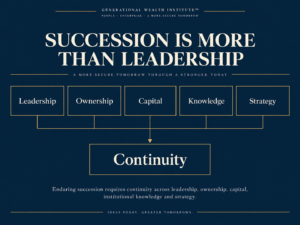
Succession is often reduced to replacing one person with another.
That is too narrow.
A durable succession process considers at least five forms of continuity:
Leadership continuity
Who will lead?
Ownership continuity
Who will own?
Capital continuity
How will the institution remain financially capable?
Knowledge continuity
What institutional knowledge must survive?
Strategic continuity
Which principles and capabilities should remain intact?
A transition can succeed in one dimension while failing in another.
A new CEO may take over successfully while ownership becomes fragmented.
Ownership may remain intact while leadership capability deteriorates.
Capital may remain available while strategic continuity is lost.
Succession therefore requires a broader institutional view.
Succession and Ownership
Ownership can create long-term economic value.
But ownership also creates responsibility.
As ownership changes hands, questions emerge:
Who receives the ownership?
Who controls it?
Can ownership be divided?
Can it be sold?
Should it remain concentrated?
How are voting rights structured?
What happens when owners disagree?
What happens when one owner wants liquidity and another wants to continue?
What happens when the next generation does not want the same role?
These are ownership questions as much as succession questions.
Succession and Enterprise Value
Enterprise value can be highly dependent on continuity.
A business may possess strong economics, competitive advantages and valuable assets.
But if those advantages disappear when a founder leaves, the underlying enterprise may be less durable than it appears.
Generational Wealth therefore studies whether value is:
transferable
institutionalized
repeatable
defensible
independent of a single individual
The goal is not to eliminate the importance of leadership.
It is to understand how leadership can become part of an institution rather than the entire institution.
The Founder Dependency Problem
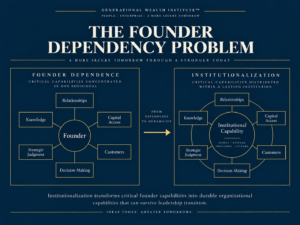
Founders can be extraordinary sources of enterprise value.
They may hold:
relationships
knowledge
vision
capital access
industry expertise
customer trust
strategic judgment
institutional history
But concentration of these capabilities within one individual can also create a form of organizational dependency.
That creates important questions:
What happens if the founder leaves?
What decisions still depend on the founder?
Which relationships are personal rather than institutional?
What knowledge has never been documented?
Who can make the most important decisions?
Can the organization function without direct founder involvement?
Founder succession should therefore begin long before a founder intends to leave.
Succession and Institutionalisation
The transition from founder-led enterprise to enduring institution requires institutionalization.
It is to design ownership and governance arrangements that can accommodate changing generations without destroying the underlying value.
Succession and Institutional Knowledge
Some of an institution’s most valuable assets are difficult to measure.
Why was a particular acquisition made?
Which relationships took decades to build?
Which mistakes should never be repeated?
Why was a particular strategy abandoned?
Which suppliers, partners or customers are critical?
What does the founder understand intuitively that the organization has never documented?
Without intentional knowledge transfer, significant institutional memory can disappear during succession.
Generational Wealth studies how institutional knowledge can become part of the institution itself rather than remaining trapped within individuals.
Succession and Culture
Culture can be another source of continuity.
But culture should not be confused with preserving everything exactly as it was.
Enduring institutions need both continuity and adaptation.
The question is:
What must remain constant, and what must be allowed to change?
Values may endure.
Strategies may change.
Ownership structures may evolve.
Leadership may change.
Markets may change.
Technology may change.
Succession therefore involves preserving the institutional foundations that matter while maintaining enough flexibility to adapt.
Succession and Time
The strongest succession strategies begin before succession is immediately necessary.
A long horizon allows institutions to:
identify potential leaders
develop talent
transfer knowledge
clarify ownership
strengthen governance
build liquidity
test decision-making
develop institutional relationships
prepare contingency plans
Time creates options.
Waiting until a transition becomes urgent reduces them.==The Succession Test
We believe an enduring institution should be able to answer:
Who leads if the current leader leaves tomorrow?
Who owns if the current ownership structure changes?
Who makes consequential decisions during a transition?
How will capital remain available?
What institutional knowledge must be preserved?
What relationships must be transferred?
What principles should remain intact?
What should the next generation be free to change?
Can the institution continue creating value without its original founder?
These questions reveal whether succession has been treated as an afterthought or as part of institutional design.
The Generational Succession Framework
Generational Wealth studies succession through seven connected dimensions:
1. Leadership
Who has the capability and authority to lead?
2. Ownership
Who owns the underlying economic interests?
3. Governance
How are important decisions made during and after transition?
4. Capital
What financial capacity is required to support continuity?
5. Knowledge
What institutional knowledge must be transferred?
6. Strategy
What should remain consistent, and what should evolve?
7. Stewardship
How will the institution’s value and purpose be protected over time?
Together, these dimensions create a broader framework for understanding succession.
The Succession Continuity Cycle
We view succession as part of a continuing institutional cycle:
Build → Institutionalize → Develop → Transition → Stabilize → Renew → Build Again
Succession should not terminate an institution’s development.
It should create the conditions for the next phase of development.
The objective is continuity without stagnation.
Succession and Intergenerational Ownership
Intergenerational ownership creates a different time horizon.
The objective is not simply to transfer assets.
It is to transfer the capacity to own, govern, operate and compound value.
That distinction matters.
A family can inherit an asset and lose its value.
A family can inherit a business and destroy its economics.
A generation can inherit capital without understanding how to allocate it.
The deeper objective is therefore capability:
ownership capability
decision-making capability
capital capability
governance capability
stewardship capability
These capabilities can determine whether ownership lasts.
What Makes Succession Durable?
A durable succession system may have:
Clear ownership
The economic interests and rights are understood.
Clear authority
Decision rights are defined.
Prepared leadership
Potential successors have been developed and evaluated.
Institutional knowledge
Critical knowledge exists beyond individual memory.
Financial resilience
The institution has sufficient capital and liquidity to manage transition.
Governance
The rules for consequential decisions are established.
Adaptability
The next generation can respond to changing conditions.
Stewardship
Long-term value remains a governing objective.
Our Succession Research Agenda
Generational Wealth investigates:
Founder succession
Leadership transitions
Ownership transitions
Family enterprise succession
Management succession
Board succession
Capital continuity
Ownership structures
Institutional knowledge transfer
Leadership development
Governance continuity
Intergenerational ownership
Institutional resilience
Strategic continuity
Long-term enterprise value
Our objective is to understand how institutions can move from one generation of leadership and ownership to the next without losing the capabilities that created their value.
From Succession to Stewardship
Succession and stewardship are closely connected.
Succession asks:
What happens next?
Stewardship asks:
How do we protect and develop what comes next?
Together they form part of a longer institutional progression:
Research → Intelligence → Capital → Assets → Ownership → Governance → Succession → Stewardship → Generations
The objective is not simply continuity for its own sake.
It is the continuation of productive ownership and value creation across time.
Build Beyond the Founder.
The ultimate test of an institution is not whether its founder can build something valuable.
It is whether the institution can remain valuable after the founder is gone.
That requires more than a successor.
It requires systems, ownership structures, capital, governance, knowledge and leadership capable of carrying the institution forward.
Build the institution so the institution can outlast the individual.
That is the deeper question behind succession research at Generational Wealth.
Building What Generations Can Own.
Research what matters. Build what lasts. Own what compounds. Steward what endures.