
Value Is More Than a Price.
A business can generate revenue without creating durable value.
It can grow without becoming stronger.
It can become larger without becoming more valuable to its owners.
Generational Wealth studies enterprise value as a measure of what an enterprise is actually worth—and, more importantly, what makes that value durable, defensible, and capable of compounding over time.
The question is not simply what a business is worth today. The question is what makes it worth owning tomorrow.
What Creates Enterprise Value?
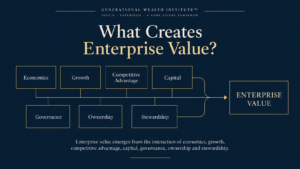
Enterprise value is ultimately connected to an enterprise’s economic capacity.
That capacity can be shaped by:
- revenue
- cash flow
- profitability
- growth
- competitive advantage
- customer relationships
- intellectual property
- operating systems
- management
- capital structure
- market position
- barriers to entry
- strategic assets
- resilience
- future opportunity
But these components do not have equal importance in every enterprise.
The quality of an enterprise depends on how these elements work together.
Enterprise Value and Ownership
Ownership creates economic participation.
Enterprise value helps us understand what that participation may be worth.
For owners, therefore, enterprise value is not merely a valuation concept.
It is central to questions of:
ownership
capital allocation
acquisition
financing
growth
succession
liquidity
wealth creation
An enterprise that increases in value can increase the economic value of the ownership attached to it.
That is why enterprise value sits directly within our broader ownership framework.
From Business Activity to Enterprise Value
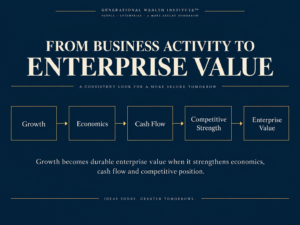
Not every business activity creates lasting enterprise value.
A company can increase sales while margins deteriorate.
It can increase customers while customer economics weaken.
It can increase employees while productivity declines.
It can grow revenue while requiring ever-increasing amounts of capital.
Generational Wealth, therefore, examines the relationship between:
Growth → Economics → Cash Flow → Competitive Strength → Enterprise Value
Growth matters.
But productive growth matters more.
The Economics of Enterprise Value
Enterprise value reflects expectations about the economic future of an enterprise.
That means valuation is influenced by questions such as:
How much cash can the enterprise generate?
How durable is that cash flow?
How quickly can it grow?
What capital is required to support that growth?
What risks could impair future performance?
How defensible is the enterprise’s position?
What happens if leadership changes?
What happens if market conditions change?
The answers determine how investors and owners may assess the enterprise.
Durable Value Creation
We are particularly interested in durable enterprise value.
Durability can come from many sources:
Strong customer relationships
Recurring revenue
Pricing power
Operational efficiency
Proprietary knowledge
Technology
Brand
Distribution
Network effects
Intellectual property
Scarce assets
Regulatory positioning
Exceptional organizational capability
The question is not whether an enterprise has advantages.
It is whether those advantages can remain economically meaningful over time.
Enterprise Value and Capital
Capital can accelerate enterprise growth.
It can finance acquisitions.
It can expand capacity.
It can develop technology.
It can build distribution.
It can strengthen operations.
But capital can also destroy enterprise value when it is poorly allocated.
Paying too much for growth can destroy returns.
Excessive leverage can increase fragility.
Misaligned incentives can weaken decision-making.
Underinvestment can reduce competitiveness.
Capital allocation and enterprise value are therefore deeply connected.
The objective is not to maximize the amount of capital deployed. It is to increase the value created by the capital deployed.
Enterprise Value and Acquisition
Acquisition is one of the most direct ways capital and ownership intersect.
An acquisition decision requires understanding:
What are we buying?
What is the enterprise actually worth?
Why is the owner selling?
What risks are embedded in the business?
What can be improved after the acquisition?
What synergies are real?
How much capital will be required?
What could destroy value?
Can the enterprise compound under new ownership?
The acquisition price matters.
But the value creation strategy after acquisition matters just as much.
Enterprise Value and Operating Performance
Enterprise value ultimately has to connect to the enterprise’s underlying economics.
We therefore examine:
Revenue growth
Gross margins
Operating margins
Cash conversion
Return on invested capital
Customer retention
Capital intensity
Working capital
Debt
Free cash flow
Reinvestment requirements
These measures help distinguish growth that creates value from growth that merely increases scale.
Enterprise Value and Intangible Assets
Some of the most valuable assets of an enterprise may never appear clearly on a traditional balance sheet.
These can include:
- intellectual property
- proprietary data
- brand
- relationships
- organizational knowledge
- systems
- culture
- specialized expertise
- distribution networks
These assets can contribute materially to enterprise value even when they are difficult to measure directly.
That is why enterprise analysis requires more than reading financial statements.
It requires understanding how the enterprise actually creates and protects economic value.
Enterprise Value and Leadership
Enterprises are ultimately operated by people.
Leadership decisions affect capital allocation, growth, risk, culture, innovation and organizational resilience.
A strong business model can be weakened by poor decisions.
A strong enterprise can be strengthened by disciplined leadership.
For this reason, Generational Wealth examines enterprise value alongside decision-making, governance and institutional leadership.
Enterprise Value and Time
Enterprise value should not be considered only at a point in time.
An owner with a long-term horizon asks different questions:
What will this enterprise be worth in five years?
What about ten?
What advantages can compound?
What capabilities can be strengthened?
What risks could emerge?
Can the business survive its current leadership?
Can it continue generating cash after its founders leave?
Can ownership be transferred without destroying value?
This is where enterprise value intersects directly with generational wealth.
Enterprise Value and Stewardship
Creating enterprise value is only one part of the challenge.
Preserving it is another.
Growing an enterprise can require:
governance
succession
capital discipline
leadership development
risk management
institutional systems
strategic reinvestment
Without those capabilities, value can erode.
Stewardship is therefore not separate from enterprise value.
It is one of the mechanisms through which enterprise value can endure.
The Enterprise Value Framework
Generational Wealth studies enterprise value through seven connected dimensions:
1. Economics
How does the enterprise make money?
2. Growth
How can the enterprise expand without destroying returns?
3. Competitive Advantage
Why can the enterprise continue creating value?
4. Capital
What resources are required to build and sustain the enterprise?
5. Governance
How are consequential decisions made?
6. Ownership
Who captures the value created?
7. Stewardship
Can the enterprise remain valuable across time and leadership transitions?
Together, these dimensions create a more complete picture of enterprise value.
The Enterprise Value Cycle
We view enterprise value as part of a longer cycle:
Capital → Enterprise → Cash Flow → Reinvestment → Competitive Strength → Greater Enterprise Value → Greater Ownership Capacity
When the cycle works well, an enterprise can become more valuable while simultaneously creating greater capacity for its owners to invest, acquire, and build again.
What Makes an Enterprise Worth Owning?
This is ultimately the question behind our enterprise value research.
A valuable enterprise may possess:
Strong economics
It produces attractive returns relative to the resources required.
Durable advantages
Its position is difficult to replicate or displace.
Reinvestment capacity
It can productively deploy capital into future growth.
Resilience
It can withstand periods of disruption.
Institutional capability
Its value does not depend entirely on one individual.
Transferability
Ownership can change without destroying the enterprise.
Compounding potential
The enterprise can become more valuable over long periods.
Enterprise Value and Generational Wealth
Generational wealth is not created simply by owning businesses.
It is created by owning productive enterprises that can create and preserve economic value over time.
That makes enterprise value central to our broader work.
Businesses can produce income.
Enterprises can produce enduring value.
Ownership allows that value to accrue to those who hold the underlying economic interest.
Stewardship determines whether that value can endure.
Our Enterprise Value Research Agenda
Generational Wealth investigates:
Enterprise valuation
Business economics
Cash flow and profitability
Competitive advantage
Capital efficiency
Acquisition economics
Capital structure
Operating performance
Intangible assets
Governance
Succession
Long-term value creation
Enterprise resilience
Ownership structures
Institutional durability
Our objective is to understand not simply what an enterprise is worth, but why it is worth owning.
From Enterprise Value to Ownership
Our institutional framework connects enterprise value to the broader Generational Wealth system:
Research → Intelligence → Capital → Enterprise → Ownership → Stewardship → Generations
Research helps identify the forces shaping enterprise value.
Intelligence helps interpret them.
Capital provides the resources to act.
Enterprises convert capital and capability into economic value.
Ownership captures participation in that value.
Stewardship protects and compounds it.
Value Worth Owning. Value Worth Preserving.
Enterprise value is not merely a number.
It is the economic expression of an enterprise’s capacity to create value over time.
The deeper question is:
What makes an enterprise worth owning for the long term?
That is the question Generational Wealth seeks to understand.
Building What Generations Can Own.
Research what matters. Build what lasts. Own what compounds. Steward what endures.