
Contents
- 1 What Is a Holding Company?
- 2 Holding Company Meaning and Definition
- 3 Why Holding Companies Exist
- 4 Holding Company vs. Operating Company
- 4.1 Holding Company vs. Operating Company
- 4.2 Operating Companies Run the Business Activity
- 4.3 Holding Companies Own the Business Interests
- 4.4 The Operating Company Does the Work. The Holding Company Organizes Ownership.
- 4.5 Why Confusing the Two Creates Misunderstanding
- 4.6 Operating Companies Run the Business Activity
- 4.7 Holding Companies Own the Business Interests
- 4.8 The Operating Company Does the Work. The Holding Company Organizes Ownership.
- 4.9 Why Confusing the Two Creates Misunderstanding
- 5 How Does a Holding Company Work?
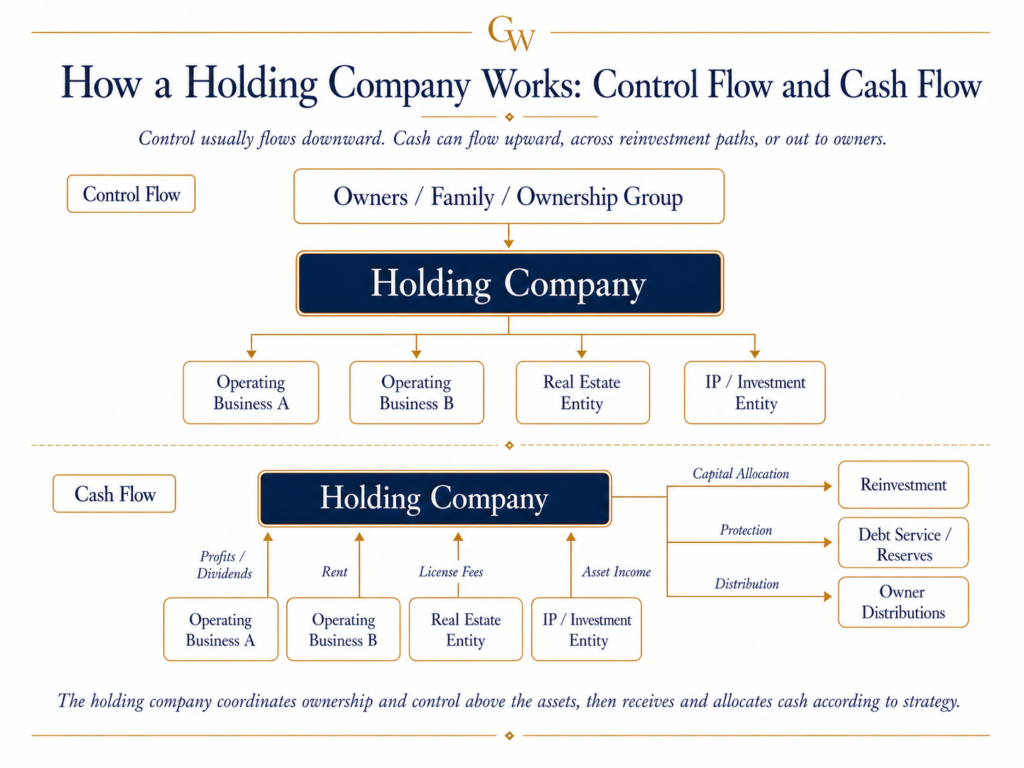
- 6 Visual Placement: How a Holding Company Works: Control Flow and Cash Flow
- 7 A Holding Company Owns Interests Below It
- 8 Control May Flow Downward
- 9 Value May Flow Upward
- 10 Structure and Agreements Determine the Details
- 11 A Holding Company Often Sits Between Owners and Assets
- 12 What Can a Holding Company Own?
- 13 Visual Placement: What a Holding Company Can Own
- 13.1 A Holding Company Can Own Operating Businesses
- 13.2 A Holding Company Can Own Real Estate Interests
- 13.3 A Holding Company Can Own Intellectual Property
- 13.4 A Holding Company Can Own Financial or Investment Assets
- 13.5 A Holding Company Can Own Future Acquisition Vehicles
- 13.6 The Four Ownership Domains
- 14 Why Owners Use Holding Companies
- 15 Visual Placement: Why Owners Use Holding Companies
- 15.1 Owners Use Holding Companies to Organize Ownership
- 15.2 Owners Use Holding Companies to Hold Multiple Assets or Entities
- 15.3 Owners Use Holding Companies to Separate Functions
- 15.4 Owners Use Holding Companies to Support Succession Planning
- 15.5 Owners Use Holding Companies to Support Long-Term Stewardship
- 15.6 Owners Use Holding Companies to Prepare for Future Growth
- 15.7 Benefits Require Proper Structure
- 16 Holding Company and Subsidiary Structure
- 17 Visual Placement: Holding Company and Subsidiary Structure
- 18 Family Holding Companies and Long-Term Ownership
- 19 Visual Placement: Family Ownership Layer and Governance Layer
- 20 Direct Ownership vs. Structured Ownership
- 21 What a Holding Company Does Not Solve by Itself
- 22 Visual Placement: What a Holding Company Does Not Solve by Itself
- 22.1 A Holding Company Does Not Automatically Create Governance
- 22.2 A Holding Company Does Not Automatically Create Family Alignment
- 22.3 A Holding Company Does Not Automatically Prepare Successors
- 22.4 A Holding Company Does Not Automatically Create Tax or Legal Benefits
- 22.5 A Holding Company Does Not Replace Capable Management
- 22.6 Structure Helps, But It Does Not Govern Itself
- 23 Reader Application
- 24 Visual Placement: Reader Application
- 25 Holding Company Readiness Questions
- 26 Visual Placement: Holding Company Readiness Questions
- 27 Key Observations
- 27.1 A holding company is an ownership layer.
- 27.2 A holding company can make ownership more visible.
- 27.3 Holding companies often own interests in companies, assets, subsidiaries, or entities.
- 27.4 Operating companies run business activity. Holding companies organize ownership.
- 27.5 A holding company can support long-term ownership, but it does not replace governance.
- 27.6 A family holding company requires family governance.
- 27.7 Structure without decision-making discipline can still create confusion.
- 27.8 A holding company may support succession, but it does not prepare successors on its own.
- 27.9 The purpose of structure is not complexity. The purpose is organized ownership.
- 27.10 Ownership architecture matters when assets, entities, and future transfer become more complex.
- 28 Conclusion
- 29 Frequently Asked Questions
- 29.1 What is a holding company?
- 29.2 What does a holding company do?
- 29.3 What is the meaning of a holding company?
- 29.4 What is a holding company structure?
- 29.5 How does a holding company work?
- 29.6 How does a holding company make money?
- 29.7 What is the purpose of a holding company?
- 29.8 What can a holding company own?
- 29.9 Can a holding company own multiple businesses?
- 29.10 Can a holding company own real estate?
- 29.11 Can a holding company own intellectual property?
- 29.12 What is the difference between a holding company and an operating company?
- 29.13 What is the difference between a holding company and a parent company?
- 29.14 What is the difference between a holding company and a subsidiary?
- 29.15 What is a family holding company?
- 29.16 Why would a family use a holding company?
- 29.17 Does a holding company provide asset protection?
- 29.18 Does a holding company create tax benefits?
- 29.19 Is a holding company only for large companies?
- 29.20 How does a holding company support business succession?
- 29.21 How does a holding company support generational wealth?
- 30 Related Institute Papers
- 30.1 Related Institute Papers
- 30.2 Why Most Families Never Build Ownership: The Missing Link Between Income and Generational Wealth
- 30.3 What Is Family Governance? The Missing Layer in Most Wealth Plans
- 30.4 Family Wealth Transfer: Why Continuity Matters More Than Inheritance
- 30.5 Business Succession Planning: What Most Owners Miss About Ownership Transfer
- 30.6 Ownership Continuity: A Framework for Building and Transferring Wealth Across Generations
- 31 Authoritative Sources
- 32 Strategic Role in the Series
What Is a Holding Company?
A holding company is a company that owns other companies, assets, or ownership interests. It is usually formed or used to hold ownership rather than to directly operate the underlying business activity. In many cases, the holding company sits above operating companies, subsidiaries, real estate entities, intellectual property entities, investment accounts, or other assets.
The simplest way to understand a holding company is this:
A holding company is an ownership layer.
It does not necessarily make the product, serve the customer, employ the operating staff, manage the storefront, perform the service, or run the daily business activity. Instead, it may own the company or entity that does those things.
This is why the distinction between ownership and operations matters. The operating company does the work. The holding company organizes ownership above the work.
A holding company may own all or part of another company. It may own shares, membership interests, partnership interests, real estate interests, intellectual property rights, investment interests, or other assets, depending on its purpose and structure. In a classic corporate structure, the company beneath the holding company may be called a subsidiary. A subsidiary is typically a separate legal entity that is owned or controlled by another entity, often a parent company or holding company.
A holding company can be simple or complex. It may own one operating business. It may own several subsidiaries. It may own real estate in one entity and intellectual property in another. It may hold investment interests or future acquisition vehicles. It may be used by a business founder, family ownership group, investment group, corporate group, or family enterprise.
The form may vary, but the underlying idea remains the same.
A holding company creates a structure above the assets being owned.
A Holding Company Is an Ownership Layer
A holding company should first be understood as an ownership layer. It sits above assets, entities, or ownership interests and provides a structure for organizing those interests. That is why the phrase “holding company” can sometimes sound more technical than it needs to. The company is “holding” ownership.
This does not mean every holding company looks the same. Some holding companies own controlling interests in subsidiaries. Some own real estate entities. Some own intellectual property. Some own investments. Some are used inside corporate groups. Some are used in family ownership structures. Some hold one asset. Others hold several entities or categories of assets.
But the central role is ownership.
Cornell Law School’s definition emphasizes control through ownership of sufficient voting stock. That definition is useful because it shows that a holding company is not only about passive possession. In many structures, the holding company may influence or control policies and management of the companies it owns.
In ownership terms, this matters because control and operations are distinct. A holding company may control or influence what sits beneath it without running every daily activity itself. That is why holding companies are often used to separate ownership from operations.
A holding company can therefore make ownership more visible. It can show who owns the assets, what sits beneath the ownership layer, how control may be organized, and where future ownership interests may be added.
A Holding Company May Own Companies, Assets, or Interests
A holding company may own companies, assets, or ownership interests. The exact structure depends on the owner’s goals, the legal form chosen, governing documents, jurisdiction, tax rules, and professional guidance.
In a business context, a holding company may own one or more operating companies. For example, one operating company may run a service business, another may own equipment, another may hold real estate, and another may hold intellectual property. The holding company may sit above them as the ownership layer.
In a real estate context, a holding company may own interests in real estate entities. Those entities may hold rental properties, commercial buildings, land, or other real estate interests. The structure can vary widely, and the legal and tax implications depend on the specific arrangement.
In an intellectual property context, a holding company or related entity may own trademarks, copyrights, patents, brand assets, licensing rights, or other intangible assets. These assets may then be licensed or used by operating businesses, depending on the structure and agreements.
In an investment context, a holding company may own securities, investment interests, partnership interests, cash reserves, or other financial assets. The United States Bureau of Economic Analysis describes holding companies within an industry classification context as businesses engaged in holding securities of companies and enterprises for ownership interest and influencing management decisions.
This is why a holding company can become an important concept in long-term ownership. It can provide a way to consolidate multiple ownership interests into a single structural layer.
A Holding Company Is Not Automatically an Operating Business
A holding company is not automatically an operating business. This is one of the most important distinctions in the article.
An operating business generally produces goods, provides services, serves customers, hires employees, manages daily operations, carries operating risk, and generates business activity. A holding company, by contrast, generally exists to own interests in companies, assets, or entities. It may have administrative, governance, oversight, or investment functions, but its core role is usually ownership rather than day-to-day operations.
This distinction helps prevent confusion. If someone asks, “What does a holding company do?” the answer is not always that it sells products or serves customers directly. Often, it owns the entities that do those things.
A holding company may own an operating company. The operating company may employ staff, manage customers, deliver services, sell products, and run the business. The holding company may hold an ownership interest greater than that of the operating company.
That separation can be useful, but it must be understood carefully. A holding company does not automatically create legal protection, tax efficiency, better management, family alignment, or business success. Those outcomes depend on structure, law, documentation, jurisdiction, governance, compliance, and professional guidance.
This paper is not legal, tax, or investment advice. It is an ownership framework.
The core point is that a holding company is a structural tool. It can help organize ownership, but it does not replace the need for good governance, capable management, and disciplined stewardship.
The Simple Definition
A holding company is a company that owns other companies, assets, or ownership interests, often to organize control, structure ownership, and support long-term management of those interests.
Said more simply:
A holding company is an ownership layer above assets or operating entities.
That is the definition readers should carry forward.
A holding company may own businesses. It may own real estate entities. It may own intellectual property. It may own investments. It may own subsidiaries. It may own future acquisition vehicles. But its deeper value is structural. It helps make ownership visible.
And once ownership becomes visible, it can be organized, governed, stewarded, and prepared for transfer with greater intention.
Holding Company Meaning and Definition
The meaning of a holding company depends on its role inside the ownership system. At its simplest, a holding company is a company that holds ownership interests. Those interests may be in other companies, assets, subsidiaries, real estate entities, intellectual property entities, investment interests, partnership interests, or other ownership positions.
But the definition alone does not explain why holding companies matter.
The real meaning of a holding company is structural. It creates a layer above assets or entities. That layer may help organize control, ownership rights, decision-making, future acquisitions, succession planning, and long-term continuity. In other words, a holding company is not only a legal or corporate term. It is one way to think about ownership architecture.
A holding company may be simple or complex. It may hold one subsidiary or several entities. It may sit above operating businesses, real estate entities, intellectual property, investment assets, or partnership interests. It may be used by a founder, a family enterprise, a corporate group, an acquisition platform, an investor group, or an ownership family. What matters is not the size of the structure. What matters is the role it plays.
A holding company holds ownership interests and can provide structure above the assets or operating entities.
This definition matters because misunderstandings about holding companies often lead to confusion among ownership, control, management, operations, and governance. A holding company may own the business, but it may not run the daily business. It may hold assets, but it may not automatically protect those assets. It may create structure, but it may not create discipline. It may support continuity, but it cannot replace governance.
That is why the Institute’s definition must be clear:
A holding company is an ownership structure that can help organize assets, control entities, and long-term ownership, but it is not a complete ownership system by itself.
The Meaning of “Holding” in Holding Company
The word “holding” refers to ownership. A holding company holds interests in companies, assets, entities, or investment positions. It may hold shares. It may hold membership interests. It may hold partnership interests. It may hold ownership rights in subsidiaries. It may hold assets through different legal or ownership structures.
This is different from saying that the holding company performs the business’s work. The holding company may own an operating company, but the operating company may be the entity that serves customers, employs workers, manages contracts, and delivers the product or service.
This distinction is essential because many people assume every company exists to operate. A holding company exists primarily to own. It may coordinate, govern, oversee, invest, or manage ownership interests, but the core idea is still ownership. The U.S. Census Bureau’s NAICS definition for “Offices of Other Holding Companies” describes these entities as primarily holding securities or equity interests for controlling interest or management influence, while not administering or managing the establishments whose securities they hold.
That is why the holding company concept is so important for long-term ownership. It gives owners a way to separate the question of who owns from the question of who operates.
Holding Company Definition in Practical Terms
In practical terms, a holding company is a company that owns other companies, assets, or interests. It may sit above one operating company or several subsidiaries. It may own business interests, real estate interests, investment interests, intellectual property, or other assets.
For a founder, a holding company may provide a structure above one or more businesses.
For a family, a holding company may help organize ownership across assets, entities, and generations.
In an acquisition platform, a holding company may own several businesses under a single ownership layer.
For a real estate owner, a holding company or related structure may organize property interests or real estate entities.
For an intellectual property owner, a holding company or related entity may hold brand assets, licensing rights, or other intangible ownership interests.
The practical value is not that the holding company sounds sophisticated. The practical value is that it can give ownership a structure.
When assets are few and simple, direct ownership may be enough. As assets, entities, owners, risks, and future transfer needs grow more complex, ownership may require clearer architecture.
Holding Company Definition in Ownership Terms
In ownership terms, a holding company is a structural layer that can help organize control, rights, assets, and long-term direction. It can sit between the ownership group and the assets being owned. It can own subsidiaries or interests below it. It can create a clearer map of what is owned and how those ownership interests relate to one another.
This is why a holding company should not be understood only through legal language. Legal structure matters, but the meaning of ownership is broader.
A holding company can help answer questions such as:
Who owns the assets?
Where are the assets held?
Which entities sit below the ownership layer?
How are operating businesses separated from owned assets?
How might future acquisitions be added?
How can ownership be prepared for transfer?
How can governance be attached to the structure?
These are ownership questions, not only legal questions.
A holding company can help organize those questions into a visible structure. But the structure still needs governance. It still needs clear documents. It still needs capable management. It still needs stewardship. It still needs professional guidance.
Structure gives ownership a place. Governance gives ownership direction.
Why the Definition Matters
The definition of a holding company matters because an unclear definition creates poor expectations. If a person thinks a holding company automatically creates tax benefits, they may misunderstand the structure’s role. If a family thinks a holding company automatically creates alignment, they may overlook governance. If a founder thinks a holding company automatically prepares successors, they may avoid the deeper work of succession planning.
A holding company is not magic. It is not a shortcut around legal, tax, management, family, or governance complexity. It is one possible structure for organizing ownership.
That is why the definition must stay disciplined.
A holding company can help organize ownership.
It can hold assets or entities.
It can support clearer control.
It can make ownership more visible.
It can support future transfer.
But it does not automatically determine how the family is governed.
It does not automatically prepare successors.
It does not automatically produce profits.
It does not automatically protect assets in every situation.
It does not automatically create tax benefits.
It does not automatically replace the need for professional advice.
This clarity protects the reader. It also protects the Institute’s credibility.
A holding company should be understood as ownership architecture. And architecture only works when it is designed, governed, maintained, and used with discipline.
Why Holding Companies Exist
Holding companies exist because ownership can become too complex to manage through direct ownership alone.
At the beginning, direct ownership may work. One person owns one business. One family owns one property. One founder owns one operating company. One investor owns one account. In that early stage, the structure may feel simple because the ownership picture is simple.
But ownership does not always stay simple.
A founder may add a second business. A family may acquire real estate. A company may create intellectual property. An ownership group may invest in multiple entities. A family enterprise may prepare for succession. A business owner may want to separate operating activity from long-term assets. An acquisition platform may need a way to hold future companies. A family may need a structure that helps organize ownership for the next generation.
As these layers grow, ownership can become scattered. Assets may sit in different places. Control may be unclear. Records may become harder to follow. Family members may not understand what is owned or how it is owned. Advisors may struggle to coordinate around the whole picture. Future transfers may become more difficult because assets are not organized within a clear ownership structure.
A holding company can create one possible structure above those assets.
It can serve as a central ownership layer. It can hold interests in subsidiaries, businesses, real estate entities, intellectual property entities, investment assets, or future acquisition vehicles. It can help owners see the ownership picture more clearly.
This does not mean every person, family, or business needs a holding company. Some ownership situations are better served by simpler structures. Some require different legal or tax planning. Some should not add complexity without a clear purpose.
But when ownership becomes more complex, structure often becomes more important.
The purpose of a holding company is not to complicate ownership. The purpose is to make ownership more organized.
The purpose of a holding company is not complexity. The purpose is organized ownership.
Ownership Can Become Scattered
Ownership often begins simply.
One person owns one business. One family owns one property. One founder owns one operating company. One investor owns one account. At that stage, the owner may be able to understand the entire ownership picture without much structure. The assets are few. The decision-maker is clear. The purpose of each asset is easy to remember.
But ownership rarely stays simple when wealth, business activity, and family complexity grow.
A founder may create a second company. A family may acquire a rental property. A business may develop intellectual property. An owner may add investment accounts, partnership interests, equipment entities, real estate entities, or future acquisition vehicles. Family members may begin to participate in different ways. Some may work inside the business. Some may only hold ownership interests. Some may expect inheritance. Others may expect leadership.
Over time, ownership can become scattered across separate assets, accounts, entities, agreements, and family expectations.
That scattered ownership may not feel like a problem at first. But it becomes harder to manage when the owner needs to answer basic questions:
What exactly is owned?
Who owns it?
Where is it held?
Who controls it?
Who benefits from it?
Who manages it?
What happens if the founder exits?
What happens if ownership must transfer?
What happens if the family disagrees?
These are not only legal questions. They are ownership architecture questions.
When ownership is scattered, the owner may still have assets but not necessarily a clear system of ownership. That distinction matters. Assets may create value, but structure helps organize value. Without structure, ownership can become difficult to govern, coordinate, and transfer.
This is one reason holding companies exist.
They can create a more visible ownership layer above assets, companies, subsidiaries, and interests that may otherwise remain disconnected.
Structure Can Create an Ownership Layer
A holding company can create a central ownership layer above assets or entities.
Instead of each asset being held separately without a clear relationship to the larger ownership system, a holding company can sit above the assets and hold ownership interests in them. The holding company may own operating companies, real estate entities, intellectual property entities, investment interests, or future acquisition vehicles.
This does not mean the holding company personally does the work of every asset beneath it. It does not necessarily run the business, manage tenants, license the intellectual property, or execute daily operations. Instead, it may hold ownership interests above those activities.
That is the structural value.
The holding company can help show how ownership is organized. It can help clarify what sits beneath the ownership layer. It can support future acquisitions by providing a place to add new ownership interests. It can help separate operating activity from long-term asset ownership. It can also support succession planning by clarifying which ownership interests exist before they need to be transferred.
This does not make the structure automatically wise. A poorly designed holding company can still create confusion. A holding company without governance can still become a family dispute. A structure without documentation can still fail. A structure without competent management can still lose value.
But when properly designed and professionally guided, a holding company can give ownership a visible architecture.
Structure is where ownership becomes tangible.
Coordination Becomes More Important as Assets Grow
As assets grow, coordination becomes more important.
One asset may be managed through direct attention. Several assets require systems. One owner may make decisions informally. Multiple owners need clearer rules. One business may rely on the founder’s memory. Several entities require documentation, reporting, governance, and decision-making discipline.
Complexity changes the ownership problem.
A family that owns one property may not need a holding company. A family that owns multiple properties, a business, intellectual property, investment interests, and plans for future acquisitions may eventually need a clearer ownership structure. A founder with one operating company may manage ownership directly. A founder building a group of businesses may need an architecture that separates ownership, operations, governance, and future transfer.
Coordination becomes even more important when ownership is shared.
Different owners may have different expectations. Some may want income. Some may want growth. Some may want control. Some may want liquidity. Some may work inside the business. Some may not. Some may understand the structure. Others may only know that the family “owns things.”
Without coordination, ownership can become emotionally and operationally fragile.
A holding company can help coordinate ownership, but it does not coordinate people on its own. The structure may hold assets, but governance must direct decisions. The structure may organize ownership, but owners still need clarity around roles, authority, voting rights, distributions, reinvestment, succession, and stewardship.
That is why holding companies belong inside a broader ownership system.
They are not the whole system. They are one structural layer within the system.
The Purpose Is Organized Ownership
The purpose of a holding company is not to make ownership appear sophisticated.
The purpose is not to add complexity for its own sake. The purpose is not to create a structure, as other wealthy families, founders, or investors already use one. The purpose is not to make ownership look more advanced than it is.
A holding company should exist because it solves a real ownership problem.
It may help organize multiple assets. It may help hold subsidiaries. It may help separate operating activity from asset ownership. It may help create a structure for future acquisitions. It may help clarify control. It may help prepare ownership for succession. It may help a family or ownership group see what is owned and how it is connected.
But the structure should follow the purpose.
If the ownership situation is simple, a holding company may be unnecessary. If the ownership situation is growing, fragmented, or difficult to coordinate, structure may become more useful. The question is not whether a holding company sounds impressive. The question is whether ownership has become complex enough to require a clearer architecture.
The purpose of a holding company is not complexity. The purpose is organized ownership.
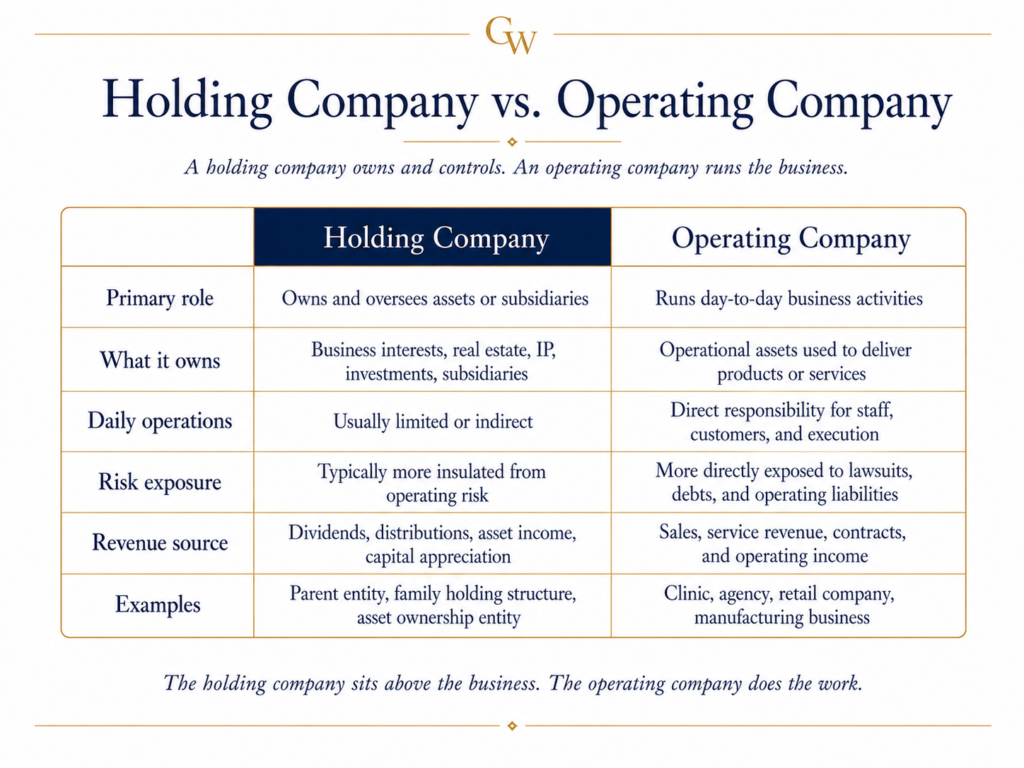
Holding Company vs. Operating Company
A holding company and an operating company are not the same.
This is one of the most important distinctions in the entire paper. Many people hear the word “company” and assume that every company exists to run a business, serve customers, employ staff, sell products, deliver services, or generate revenue through daily operations. That is usually true for an operating company. It is not always true for a holding company.
An operating company usually conducts business activity. It performs the work. It may sell products, provide services, manage customers, hire employees, sign contracts, maintain locations, deliver projects, handle payroll, manage vendors, and carry direct operating responsibilities.
A holding company usually owns interests in businesses, assets, or entities. It may own the operating company, but it does not necessarily perform the operating company’s daily work. Its main function is ownership, not execution.
This distinction helps readers understand why holding companies are often used in ownership structures. The operating company is where business activity happens. The holding company is where ownership may be organized above that activity.
Holding Company vs. Operating Company
| Holding Company | Operating Company |
|---|---|
| Owns assets or entities | Runs business activity |
| Holds ownership interests | Produces goods or services |
| Organizes control | Serves customers |
| May own subsidiaries | Employs staff directly |
| Focuses on ownership structure | Focuses on operations and execution |
| Supports long-term ownership | Supports daily business activity |
The operating company does the work. The holding company organizes ownership above the work.
Operating Companies Run the Business Activity
An operating company is the entity that runs the business activity.
It may employ people. It may serve the customers. It may deliver the service. It may sell the product. It may lease the space. It may sign the customer contracts. It may manage the vendors. It may carry the direct operational risks connected to the business.
If a company operates a clinic, restaurant, technology service, construction firm, consulting practice, logistics business, retail store, manufacturing company, or service business, that company is usually functioning as an operating company.
The operating company is where execution happens.
That execution may create revenue, build customer relationships, develop employees, produce operational systems, and generate business value. But it may also carry liabilities, payroll responsibilities, vendor obligations, customer disputes, regulatory requirements, and market risk.
This is why owners often need to understand the difference between the business that operates and the structure that owns.
A person may say, “I own a business,” but structurally, there may be several layers beneath that sentence. The owner may own a holding company. The holding company may own an operating company. The operating company may serve the customers and employ the staff. Another related entity may own the real estate. Another may hold intellectual property. Another may hold investment assets.
That distinction is not just technical. It affects how ownership is understood, governed, valued, and eventually transferred.
Holding Companies Own the Business Interests
A holding company owns the business interests.
It may own shares in a corporation. It may own membership interests in an LLC. It may own partnership interests. It may own subsidiary entities. It may own asset-holding entities. It may own intellectual property interests, real estate interests, investment interests, or future acquisition vehicles.
The holding company may not be the entity that serves customers or produces goods. Instead, it may hold the ownership position above the entity that does those things.
This is why holding companies are useful in multi-entity ownership structures. They can create a central layer that holds ownership interests in several businesses or asset categories. Instead of a single owner directly holding each asset or business, the holding company may sit above those assets as the ownership layer.
For example, a founder may own a holding company. The holding company may own three operating businesses. Each operating business may have different customers, staff, risks, and revenue streams. The holding company does not need to perform the daily activities of all three businesses. Its role may be to hold ownership interests, coordinate control, receive distributions where appropriate, and support long-term ownership strategy.
The details depend on law, tax rules, governing documents, jurisdiction, entity type, and professional guidance. But the concept is straightforward.
The operating company performs the work.
The holding company owns the interest.
The Operating Company Does the Work. The Holding Company Organizes Ownership.
The simplest way to remember the difference is this:
The operating company does the work. The holding company organizes ownership.
This is the distinction readers should carry throughout the article.
An operating company is usually judged by its execution. Can it serve customers? Can it produce revenue? Can it manage employees? Can it deliver quality? Can it survive competition? Can it operate without constant founder intervention?
A holding company is judged by a different set of questions. What does it own? How is ownership structured? What entities sit beneath it? How is control organized? How are decisions made? How are distributions handled? How is governance attached? How does the structure support future acquisition, continuity, or transfer?
Both matter.
A weak operating company can undermine the value of the holding company’s assets. A poorly structured holding company can create confusion above otherwise valuable operating companies. Both the operating layer and the ownership layer must be understood.
This is especially important for long-term ownership. A family or founder may build a successful operating company but never build a clear ownership structure around it. That business may generate income, employ people, and create value, yet still be difficult to transfer if ownership is unclear or overly dependent on a single person.
This connects directly to the Institute’s prior paper, Business Succession Planning: What Most Owners Miss About Ownership Transfer, where the central argument is that succession is not simply the naming of a replacement. Succession is the transfer of responsibility.
A holding company does not solve succession by itself. But it may help create one structural layer through which ownership can be clarified before succession occurs.
Why Confusing the Two Creates Misunderstanding
Confusing a holding company with an operating company creates misunderstanding.
If a person thinks a holding company automatically runs the business, they may misunderstand the role of the operating company beneath it. If a person thinks an operating company is the same as the ownership structure, they may overlook how ownership is actually held. If a family thinks owning the operating business directly is the same as having an ownership architecture, they may miss the structural questions that appear during succession, sale, acquisition, governance, or transfer.
This confusion can affect several areas.
It can affect control because the person or entity managing the business may not be the same as the one that owns it.
It can affect governance because the operating team may make daily decisions while the ownership group retains authority over major decisions.
It can affect succession because management transfer and ownership transfer are not the same.
It can affect risk because operating activities and owned assets may need to be understood separately.
It can affect value because buyers, lenders, successors, and family members may need to know what is owned, where it is held, and who controls it.
In simple terms, operations explain how the business works. Ownership explains who controls and benefits from what the business creates.
A holding company belongs to the ownership layer.
An operating company belongs to the execution layer.
When those layers are confused, ownership becomes harder to understand. When those layers are clarified, the entire ownership system becomes easier to govern, manage, transfer, and build intentionally.
Operating Companies Run the Business Activity
Operating companies run the business activity.
They are usually the entities closest to the customer: the employee, the vendor, the contract, the product, the service, and the daily risk of execution. An operating company may sell products, deliver services, manage employees, sign customer agreements, lease space, handle payroll, maintain equipment, manage vendors, serve clients, and produce revenue through active business operations.
This is where the work happens.
If a company runs a clinic, construction business, consulting firm, transportation company, restaurant, software service, retail operation, manufacturing business, professional practice, or service agency, it is functioning as an operating company. It has customers to serve, people to manage, costs to control, systems to maintain, and obligations to meet.
Operating companies are often where value is created, but they are also where many risks live. Customer disputes, vendor issues, employment problems, operational failures, market pressures, regulatory obligations, delivery delays, and execution errors usually surface at the operating level.
This is why operating companies matter so much. They produce the activity that may make ownership valuable.
But operating activity and ownership structure are not the same thing.
A company may operate successfully and still have a weak ownership structure above it. A founder may build a profitable business and still fail to clarify who owns what, how ownership will transfer, where assets are held, or how control will continue after the founder exits.
That is the distinction this paper is making.
The operating company runs the business activity. The ownership structure determines how the value, control, and long-term direction of that business are organized.
Holding Companies Own the Business Interests
Holding companies usually own the business interests.
A holding company may own shares in a corporation, membership interests in a limited liability company, partnership interests, subsidiary entities, asset-holding entities, real estate entities, intellectual property entities, or investment interests. It may hold controlling interests or partial interests depending on the structure.
The holding company does not necessarily serve the customer directly. It may not employ the operating staff. It may not deliver the service. It may not manufacture the product. It may not run the day-to-day business activity.
Instead, it may own the entity that does those things.
This is why holding companies are often used when ownership becomes more complex. A single operating company may be easy to understand. But when there are multiple operating companies, several assets, different ownership groups, future acquisition plans, or family succession issues, ownership may need a clearer layer above the activity.
For example, a holding company may own three operating companies. Each operating company may serve different customers, employ different staff, carry different risks, and generate different revenue streams. The holding company may sit above them as the ownership layer.
In another structure, a holding company may own an operating business, a real estate entity, an intellectual property entity, and an investment entity. Each entity may serve a different purpose. The holding company provides a structural relationship among them.
This does not mean the holding company is automatically better, safer, or more efficient. The usefulness of the structure depends on legal design, tax treatment, governing documents, jurisdiction, compliance, management, governance, and professional guidance.
But the core idea is simple.
The holding company owns interests. The operating company carries activity.
The Operating Company Does the Work. The Holding Company Organizes Ownership.
The clearest distinction is this:
The operating company does the work. The holding company organizes ownership.
This line should anchor the reader’s understanding of the entire section.
The operating company is judged by execution. Can it serve customers? Can it deliver the product or service? Can it hire and manage people? Can it produce revenue? Can it control costs? Can it maintain quality? Can it survive competition? Can it operate without constant founder intervention?
The holding company is judged by a different set of questions. What does it own? What entities sit beneath it? How are ownership rights structured? Who controls major decisions? How are distributions handled? How are subsidiaries governed? How are future acquisitions added? How does the structure support continuity, succession, or long-term ownership?
Both layers matter.
A strong operating company without a clear ownership structure may become difficult to transfer, sell, govern, or scale. A holding company without strong operating assets beneath it may be structurally organized but economically weak. The ownership layer and the operating layer serve different purposes, but they must still work together.
This distinction is especially important for family ownership and business succession.
A family may inherit ownership of an operating business but not understand how the business works. A successor may be ready to manage operations but not prepared to own. A founder may transfer management responsibility but fail to transfer economic rights, voting rights, or governance authority. An ownership group may think the business is organized because the operating company is successful, even though the ownership layer is unclear.
That is why the Institute separates operations from ownership.
Operations answer the question: How does the business function?
Ownership answers the question: Who controls, benefits from, and carries responsibility for what has been built?
A holding company belongs to the ownership layer.
Why Confusing the Two Creates Misunderstanding
Confusing a holding company with an operating company creates several problems.
First, it causes people to confuse ownership with management. The person or entity running the business may not be the same as the one that owns it. A manager may have operational authority without economic ownership. An owner may have economic rights without daily management responsibility. A holding company may own the operating company without directly managing every operating decision.
Second, it causes people to confuse structure with execution. A holding company may create a clear ownership layer, but it does not automatically make the operating business successful. The operating company still needs customers, employees, systems, leadership, cash flow, discipline, and execution.
Third, it causes people to confuse control with activity. Control may sit at the ownership level, while activity happens at the operating level. The holding company may have rights connected to major decisions, ownership interests, subsidiary governance, or distributions. The operating company may handle the day-to-day activities that create or protect value.
Fourth, it can create confusion during succession. A successor may be prepared to manage operations but not prepared to own. A family member may expect ownership but have no role in management. An outside executive may run the company but not hold ownership. A founder may leave the operating role but still control the ownership layer.
These distinctions matter because long-term ownership depends on clarity.
If the ownership and operating layers are conflated, families may fight over roles. Founders may delay succession. Buyers may struggle to understand the structure. Advisors may work from incomplete information. Successors may inherit assets without understanding authority. Operating leaders may lack clarity about who can make major decisions.
A holding company can help organize ownership, but it cannot fix confusion if the owners themselves do not understand the difference between ownership and operations.
That is why this distinction belongs near the beginning of the article.
Ownership is not the same as operation. Structure is not the same as execution.
How Does a Holding Company Work?
A holding company typically works by owning interests in other entities, companies, or assets.
It may own shares in a corporation, membership interests in a limited liability company, partnership interests, subsidiary companies, real estate entities, intellectual property entities, investment interests, or other assets. Through those ownership interests, the holding company may have certain rights connected to control, governance, distributions, sale proceeds, voting, appointment authority, or economic benefit.
At the simplest level, a holding company sits above the assets or entities it owns.
Control may flow downward through ownership rights. Value may flow upward through dividends, distributions, profits, sale proceeds, royalties, interest, management fees, or other returns, depending on the structure, agreements, laws, tax treatment, and governing documents.
This language must be handled carefully.
A holding company does not automatically make money simply because it exists. It does not automatically receive income from every entity beneath it. It does not automatically create tax advantages. It does not automatically create legal protection. It does not automatically guarantee distributions, profits, or liquidity.
The actual financial, legal, and tax outcomes depend on the structure, jurisdiction, documentation, ownership percentages, operating agreements, shareholder agreements, tax rules, compliance requirements, and professional guidance.
The purpose of this section is not to give legal, tax, or investment advice.
The purpose is to explain the ownership logic.
A holding company works by creating a structural relationship between the owners above it and the assets or entities below it. It may help organize who owns what, how control is exercised, how value may move, and how the ownership system can support future growth or transfer.
Visual Placement: How a Holding Company Works: Control Flow and Cash Flow
Place this visual near the beginning of the How Does a Holding Company Work? section, after the opening explanation.
Visual Title:
How a Holding Company Works: Control Flow and Cash Flow
Visual Purpose:
This visual should help the reader understand that control and value may move in different directions.
Visual Structure:
Top layer: Owners / Family / Ownership Group
Middle layer: Holding Company
Lower layer: Subsidiary A, Subsidiary B, Real Estate Entity, Intellectual Property Entity, Investment Entity
Use downward arrows labeled:
Control / Ownership Direction
Use upward arrows labeled:
Value / Distributions / Returns
Supporting line:
Control and value do not always move in the same direction. A holding company often sits at the center of both.
Important wording note:
The visual should avoid promising guaranteed income, tax benefits, legal protection, or asset protection. It should show only the conceptual ownership flow.
A Holding Company Owns Interests Below It
A holding company operates by owning interests in the companies below it.
Those interests may be in subsidiaries, operating businesses, real estate entities, intellectual property entities, investment entities, partnership interests, or other assets. The holding company may own all of an entity or only part of it. It may hold voting rights, economic rights, membership interests, shares, partnership units, or other forms of ownership, depending on the structure.
This is why the holding company is best understood as an ownership layer.
It does not need to perform the daily activity of every entity beneath it. It may own an operating company without directly serving the operating company’s customers. It may own a real estate entity without directly managing every tenant relationship. It may own intellectual property without directly producing the goods or services that use that intellectual property. It may hold investment interests without directly engaging in the underlying investment activity.
The holding company sits above the owned interests.
For example, a holding company may own an operating business that provides services. It may also own a real estate entity that holds the building used by the business. It may own an intellectual property entity that holds trademarks, brand assets, or licensing rights. It may own an investment entity that holds reserves or portfolio assets. Each entity beneath the holding company may serve a different purpose.
The holding company provides the ownership relationship among them.
This does not mean every holding company should own multiple entities. Some may own only one operating business or one category of assets. Others may sit above several subsidiaries. The right structure depends on purpose, scale, legal design, tax considerations, governing documents, jurisdiction, risk profile, and professional guidance.
But the basic logic remains consistent:
A holding company owns interests beneath it.
That is how the structure begins.
Control May Flow Downward
Control may flow downward from the ownership layer.
When a holding company owns interests in subsidiaries, operating businesses, or other entities, those ownership interests may carry certain rights. Those rights may include voting rights, appointment rights, approval rights, distribution rights, transfer rights, or other decision-making powers, depending on the legal structure and governing documents.
For example, a holding company may have the right to appoint directors or managers. It may have voting rights over major decisions. It may approve large transactions, financing, asset sales, mergers, acquisitions, or changes in ownership. It may control or influence policies through shareholder agreements, operating agreements, bylaws, partnership agreements, or other governance documents.
This is why control must be understood separately from daily activity.
The operating company may run the business day-to-day. It may manage staff, serve customers, sign contracts, deliver services, and handle operational execution. But the holding company may retain ownership-level control over certain major decisions.
That distinction matters for founders, families, investors, and ownership groups.
A founder may step back from operations but still control the ownership layer. A family may own a holding company that controls several subsidiaries. A board may govern the holding company while operating leaders manage the businesses below. An ownership group may separate operating authority from ownership authority.
Control does not always mean daily management.
Control may mean the ability to make or approve major decisions through ownership rights. It may mean authority over the structure, not necessarily authority over every operating detail.
This is why strong governance matters. Without clear governance, control can become confusing. Owners may not know who has authority. Managers may not know what decisions they can make. Family members may confuse ownership rights with operating roles. Advisors may struggle to understand who can approve what.
A holding company can organize control, but it must be supported by clear documents, defined roles, and disciplined decision-making.
Value May Flow Upward
Value may flow upward from the assets or entities beneath the holding company.
This is the economic side of the structure.
Depending on the structure, a holding company may receive dividends, distributions, profits, royalties, interest, sale proceeds, investment returns, management fees, or other economic benefits from the entities or assets it owns. The exact form depends on the legal structure, tax rules, agreements, ownership percentages, jurisdiction, and business activity involved.
For example, an operating company may generate profits and make distributions to its owner. If the holding company owns that operating company, those distributions may flow upward to the holding company.
A real estate entity may generate rental income and distribute profits to its owner. If the holding company owns that real estate entity or an interest in it, value may flow upward through that ownership interest.
An intellectual property entity may receive licensing revenue or royalties. If the holding company owns that entity or the intellectual property interest, value may flow upward depending on the agreements in place.
An investment entity may produce dividends, interest, gains, or other returns. If the holding company owns those interests, the value may flow upward through the structure.
But this must be stated carefully.
A holding company does not automatically make money. It does not automatically receive distributions. It does not automatically create profits. It does not automatically create tax benefits. It does not automatically make assets safer, cleaner, or more valuable.
The assets held by the holding company must still generate value. The operating companies must still perform. The real estate must still be managed. The intellectual property must still be useful. The investment assets must still carry risk. The agreements must still be valid. The structure must still comply with law and tax requirements.
A holding company may sit above value-producing assets, but it does not create value simply by existing.
That is an important distinction.
The structure can organize economic flow. It cannot guarantee an economic outcome.
Structure and Agreements Determine the Details
The details of how a holding company works are determined by its structure and agreements.
This is where many people oversimplify the topic. They hear “holding company” and assume there is one standard model. In reality, holding companies can vary widely. The actual rights, responsibilities, cash flows, control rights, tax treatment, liability implications, governance rules, and reporting obligations depend on the specific structure.
Several factors matter:
The type of entity used
The jurisdiction where it is formed
The assets or entities it owns
The ownership percentages involved
The operating agreements or shareholder agreements
The tax rules that apply
The governance documents
The role of managers, directors, or officers
The relationship among owners
The purpose of the structure
The compliance obligations attached to it
A holding company that owns several operating businesses may function differently from one that owns real estate entities. A family holding company may require different governance from a corporate holding company. A holding company used for acquisitions may need different agreements from those used to hold intellectual property or investment assets.
This is why professional guidance matters.
A holding company should not be created only because the concept sounds sophisticated. It should be designed around a real ownership purpose. The structure should align with the assets, owners, risks, tax context, governance needs, and long-term strategy.
The Institute’s role here is not to tell readers how to form one.
The Institute’s role is to help readers understand what a holding company is inside an ownership system.
A holding company can organize ownership, but the governing documents determine how the structure actually operates.
A Holding Company Often Sits Between Owners and Assets
A holding company often sits between the owners and the assets.
This is the architectural idea at the heart of the article.
At the top, there may be an individual owner, founder, family, trust, ownership group, investment group, or family enterprise. Beneath that ownership group, there may be a holding company. Beneath the holding company, there may be operating businesses, real estate entities, intellectual property, investment assets, subsidiaries, or other ownership interests.
The holding company serves as the structural layer between the owners and the assets they own.
This can make the ownership picture easier to understand.
Instead of several owners directly holding separate interests in multiple assets, the holding company may provide a single organized layer through which ownership is coordinated. Instead of each new acquisition being a standalone entity, the holding company may provide a platform for adding future ownership interests. Instead of ownership being scattered across assets and agreements, the holding company can make the structure more visible.
This is why the first visual in the article matters so much.
It shows that a holding company is not the only form of ownership. It is one layer inside the system.
Above it are the owners.
Beneath it are assets or entities.
Around it are governance, agreements, tax rules, legal requirements, management responsibilities, and stewardship decisions.
A holding company can organize ownership architecture, but it must still be directed by disciplined ownership behavior.
A holding company makes ownership visible. But visibility is only the beginning.
What Can a Holding Company Own?
A holding company can own different kinds of assets or ownership interests depending on its purpose, structure, jurisdiction, governing documents, and professional design.
This is one reason holding companies are widely discussed. The concept is flexible. A holding company may own operating businesses, subsidiaries, real estate entities, intellectual property, investment interests, partnership interests, cash reserves, or future acquisition vehicles.
But flexibility should not be confused with simplicity.
Just because a holding company can own different types of interests does not mean it should own everything. A strong ownership structure should have a clear purpose. The assets beneath the holding company should be organized intentionally. The structure should make ownership clearer, not more confusing.
This section connects directly to the Generational Wealth Institute™ framework because long-term ownership often develops across several ownership domains:
Business ownership
Real estate ownership
Financial ownership
Intellectual property ownership
A holding company may serve as a structural layer through which those domains are organized.
Visual Placement: What a Holding Company Can Own
Place this visual near the beginning of the What Can a Holding Company Own? section.
Visual Title:
What a Holding Company Can Own
Visual Purpose:
This visual should help readers see that a holding company can own multiple types of assets or entities. It should make the ownership domains tangible.
Visual Structure:
Place Holding Company at the center.
Around it, show ownership categories such as:
Operating Businesses
Real Estate Entities
Intellectual Property
Investment Assets
Subsidiaries
Partnership Interests
Cash Reserves
Future Acquisition Vehicles
Supporting line:
A holding company is not limited to one asset type. It can become an ownership layer across multiple domains.
Important wording note:
The visual should avoid suggesting that every holding company should own all of these categories. It should show possible ownership categories, not a required structure.
A Holding Company Can Own Operating Businesses
A holding company can own operating businesses.
This is one of the most common ways people understand holding companies. A holding company may sit above one operating business or several operating businesses. Those businesses may operate in the same industry, serve different markets, or perform different functions inside a larger ownership strategy.
For example, one operating company may provide services. Another may sell products. Another may handle a specialized business line. Another may be acquired later and added beneath the holding company. The holding company can create a central ownership layer above those operating businesses.
This structure can be especially useful when a founder, family, or ownership group begins moving from owning one company to owning multiple companies. Without structure, each business may sit separately. Ownership records may become harder to follow. Control may become unclear. Future succession may become more difficult. The owner may understand the structure personally, but others may not.
A holding company can help create a clearer map.
It may own the shares, membership interests, or ownership rights in the operating companies beneath it. Each operating company may continue to run its own activity, serve its own customers, employ its own staff, manage its own vendors, and carry its own operating responsibilities. The holding company does not have to perform the daily work of each business. Its role may be to hold the ownership interests above them.
This can matter for acquisitions. A holding company may provide a structure through which future businesses are acquired and organized. Instead of every acquisition being held separately or personally, the holding company may become the ownership layer above a growing group of businesses.
This does not mean every business owner needs a holding company. A single business may not require that level of structure. The decision depends on purpose, complexity, legal design, tax considerations, ownership goals, succession needs, and professional guidance.
But when a business owner begins thinking beyond one operating company, the holding company concept becomes more relevant.
It provides one possible way to organize business ownership above the operating activity.
A Holding Company Can Own Real Estate Interests
A holding company can also own real estate interests.
This may include interests in entities that own rental properties, commercial buildings, land, development projects, mixed-use properties, or other real estate assets. In some structures, real estate may be held separately from the operating business. In others, a holding company may own interests in a real estate entity that holds the property.
The details vary widely.
A family may own several rental properties. A business owner may want the operating business and the building it uses to sit in separate entities. A real estate group may own multiple property-specific entities. A family enterprise may hold land, commercial property, or income-producing property as part of a long-term ownership strategy.
A holding company may help organize these interests under a clearer ownership layer.
For example, instead of one person directly owning several properties or property entities separately, a holding company may own interests in those real estate entities. Each property or entity may still have its own purpose, obligations, financing, management, leases, risks, and reporting requirements. The holding company may provide the ownership relationship above them.
This is not the same as saying a holding company automatically creates asset protection or tax benefits. Real estate structures involve legal, tax, financing, liability, insurance, and jurisdiction-specific issues. Those require professional advice.
The broader ownership point is simpler.
Real estate can be an important ownership domain. As real estate ownership becomes more complex, scattered, or multi-generational, owners may need a clearer way to understand where the properties are held, who controls them, how income is treated, how risks are managed, and how ownership may transfer.
A holding company may become one structural layer in that larger ownership system.
A Holding Company Can Own Intellectual Property
A holding company can own intellectual property or own interests in entities that hold intellectual property.
Intellectual property may include trademarks, copyrights, patents, trade names, brand assets, licensing rights, software rights, media assets, proprietary methods, written materials, creative works, or other intangible assets. For some businesses and families, these assets can become important sources of long-term value.
Intellectual property is often misunderstood because it may not look like a traditional asset. It may not be a building, a bank account, or a piece of equipment. But it can still carry significant economic, strategic, or brand value.
A business may build a brand name over many years. A founder may create proprietary methods. A company may own software, content, systems, designs, or licensing rights. A family enterprise may own media assets, trademarks, or intellectual property attached to a business platform.
A holding company or related ownership structure may help organize those rights.
For example, the intellectual property may be held separately from the operating company that uses it. The operating company may license the intellectual property under an agreement. The ownership structure may help clarify who owns the IP, how it is used, who may benefit from it, and how it may be protected or transferred.
The specific legal and tax treatment of intellectual property ownership must be handled carefully. Different types of intellectual property require different registration, documentation, licensing, enforcement, and valuation considerations.
But inside the Institute’s framework, the deeper point is this:
Intellectual property is an ownership domain.
If it is valuable, it should not remain invisible. It should be identified, documented, governed, and placed inside an intentional ownership structure.
A holding company may help make that ownership more visible.
A Holding Company Can Own Financial or Investment Assets
A holding company may also own financial or investment assets, depending on its structure and purpose.
These may include securities, investment interests, partnership interests, fund interests, cash reserves, portfolio assets, private investments, or other financial ownership positions. The specific form depends on the legal structure, investment strategy, tax treatment, regulatory context, jurisdiction, and governing documents.
This area requires careful language.
A holding company is not automatically an investment company in the regulatory sense. It is not automatically a family office. It is not automatically a fund. It is not automatically a tax-efficient investment vehicle. Whether a structure touches securities regulation, investment company rules, tax rules, reporting obligations, or other legal requirements depends on the facts and professional guidance.
The article should not suggest that a holding company is a shortcut for investing.
The ownership point is more limited and more useful.
A holding company may provide a layer through which certain financial ownership interests are held or coordinated. It may hold cash reserves for future acquisitions. It may own interests in partnerships or private companies. It may receive distributions from subsidiaries. It may hold investment assets connected to a broader ownership strategy.
For families and founders, this can matter because financial assets often become disconnected from operating assets. A family may own businesses in one place, real estate in another, investment accounts somewhere else, and intellectual property with unclear ownership. Over time, that separation can make ownership harder to understand.
A holding company may help create a clearer map of financial ownership, but it should be designed carefully and professionally.
Financial ownership requires discipline. The structure can hold assets, but it does not replace investment strategy, risk management, compliance, governance, or professional advice.
A Holding Company Can Own Future Acquisition Vehicles
A holding company can also help organize future growth.
For founders, families, and ownership groups, this may be one of the most important uses of structure. Ownership does not always remain static. A family may acquire another business. A founder may launch a second company. An ownership group may buy real estate. A business may create new intellectual property. A platform may add subsidiaries over time.
Without a clear ownership layer, each new asset can make the system more scattered.
A holding company can provide a place where future ownership interests may be added. It can sit above existing assets while also creating room for future acquisitions, new subsidiaries, new entities, or new lines of ownership.
For example, a holding company may own one operating business today. Later, it may acquire a second business. Later still, it may create a real estate entity, an intellectual property entity, or an investment entity. The holding company becomes the ownership layer through which growth is organized.
This does not mean growth should be pursued casually. Adding entities, assets, or acquisitions can create complexity. It can introduce legal obligations, tax consequences, financing issues, governance needs, management demands, and operational risk.
But if growth is part of the long-term plan, structure matters.
A holding company can help owners avoid treating every new asset as a disconnected event. It can make future growth part of a broader ownership architecture.
The Four Ownership Domains
The holding company concept connects directly to the Generational Wealth Institute™ framework because long-term wealth is rarely built through one kind of ownership alone.
Over time, serious ownership often touches four broad domains:
Business Ownership
Real Estate Ownership
Financial Ownership
Intellectual Property Ownership
Business ownership may include operating companies, professional practices, service businesses, family businesses, acquisition targets, or subsidiaries.
Real estate ownership may include rental properties, commercial buildings, land, development interests, or property entities.
Financial ownership may include investment interests, securities, partnership positions, cash reserves, private investments, or portfolio assets.
Intellectual property ownership may include trademarks, copyrights, patents, brand assets, licensing rights, proprietary systems, or creative works.
A holding company may become one structural layer through which these ownership domains are organized. It can help owners see how different assets relate to one another. It can support clearer ownership mapping. It can provide a framework for future acquisition. It can help separate ownership from operations. It can support succession planning by making ownership interests more visible before transfer occurs.
But the holding company is not the whole system.
Each ownership domain still requires its own discipline. Business ownership requires operating strength. Real estate ownership requires management, financing, maintenance, and risk control. Financial ownership requires investment discipline and risk management. Intellectual property ownership requires documentation, protection, licensing, and enforcement.
The holding company can organize the domains.
It cannot replace the work required inside each domain.
That is why the Institute treats a holding company as ownership architecture, not as a complete wealth plan.
Why Owners Use Holding Companies
Owners may use holding companies because ownership eventually needs structure.
At a simple stage, direct ownership may be enough. One person owns one asset. One founder owns one business. One family owns one property. One investor owns one account. The ownership picture is easy to understand because the structure is small.
But as assets grow, ownership often becomes more complicated. A founder may own multiple operating businesses. A family may own real estate, investments, and business interests. A company may develop intellectual property. A family enterprise may need to prepare for succession. An ownership group may want to separate operating activity from long-term asset ownership. A platform may want to acquire additional businesses over time.
At that point, owners may begin asking different questions.
How should ownership be organized?
Where should assets sit?
How should operating risk be separated from long-term assets?
How should future acquisitions be added?
How should control be clarified?
How should ownership transfer be prepared?
How should family members understand their roles?
How should governance attach to the structure?
A holding company may help answer some of these questions by creating a central layer of ownership. It may help organize ownership, create structure, separate ownership from operations, coordinate multiple assets, support succession planning, or prepare for long-term stewardship.
But a holding company should not be oversold.
It is not a magic structure. It does not automatically create tax benefits. It does not automatically protect assets. It does not automatically produce income. It does not automatically create governance. It does not automatically prepare heirs. It does not automatically make a business transferable.
A holding company can create structure.
The owners still have to provide discipline.
Visual Placement: Why Owners Use Holding Companies
Place this visual near the beginning of the Why Owners Use Holding Companies section.
Visual Title:
Why Owners Use Holding Companies
Visual Purpose:
This visual should explain the main reasons owners may use holding companies without overselling the structure.
Visual Structure:
Use a restrained card layout with six or seven boxes.
Owners may use holding companies to help:
Organize ownership
Separate operating activity from asset ownership
Hold multiple businesses or assets
Clarify control
Support succession planning
Coordinate long-term stewardship
Create a structure for future growth
Supporting line:
The purpose of a holding company is not complexity. The purpose is organized ownership.
Important wording note:
The visual should not imply guaranteed tax savings, legal protection, asset protection, or automatic wealth creation. It should present possible structural purposes, not promised outcomes.
Owners Use Holding Companies to Organize Ownership
Owners use holding companies to organize ownership.
This is one of the most important reasons the structure exists. As ownership grows, the problem is not only that there are more assets. The problem is that the relationship among those assets can become harder to see.
A founder may own one company directly, then launch another. A family may own real estate in one place, a business in another, investment interests somewhere else, and intellectual property that is not clearly documented. An ownership group may acquire several businesses over time. A family enterprise may have assets spread across different entities, accounts, agreements, and family members.
Without a clear structure, ownership can become difficult to map.
A holding company may help centralize the ownership picture. It can provide a place to hold, track, govern, and coordinate ownership interests. Instead of each asset sitting separately in the mind of the founder or family, the holding company can help create a visible architecture.
This matters because clarity of ownership is not only useful to the current owner. It is useful for successors, family members, advisors, lenders, buyers, managers, and future decision-makers.
A holding company may help answer basic questions:
What does the ownership group own?
Which entities sit beneath the ownership layer?
Which assets are operating assets?
Which assets are long-term holdings?
Which assets are used by the business?
Which assets are held for future growth?
Which assets may eventually transfer?
These questions become more important as the ownership system grows.
A holding company does not answer every question by itself. But it can create a structural place where those questions can be organized.
That is why ownership mapping matters.
When ownership is visible, it becomes easier to govern. When it is hidden, scattered, or informal, it becomes harder to steward across time.
Owners Use Holding Companies to Hold Multiple Assets or Entities
Owners may also use holding companies to hold multiple assets or entities.
This is often where the structure becomes practical. A holding company may own several operating businesses, real estate entities, intellectual property entities, investment interests, subsidiaries, partnership interests, or future acquisition vehicles.
For example, a founder may build one operating company and later acquire another. A family may own a business, a commercial building, rental properties, and investment interests. A business may develop valuable trademarks, brand assets, proprietary systems, or licensing rights. An ownership group may plan to acquire additional companies over time.
Without a central ownership layer, these assets may sit in separate places with no clear connection.
A holding company can help organize those interests under a single structural layer. The holding company may own the operating company. It may own a real estate entity. It may own an intellectual property entity. It may own investment interests. It may own a new acquisition vehicle.
Each asset or entity may still serve a distinct purpose. The operating business may serve customers. The real estate entity may hold property. The intellectual property entity may own brand assets or licensing rights. The investment entity may hold reserves or investment positions. The future acquisition vehicle may be used for expansion.
The holding company does not erase those distinctions. It organizes them.
This is especially important for long-term ownership because scattered ownership can become difficult to transfer. If future owners do not understand what exists, where it sits, and how it relates to the larger ownership system, continuity becomes weaker.
A holding company may help create the map.
And in long-term ownership, the map matters.
Owners Use Holding Companies to Separate Functions
Owners may use holding companies to separate functions.
This does not mean separation is always required or always beneficial. It means that as ownership becomes more complex, it may be useful to distinguish between different kinds of activity.
Operating activity is not the same as ownership activity.
An operating company may serve customers, hire employees, manage vendors, generate revenue, and carry daily business obligations. A real estate entity may hold property. An intellectual property entity may hold trademarks, copyrights, patents, brand assets, or licensing rights. An investment entity may hold financial assets or reserves. A holding company may sit above these entities as the ownership layer.
This separation can help clarify what each entity exists to do.
One entity may operate.
One entity may hold property.
One entity may hold intellectual property.
One entity may hold investment interests.
One entity may coordinate ownership above them.
That kind of separation can be useful when it reflects a real ownership purpose. It can help owners understand which assets are connected to operations, which assets are held for long-term value, which assets require separate management, and which assets may need separate governance.
But separation can also become overdone.
Creating entities without purpose can add confusion, cost, compliance burden, and administrative complexity. A holding company should not be used to make ownership look sophisticated. It should be used only when structure helps solve a real ownership problem.
The principle is simple:
Structure should clarify ownership, not complicate it.
Owners Use Holding Companies to Support Succession Planning
Owners may use holding companies to support succession planning.
This connects directly to the Institute’s prior paper, Business Succession Planning: What Most Owners Miss About Ownership Transfer. In that paper, the central argument was that succession is not merely the naming of a replacement. Succession is the transfer of responsibility.
A holding company does not solve succession by itself. It does not automatically prepare successors. It does not automatically create family agreement. It does not automatically move authority wisely. It does not automatically protect the business from founder dependence.
But it may help clarify what ownership must eventually transfer.
That matters.
If a founder owns several businesses, properties, investment interests, and intellectual property, succession becomes harder when ownership is scattered. Future owners may not know what exists. Advisors may not understand the full ownership picture. Family members may have different expectations. Successors may be prepared to manage one business but not prepared to own the broader system.
A holding company can help make the ownership structure more visible before the transition occurs.
It may show which entities are owned. It may clarify which assets sit inside the ownership system. It may help distinguish operating roles from ownership rights. It may help families discuss control, distributions, voting, governance, successor preparation, and future transfer.
Succession requires clarity before transition.
A holding company can support that clarity, but it cannot replace the deeper work.
Successors still need preparation. Families still need communication. Governance still needs structure. Advisors still need clear direction. Operating leaders still need authority. Ownership rights still need to be defined.
The holding company may create the ownership architecture.
Succession still requires the transfer of responsibility.
Owners Use Holding Companies to Support Long-Term Stewardship
Owners may also use holding companies to support long-term stewardship.
Stewardship is different from possession. Possession means something is owned. Stewardship means ownership is directed, protected, governed, and prepared for continuity.
A holding company can help organize ownership for stewardship because it can create a visible structure around assets. It can show what is owned, where it sits, how entities relate, and how decisions may be coordinated. But stewardship requires more than structure.
This is where family enterprise becomes important.
A family may hold assets, but still lack governance. It may own businesses, but lack role clarity. It may own real estate, but lack a shared reinvestment policy. It may own intellectual property, but lack documentation. It may own investments, but lack a decision-making process. It may have future heirs, but lack preparation.
A holding company may help organize the ownership layer. Family governance helps direct it.
This connects to the Institute’s paper, What Is Family Governance? The Missing Layer in Most Wealth Plans, where governance is treated as the decision-making system that helps family ownership remain coordinated. A holding company can give ownership a structure, but governance determines how that structure is used.
That distinction is essential.
A holding company can hold assets across time. But stewardship determines whether those assets are managed with discipline, purpose, and continuity.
Structure can preserve the map.
Stewardship determines whether the map is followed.
Owners Use Holding Companies to Prepare for Future Growth
Owners may use holding companies to prepare for future growth.
Growth often changes the ownership problem. One business may be simple. Two businesses require more coordination. A business plus real estate creates another layer. A business plus intellectual property creates another layer. A family enterprise with multiple owners, assets, and plans for future acquisitions creates even more complexity.
A holding company can provide a structure for growth before growth becomes disorder.
For example, a founder may begin with one operating business. Later, the founder may acquire a second business. Then, a real estate entity may be created to hold a building. Then, intellectual property may be separated and documented. Later, investment assets or acquisition reserves may be added.
If there is no structure, each new asset may become a separate decision. Over time, the ownership system can become fragmented.
A holding company can create a central layer where new interests may be added more intentionally. It can support a platform approach to ownership. It can help owners think beyond one asset and begin organizing multiple assets inside a broader structure.
This is especially relevant for owners who want to acquire businesses, expand real estate holdings, develop intellectual property, or build a multi-entity family enterprise.
But growth should not be confused with accumulation.
Adding more assets does not automatically create stronger ownership. A larger structure can still be fragile if it lacks governance, documentation, professional guidance, operating strength, and decision-making discipline.
A holding company can prepare the architecture for growth.
The owner still has to build wisely.
Benefits Require Proper Structure
Holding company benefits require a proper structure.
This caution matters because holding companies are often discussed in overly simplistic ways. Some people hear the term and assume it automatically creates tax benefits, asset protection, legal separation, business sophistication, or wealth preservation. That is not a responsible way to understand the concept.
A holding company can be useful, but its usefulness depends on design.
The benefits of a holding company depend on legal structure, tax rules, governing documents, management, compliance, jurisdiction, entity type, ownership percentages, agreements, reporting obligations, and governance. They also depend on whether the assets held by the holding company are valuable, well-managed, and aligned with the structure’s purpose.
A poorly designed holding company can create confusion.
A holding company without governance can create family conflict.
A holding company without proper documentation can create uncertainty.
A holding company without compliance can create legal and administrative risk.
A holding company without capable operating businesses beneath it may have a structure without substance.
This is why the Institute’s language must stay disciplined.
A holding company may help organize ownership, but it is not a magic structure. It does not replace legal advice. It does not replace tax advice. It does not replace investment discipline. It does not replace operational excellence. It does not replace family governance. It does not replace successor preparation.
Structure is useful only when it serves a real ownership purpose.
A holding company can organize assets, but governance determines how those assets are directed.
Holding Company and Subsidiary Structure
A holding company may own subsidiaries.
This is one of the clearest ways to understand how holding companies work. The holding company sits above one or more subsidiary entities. Each subsidiary may serve a separate function inside the broader ownership system.
One subsidiary may operate a business. Another may own real estate. Another may hold intellectual property. Another may hold investment assets. Another may be created for a future acquisition. The holding company owns interests in those subsidiaries and provides the ownership layer above them.
This structure can make ownership more visible.
Instead of seeing several disconnected entities, the owner can see a relationship:
The holding company sits above.
The subsidiaries sit below.
Each subsidiary has a role.
The ownership layer connects them.
This does not mean each subsidiary is the same. Each may have different responsibilities, risks, agreements, managers, tax treatment, and compliance requirements. Some subsidiaries may actively operate. Others may hold assets. Others may exist for future ownership planning.
The key is that subsidiaries should serve a purpose.
A subsidiary should not exist only because complexity appears impressive. It should exist because separating that function helps clarify ownership, operations, risk, management, future transfer, or long-term strategy.
Visual Placement: Holding Company and Subsidiary Structure
Place this visual near the beginning of the Holding Company and Subsidiary Structure section.
Visual Title:
Holding Company and Subsidiary Structure
Visual Purpose:
This visual should help readers understand the relationship between a holding company and the entities beneath it.
Visual Structure:
Top layer:
Holding Company
Lower layer:
Subsidiary 1
Subsidiary 2
Subsidiary 3
Subsidiary 4
Optional labels beneath subsidiaries:
Operating Business
Real Estate Entity
Intellectual Property Entity
Investment Entity
Future Acquisition Entity
Supporting line:
A holding company often sits above the entities it owns, while each subsidiary may serve a distinct purpose.
Important wording note:
The visual should show the structural relationship clearly without implying that every holding company requires multiple subsidiaries.
What Is a Subsidiary?
A subsidiary is a company or entity that is owned or controlled by another company.
In a holding company structure, the holding company often sits above one or more subsidiaries. The subsidiaries sit below the holding company. Each subsidiary may have its own purpose, activity, assets, responsibilities, management, documents, risks, and obligations.
The easiest way to understand it is this:
A holding company owns.
A subsidiary is owned.
A subsidiary may operate a business. It may hold real estate. It may own intellectual property. It may hold investment assets. It may be used for a future acquisition. It may serve a narrow purpose inside a larger ownership structure.
For example, a holding company may own one subsidiary that runs a service business, another that owns a building, another that holds intellectual property, and another that is used for a new acquisition. The subsidiaries are separate entities beneath the holding company, but each one may serve a distinct role.
This structure can help organize ownership.
Instead of placing every asset, business, or activity within a single entity, subsidiaries can separate functions, making them easier to understand. That separation may help clarify operations, management, assets, ownership rights, reporting, and future transfer.
But subsidiaries should not be created casually.
Every subsidiary should have a purpose. If the structure becomes more complex without clearer ownership, better governance, stronger documentation, or a real strategic reason, then the structure can become a burden instead of a benefit.
A subsidiary should help clarify the ownership system, not make it harder to understand.
How a Holding Company Can Own Subsidiaries
A holding company can own subsidiaries through shares, membership interests, partnership interests, or other entity interests, depending on the type of entity and the legal structure used.
If the subsidiary is a corporation, the holding company may own shares. If the subsidiary is a limited liability company, the holding company may own membership interests. If the subsidiary is a partnership or similar structure, the holding company may own partnership interests or other forms of ownership. The exact form depends on the entity type, jurisdiction, governing documents, tax structure, and professional guidance.
Through those ownership interests, the holding company may have certain rights.
It may have voting rights.
It may have economic rights.
It may have rights to distributions.
It may have the right to appoint directors or managers.
It may have approval rights over major decisions.
It may have rights connected to sale, transfer, or liquidation.
The specific rights depend on the governing documents.
This is why the paper must treat holding companies as ownership architecture, not as a one-size-fits-all structure. Two holding companies may look similar on a diagram but operate very differently in reality. One may own 100 percent of its subsidiaries. Another may own partial interests. One may control every major decision. Another may share control with other owners. One may receive distributions. Another may reinvest capital into the subsidiaries.
The visual architecture helps the reader understand the basic structure. But the actual authority, economics, and obligations come from the documents and the law.
That is why a holding company structure should be designed with professional guidance.
The Institute’s purpose is to clarify the concept.
The legal, tax, and operational details must be addressed through qualified advisors.
Why Subsidiaries May Serve Different Purposes
Subsidiaries may serve different purposes inside a holding company structure.
This is one reason the structure can be useful. Not every asset or activity has the same purpose. Not every business carries the same risk. Not every ownership interest needs the same management. Not every entity should necessarily hold the same assets.
One subsidiary may operate a business.
That operating company may serve customers, hire employees, deliver services, manage vendors, and carry the daily obligations of business activity.
Another subsidiary may own real estate.
That real estate entity may hold a commercial building, rental property, land, or other property interest. It may have different financing, insurance, leases, maintenance obligations, and risk considerations from the operating business.
Another subsidiary may hold intellectual property.
That IP entity may own trademarks, copyrights, patents, brand assets, licensing rights, proprietary methods, or other intangible assets. It may license those assets to an operating company or hold them as part of the broader ownership strategy.
Another subsidiary may hold investment interests.
That entity may hold cash reserves, securities, partnership interests, private investments, or other financial assets, depending on the structure and applicable rules.
Another subsidiary may be created for acquisitions.
That entity may be used to acquire or hold a new business, asset, or ownership interest in the future.
The value of this structure lies not merely in the separation of assets. The value is that each entity can have a defined role. When the purpose of each subsidiary is clear, ownership becomes easier to understand, govern, manage, and eventually transfer.
But the reverse is also true.
If subsidiaries are created without a clear purpose, the structure can become confusing. Owners may not understand which entity owns what. Advisors may struggle to coordinate. Family members may misunderstand their rights. Successors may inherit a structure they cannot explain. Compliance may become harder. Costs may increase.
The principal should remain disciplined:
Each subsidiary should serve a purpose within the ownership architecture.
Parent Company vs. Holding Company
A parent company and a holding company can overlap, but they are not always the same thing.
A parent company is generally a company that owns or controls another company. The company beneath it is commonly called a subsidiary. If a company owns enough of another company to control or significantly influence it, that company may be described as the parent company.
A holding company can be a parent company if it owns a controlling interest in its subsidiaries.
But not every parent company is purely a holding company.
Some parent companies also operate. They may own subsidiaries while also running their own business activity. For example, a parent company may operate a core business and also own several subsidiaries. In that case, it is a parent company, but not a holding company in the strict sense, as it also conducts business operations.
A holding company, by contrast, is usually understood as a company whose primary role is ownership. It holds interests in other companies, entities, or assets. It may have administrative, governance, oversight, or investment functions, but it generally exists to own, not operate.
The distinction matters because readers often use these terms interchangeably.
A holding company may be a parent company.
A parent company may be a holding company.
But a parent company may also be an operating company.
The key question is function.
Does the company primarily own interests in other entities or assets?
Or does it also run substantial operating activity itself?
That functional distinction helps clarify the structure.
This paper focuses on the holding company as an ownership layer. It may act as a parent company when it owns subsidiaries, but its deeper significance lies in organizing ownership over the entities and assets beneath it.
Holding Company vs. Subsidiary
A holding company and a subsidiary sit at different levels of the ownership structure.
The holding company sits above.
The subsidiary sits below.
The holding company owns or controls interests in the subsidiary. The subsidiary is the entity owned or controlled by the holding company. The holding company may hold the ownership rights. The subsidiary may carry out a specific function beneath the ownership layer.
This difference is important.
A subsidiary may operate a business. It may own a building. It may hold intellectual property. It may own investment assets. It may serve as an acquisition vehicle. But it sits beneath the holding company in the structure.
The holding company’s role is to own or control the subsidiary interest.
The subsidiary’s role is to fulfill its specific purpose within the broader ownership architecture.
If this distinction is not clear, the structure becomes harder to understand. Family members may not know which entity owns what. Operators may not understand where decision rights sit. Advisors may struggle to map control. Successors may inherit an ownership system they cannot explain.
A clear holding company and subsidiary structure should make the ownership map easier, not harder.
That is the point.
The holding company provides the ownership layer.
The subsidiaries provide functional separation beneath that layer.
Together, they may help organize ownership across businesses, real estate, intellectual property, investments, and future acquisitions.
But the structure still requires governance.
That is where family ownership becomes especially important.
Family Holding Companies and Long-Term Ownership
A family holding company can help organize family ownership, but the entity itself does not create family alignment.
This is one of the most important cautions in the entire paper.
Families often assume that structure solves family complexity. It does not. A holding company may organize ownership on paper, but it cannot, by itself, create trust, communication, role clarity, decision-making discipline, successor readiness, or a shared purpose.
A family holding company may own business interests, real estate, intellectual property, investment assets, subsidiaries, or other ownership interests. It may provide a central structure for long-term ownership. It may help the family see what is owned, where assets are held, how entities relate, and how future ownership may be transferred.
But the company is only the structure.
The family still needs governance.
Without governance, a family holding company can become another place where confusion gathers. Family members may disagree about distributions. Some may want growth, while others want income. Some may work within the business, while others hold only ownership. Some may expect voting power. Others may expect employment. Some may understand the structure. Others may only know that the family owns assets somewhere.
A holding company can organize the ownership layer.
It cannot automatically organize the family.
This connects directly to the Institute’s governance framework. The prior paper, What Is Family Governance? The Missing Layer in Most Wealth Plans argued that governance is the decision-making system that helps families coordinate ownership. That idea becomes even more important when a family holding company exists.
The structure may answer where ownership sits.
Governance answers how ownership is directed.
A family holding company may support continuity, but only if the family develops the rules, roles, communication systems, decision processes, and stewardship expectations needed to use the structure well.
A holding company can organize family ownership, but governance determines whether family ownership remains coordinated.
Visual Placement: Family Ownership Layer and Governance Layer
Place this visual near the beginning of the Family Holding Companies and Long-Term Ownership section.
Visual Title:
Family Ownership Layer and Governance Layer
Visual Purpose:
This visual should show that a family holding company is not just an entity. It sits inside a broader ownership system that includes family ownership, governance, the holding company, and the assets beneath it.
Visual Structure:
Top layer:
Family / Ownership Group
Second layer:
Governance Layer
Include:
Family governance
Ownership policy
Decision-making structure
Succession expectations
Advisor coordination
Third layer:
Holding Company
Fourth layer:
Business interests
Real estate
Intellectual property
Investment assets
Subsidiaries
Supporting line:
A holding company can organize ownership, but governance determines how ownership is directed.
Important wording note:
The visual should not suggest that a holding company automatically creates family harmony or governance. It should show that governance must sit above or alongside the structure.
A Family Holding Company Can Organize Family Ownership
A family holding company can help organize family ownership.
For some families, ownership begins with one asset. A family business. A rental property. A parcel of land. A small investment account. A professional practice. At that stage, ownership may be easy to understand because the family is dealing with a single primary asset and a single primary decision-maker.
But as ownership grows, the family’s assets may become harder to view as a single system.
The family may own an operating business. It may own real estate. It may hold investment interests. It may develop intellectual property. It may acquire additional businesses. It may create subsidiaries or separate entities over time. It may have one generation still controlling assets while the next generation is beginning to ask what will ultimately be transferred.
A family holding company may help organize these interests under a clearer layer of ownership.
It may own business interests, real estate entities, intellectual property entities, investment interests, subsidiaries, partnership interests, or other ownership positions. It can create a structure that helps the family see what is owned, where it sits, how different assets relate to one another, and how ownership may eventually transfer.
This matters because family ownership often becomes confusing before families realize it.
One family member may know the business. Another may know the real estate. Another may understand the investments. Another may be named in documents but not understand the structure. Some may assume they will inherit ownership. Others may assume they will manage the business. Some may expect income. Others may expect growth.
A family holding company can help make the ownership picture more visible.
But visibility is only the beginning.
A family holding company can organize assets. It cannot automatically organize expectations. It can hold ownership interests. It cannot automatically create trust. It can create a structure. It cannot automatically create shared purpose.
That is why the structure must be supported by governance.
Governance Must Sit Above or Alongside the Structure
Governance must sit above or alongside the structure.
A family holding company may show where ownership sits, but governance determines how ownership is directed. Without governance, the structure can become another place where family confusion collects.
This connects directly to the Institute’s prior paper, What Is Family Governance? The Missing Layer in Most Wealth Plans. That paper argued that governance is the decision-making system that helps maintain coordination in family ownership. This becomes especially important when a family owns assets through a holding company.
A holding company may answer structural questions:
What does the family own?
Where are the assets held?
Which entities sit beneath the ownership layer?
How are business interests, real estate, intellectual property, and investment assets organized?
But governance answers decision-making questions:
Who has authority?
How are major decisions made?
How are disagreements handled?
How are distributions decided?
How are successors prepared?
How are working and nonworking family owners treated?
How are advisors coordinated?
How does the family define stewardship?
A holding company can create the container. Governance determines how the container is used.
This is why families should not confuse entity formation with ownership maturity. Creating a holding company may organize assets on paper, but it does not automatically create discipline in practice.
The family still needs policies. It still needs communication. It still needs role clarity. It still needs a process for making decisions. It still needs to define what ownership means, who can participate, who can manage, who can vote, who can benefit, and how future generations will be prepared.
Structure without governance can still become confusing.
Family Members May Have Different Roles
Family members may have different roles within a family ownership system.
This is one of the reasons governance becomes so important. In a family holding company, not every family member will relate to ownership in the same way. Some may be active. Some may be passive. Some may work in the business. Some may sit on a board. Some may be beneficiaries. Some may be trustees. Some may inherit ownership later. Some may never work inside the operating business but may still hold economic interests.
These differences need clarity.
A family member may be an owner but not a manager.
A family member may be a manager but not yet an owner.
A family member may be a beneficiary but not a decision-maker.
A family member may be a trustee with fiduciary responsibility.
A family member may be an employee with a defined job role.
A family member may serve as a board member with oversight responsibilities.
A family member may be an inactive owner who receives information but does not manage operations.
A future heir may be connected to the ownership system but not yet prepared for control.
When these roles are not clearly separated, family conflict becomes more likely.
A sibling working inside the business may expect more control because of operating contributions. A sibling outside the business may expect equal economic treatment because of family status. A parent may confuse love with readiness for ownership. A founder may avoid hard conversations because the structure feels emotionally difficult. A future heir may assume that inheritance automatically includes authority.
A family holding company can make these role questions more visible.
But it cannot answer them on its own.
The family must decide how ownership, management, governance, employment, distributions, voting, succession, and stewardship will be handled. Those decisions cannot be left to assumption.
Unclear roles create fragile ownership.
Clear roles make long-term ownership more governable.
Structure Can Support Succession, But It Cannot Replace Preparation
Structure can support succession, but it cannot replace preparation.
This point connects directly to the Institute’s paper, Business Succession Planning: What Most Owners Miss About Ownership Transfer. That paper argued that succession is not simply the naming of a replacement. Succession is the transfer of responsibility.
A family holding company may help organize what must eventually be transferred. It may show which entities exist, what assets are owned, where control sits, and how ownership rights may be structured. It may make it easier for advisors, family members, successors, and governing bodies to understand the ownership system.
That is useful.
But it is not enough.
A successor still needs preparation. A future owner still needs education. A family still needs communication. A board still needs authority. Advisors still need direction. The operating business still needs leadership. The family still needs to understand the difference between ownership rights and management responsibilities.
A holding company can help organize the ownership layer before the transition occurs.
But a holding company cannot make an unprepared successor ready.
It cannot make a divided family aligned.
It cannot turn passive heirs into responsible stewards.
It cannot replace the founder’s knowledge transfer.
It cannot explain decision logic unless the family documents and teaches it.
It cannot preserve continuity if the people inheriting the structure do not understand how to govern it.
This is why structure and preparation must work together.
A holding company may help ownership become more transferable. But succession still requires people who are prepared to receive, govern, and steward what is being transferred.
Holding Companies and Long-Term Continuity
Holding companies can support long-term continuity when ownership must move across generations.
This is one of the deeper reasons the holding company concept matters inside a generational wealth framework. The issue is not only what the family owns today. The issue is whether ownership can remain organized when control, responsibility, knowledge, and economic interests move from one generation to the next.
Direct ownership may work while the founder is alive, active, and mentally holding the whole system together. But the founder’s memory is not a governance system. The founder’s personal authority is not a transfer plan. The founder’s understanding of the assets is not the same as institutional continuity.
Long-term continuity requires that ownership be understandable beyond the founder.
A holding company may help create that continuity by making the ownership system more visible. It can show how businesses, real estate, intellectual property, investment interests, subsidiaries, and acquisition vehicles relate to one another. It can provide a structure through which future owners can understand what exists and how it is connected.
But continuity requires more than structure.
The family still needs governance. It still needs policies. It still needs prepared successors. It still needs reporting. It still needs communication. It still needs advisors who understand the structure. It still needs a way to manage conflict. It still needs a shared understanding of stewardship.
A holding company may help ownership survive transition, but only if the family uses the structure with discipline.
The goal is not merely to pass down assets.
The goal is to preserve ownership capacity across generations.
That is the difference between inheritance and continuity.
Direct Ownership vs. Structured Ownership
Direct ownership may work in the early stages, but as ownership becomes more complex, structured ownership may be more useful.
This is not an argument that every owner needs a holding company. It is an argument that ownership structure should match ownership complexity.
At the beginning, direct ownership may be simple, practical, and appropriate. A person may own one asset directly. A founder may own one operating business. A family may own one property. A professional may own one practice. In those cases, adding unnecessary structure may create cost, complexity, and administrative burden without solving a real problem.
But ownership can outgrow direct simplicity.
As assets multiply, owners change, family members enter the picture, businesses expand, real estate is added, intellectual property develops, investments grow, or succession becomes relevant, the ownership problem changes. The question is no longer only, “What do we own?” The question becomes, “How is ownership organized?”
That is where structured ownership becomes more useful.
Structured ownership creates clearer relationships among assets, entities, rights, responsibilities, and decision-makers. It may separate operating activity from asset ownership. It may clarify where control sits. It may help organize multiple entities. It may support future acquisitions. It may make succession easier to discuss. It may create a more visible architecture for long-term ownership.
A holding company is one possible form of structured ownership.
It is not the only form. It is not always the right form. It is not a substitute for trusts, wills, shareholder agreements, operating agreements, family governance, tax planning, legal planning, or investment planning. It is one structural tool that may help organize ownership when direct ownership becomes too scattered or limited.
The key is purpose.
Structure should follow the ownership problem.
If direct ownership is still clear, appropriate, and manageable, a holding company may not be necessary. If ownership is becoming fragmented, multi-entity, multi-generational, or difficult to coordinate, a holding company may become worth considering with professional guidance.
The deeper lesson is this:
Ownership should become more structured as ownership becomes more complex.
A holding company is one way that structure can begin to appear.
Direct Ownership Can Be Simple at the Beginning
Direct ownership can be simple at the beginning.
One person owns one asset. One founder owns one business. One family owns one property. One investor owns one account. One professional owns one practice. In that early stage, ownership may be clear enough without a more advanced structure.
The owner knows what is owned. The asset is easy to identify. The decision-maker is obvious. The paperwork may be manageable. The risks may be easier to understand. The question of future transfer may not yet feel urgent.
There is nothing wrong with simplicity when simplicity matches the ownership reality.
In fact, unnecessary structure can create problems. It can add costs, administrative burden, paperwork, compliance obligations, tax complexity, legal maintenance, and confusion. A holding company should not be created only because it sounds sophisticated or because other owners use one.
At the beginning, direct ownership may be appropriate.
If the ownership picture is small, clear, and manageable, the owner may not need a holding company. The more important question is whether the structure serves the ownership purpose.
Simplicity is not weakness when the ownership system is still simple.
But simplicity can become fragile when ownership becomes more complex.
Complexity Changes the Ownership Problem
Complexity changes the ownership problem.
A single asset may be easy to understand. Multiple assets require coordination. One business may be manageable. Several businesses create questions about control, risk, reporting, management, and future transfer. One property may be simple. Several properties may require a clearer ownership structure. One owner may make decisions informally. Multiple owners need rules.
This is where direct ownership can begin to show its limits.
A founder may own more than one operating company. A family may own several rental properties. A business may develop valuable intellectual property. An ownership group may acquire additional companies. A family enterprise may include working family members, nonworking owners, future heirs, advisors, trustees, managers, and board members. A succession plan may need to transfer ownership across generations.
At that point, ownership is no longer only about possession.
It becomes about structure, control, governance, transfer, risk, and coordination.
Multiple businesses may carry different risks. Multiple properties may have different financing, lease, insurance, and management needs. Multiple owners may have different expectations. Family members may disagree about income, reinvestment, employment, voting rights, control, and succession. Future heirs may inherit interests they do not understand. Advisors may struggle to see the full picture if ownership is scattered across entities, accounts, and informal assumptions.
This is why ownership architecture matters.
The more complex ownership becomes, the more important it is to understand where assets sit, who controls them, who benefits from them, how decisions are made, and how ownership can eventually transfer.
A holding company may become useful when direct ownership no longer provides enough clarity.
Structured Ownership Can Support Coordination
Structured ownership can support coordination.
It can create clearer relationships among assets, entities, rights, roles, and decision-makers. It can help owners understand what is owned, where it is held, how different entities relate to one another, and how authority is organized.
A holding company is one possible form of structured ownership.
It may sit above operating businesses, real estate entities, intellectual property entities, investment interests, subsidiaries, or acquisition vehicles. By creating an ownership layer above those assets, the holding company may help coordinate the larger ownership system.
That coordination can matter in several ways.
It can clarify ownership rights.
It can distinguish ownership from management.
It can separate operating activity from asset ownership.
It can help organize multiple subsidiaries.
It can support future acquisitions.
It can make succession discussions more concrete.
It can help advisors see the ownership map more clearly.
It can support governance by giving decision-making a clearer structure.
Structured ownership can also help families and founders move beyond memory-based ownership. If the founder is the only person who understands the assets, the entities, the agreements, the relationships, and the logic of the structure, the ownership system remains fragile.
A visible structure can reduce that fragility.
But structure only supports coordination when it is clear, documented, maintained, and governed. A holding company that nobody understands does not solve the coordination problem. A structure that is not supported by governance can still become confusing. A structure that exists only on paper but is not used with discipline can become a liability.
The purpose of structured ownership is not to make ownership look impressive.
The purpose is to make ownership more understandable, governable, and transferable.
Structure Should Follow Purpose
Structure should follow purpose.
This is the discipline that protects owners from unnecessary complexity. A holding company should not be created because it sounds advanced. It should not be created because another family has one. It should not be created because the owner wants the appearance of sophistication.
Structure should solve an ownership problem.
If ownership is scattered, structure may help organize it. If multiple businesses exist, a structure may help clarify ownership relationships. If real estate and operating activity should be separated, a structure may help create that separation. If intellectual property needs clearer ownership, a structure may help identify and hold it. If future acquisitions are planned, structure may help create an ownership layer for growth. If succession is approaching, structure may help make ownership more visible before transfer.
But if there is no clear ownership problem, adding structure may create more burden than benefit.
A holding company can add legal, administrative, tax, accounting, reporting, governance, and compliance requirements. It may require agreements, records, filings, professional advice, and ongoing maintenance. Those obligations may be worthwhile when the structure serves a real purpose. They may become unnecessary weight when the structure is created without a clear reason.
The question should not be, “Should every serious owner have a holding company?”
The better question is:
What ownership problem are we trying to solve?
If the problem is unclear, the structure will likely be unclear too.
A well-designed holding company begins with purpose. The structure should align with the assets, owners, risks, governance needs, succession plan, growth strategy, and long-term ownership vision.
That is why the Institute treats holding companies as ownership architecture, not status symbols.
The goal is not complexity.
The goal is organized ownership.
What a Holding Company Does Not Solve by Itself
A holding company can organize ownership, but it does not solve every ownership problem on its own.
This section matters because holding companies are often discussed as if they automatically create sophistication, protection, tax efficiency, family alignment, or long-term wealth preservation. That is not a responsible way to understand the structure.
A holding company is a tool.
It may help organize assets, entities, control, and ownership rights. It may create a central layer above operating businesses, real estate entities, intellectual property, investment assets, subsidiaries, or acquisition vehicles. It may support coordination, succession planning, and long-term stewardship.
But it does not automatically create good governance.
It does not automatically create tax certainty.
It does not automatically create legal protection.
It does not automatically create family alignment.
It does not automatically create business success.
It does not automatically prepare successors.
It does not automatically create stewardship discipline.
This distinction protects the reader from oversimplification.
A holding company can make ownership more visible. But visibility does not equal wisdom. A structure can show where assets sit, but it cannot decide how owners should behave. A structure can hold subsidiaries, but it cannot make those subsidiaries successful. A structure can organize control rights, but it cannot guarantee that control will be used well.
That is why holding companies must be understood within a broader ownership system.
The structure matters.
But governance, stewardship, management, documentation, legal design, tax planning, compliance, and successor preparation matter just as much.
Visual Placement: What a Holding Company Does Not Solve by Itself
Place this visual near the beginning of the What a Holding Company Does Not Solve by Itself section.
Visual Title:
What a Holding Company Does Not Solve by Itself
Visual Purpose:
This visual should protect credibility by showing that a holding company is a useful structure, not a complete solution for ownership.
Suggested Visual Format:
A clean two-column table.
| A Holding Company Can Help Organize | But It Does Not Automatically Create |
|---|---|
| Ownership structure | Good governance |
| Subsidiaries | Family alignment |
| Asset ownership | Prepared successors |
| Control rights | Sound decision-making |
| Long-term structure | Business profitability |
| Separation of functions | Legal or tax certainty |
| Future transfer | Stewardship discipline |
Supporting line:
Structure helps organize ownership. It does not replace governance, stewardship, or capable management.
Important wording note:
The visual should avoid sounding negative. The purpose is not to weaken the value of a holding company. The purpose is to clearly define its role. A holding company can be useful when properly designed, but it should not be presented as a structure that automatically solves legal, tax, family, business, or governance problems.
A Holding Company Does Not Automatically Create Governance
A holding company does not automatically create governance.
This is one of the most important points in the article. A holding company may organize ownership on paper, but governance determines how ownership decisions are actually made. Without governance, the structure may exist, but the decision-making system may still be unclear.
A family may form a holding company and still have no process for resolving disagreements. A founder may create a holding company and still remain the only person who understands the ownership structure. A group of owners may hold assets through a company yet have no clear policy on distributions, reinvestment, voting, succession, or future acquisitions.
The entity does not govern itself.
Governance answers questions that the holding company alone cannot answer:
Who has authority?
How are major decisions made?
Who can approve new investments?
How are distributions decided?
How are conflicts handled?
How are successors prepared?
How are working and nonworking owners treated?
How are advisors coordinated?
How does the family or ownership group define stewardship?
These questions become especially important in family ownership. A holding company may make the ownership structure visible, but visibility does not create agreement. The family still needs a system for communication, decision-making, oversight, and accountability.
This connects directly to the Institute’s paper, What Is Family Governance? The Missing Layer in Most Wealth Plans. That paper explains governance as the decision-making system that allows family ownership to remain coordinated. A holding company may provide the structure, but governance provides direction.
A holding company can hold assets.
Governance determines how those assets are directed.
A Holding Company Does Not Automatically Create Family Alignment
A holding company does not automatically create family alignment.
This is where many families misunderstand structure. They assume that if assets are placed into an entity, the family ownership problem has been solved. But family conflict does not disappear because ownership is organized on paper.
Family members may still have different expectations.
Some may want income.
Some may want growth.
Some may want control.
Some may want liquidity.
Some may want employment.
Some may want equality.
Some may want recognition for working in the business.
Some may want the benefits of ownership without the responsibilities of stewardship.
These differences can intensify when assets are held together.
A family holding company may organize the ownership layer, but it cannot automatically resolve emotional history, sibling tension, unclear roles, founder avoidance, entitlement, distrust, or different visions for the future.
This is why role clarity matters.
One family member may be an owner. Another may be an employee. Another may be a manager. Another may be a board member. Another may be a trustee. Another may be a beneficiary. Another may be a future heir. These roles may overlap, but they should not be confused.
A family member who works inside the operating business may not automatically have more ownership rights. A family member who holds ownership may not automatically have management authority. A beneficiary may not automatically have decision-making control. A future heir may not automatically be prepared to govern.
When families fail to clarify these roles, the holding company can become the place where unresolved expectations collide.
The structure may hold the assets.
But the family must still do the work of alignment.
A Holding Company Does Not Automatically Prepare Successors
A holding company does not automatically prepare successors.
This point connects directly to the Institute’s paper, Business Succession Planning: What Most Owners Miss About Ownership Transfer. That paper argued that succession is not the naming of a replacement. Succession is the transfer of responsibility.
A holding company may help identify what ownership interests exist. It may help organize subsidiaries, businesses, real estate, intellectual property, investments, and future acquisition vehicles. It may make the ownership system easier to map. It may help advisors and family members understand what must eventually be transferred.
But it cannot prepare unprepared successors.
A successor still needs education. A future owner still needs to understand the assets. A family member still needs to understand governance. A next-generation leader still needs practice in decision-making. A future board member still needs oversight capacity. A future owner still needs to understand the difference between income, control, responsibility, and stewardship.
A holding company may make the structure transferable.
It does not prepare the people.
This is where many ownership systems fail. The founder may create entities, documents, and ownership layers, but never teach the next generation how the system works. The assets may be organized, but the future owners may not understand how to govern them.
A holding company can support succession planning.
It cannot replace successor preparation.
A Holding Company Does Not Automatically Create Tax or Legal Benefits
A holding company does not automatically create tax or legal benefits.
This is an important credibility point. Holding companies are often discussed online as if they automatically create asset protection, tax efficiency, liability separation, or legal advantages. That is not a responsible way to explain the concept.
Legal and tax outcomes depend on the specific structure.
They may depend on the entity type, jurisdiction, ownership percentages, governing documents, operating agreements, shareholder agreements, tax classification, compliance requirements, financing arrangements, reporting obligations, insurance, asset type, business activity, and professional implementation.
The IRS notes that legal and tax considerations inform the choice of a business structure, and that the form of business affects tax filing obligations. That is one reason holding company discussions should avoid blanket claims about tax outcomes.
Similarly, the fact that a company owns another company does not automatically mean that all legal risks disappear. Limited liability is a legal principle associated with certain entities, but how liability works in practice depends on facts, law, documentation, conduct, compliance, and the specific structure involved. Cornell’s Legal Information Institute describes limited liability as shielding investors from business debts to the extent of their investment, but that general principle should not be turned into a promise that any specific holding company structure will protect assets in every situation.
This paper is not legal, tax, investment, or entity-formation advice.
The proper point is narrower:
A holding company may help organize ownership. It may help separate functions. It may help clarify where assets sit. It may help create a structure that legal and tax professionals can design around.
But the benefits depend on proper design and proper use.
A holding company that is poorly structured, poorly documented, poorly governed, or poorly maintained may create more confusion than protection.
A Holding Company Does Not Replace Capable Management
A holding company does not replace capable management.
This is especially important when the holding company owns operating businesses. The holding company may organize the ownership layer, but the operating companies beneath it still need leadership, execution, people, systems, customers, revenue, cash flow, quality control, compliance, and operational discipline.
The structure can own the business.
It cannot operate the business well on its own.
An operating company still needs capable managers. It still needs people who understand the customers, the market, the service, the product, the team, the financials, and the daily decisions required to protect value. A holding company may appoint leadership or exercise ownership rights, but the actual operating business must still be led and managed.
This matters because some owners confuse structure with strength.
A holding company can create a sophisticated ownership map around weak assets. It can sit above underperforming companies. It can own businesses with poor leadership. It can hold mismanaged real estate. It can own intellectual property that is undocumented or unused. It can own investment assets without a coherent strategy.
Structure does not create operating excellence.
Operating companies still need execution.
A strong holding company structure should therefore be paired with strong management beneath it. Ownership architecture matters, but the assets inside the architecture still need to perform.
Structure Helps, But It Does Not Govern Itself
Structure helps, but it does not govern itself.
That is the central lesson of this section.
A holding company can organize ownership. It can make assets more visible. It can create a layer above subsidiaries, businesses, real estate, intellectual property, investments, and future acquisition vehicles. It can support coordination, continuity, succession planning, and long-term stewardship.
But it cannot make decisions on its own.
It cannot create wisdom.
It cannot create family alignment.
It cannot create trust.
It cannot prepare successors.
It cannot guarantee business success.
It cannot replace management.
It cannot replace documentation.
It cannot replace legal, tax, or professional guidance.
It cannot replace governance.
This is not a weakness of holding companies. It is simply a clear definition of their role.
A holding company is an ownership architecture.
Architecture matters because it gives ownership structure.
But architecture must still be designed, maintained, governed, and used with discipline.
Structure helps organize ownership. It does not govern itself.
Reader Application
The question is not only whether you own assets.
The question is whether your ownership is organized.
Can your structure hold multiple assets or entities?
Can it separate operations from ownership?
Can it clarify control?
Can it support future transfer?
Can it support family continuity?
Can it organize growth over time?
These questions matter because ownership can appear stronger than it really is. A person may own valuable assets, but those assets may be scattered. A family may own businesses and real estate, but the structure may be unclear. A founder may own several entities, but no one else may understand how they relate. An ownership group may have assets, but no clear governance system attached to them.
A holding company may help create structure, but the deeper question is whether the ownership system can be understood, governed, and transferred.
The goal is not to create complexity.
The goal is to make ownership more visible before transition, growth, conflict, or succession forces the issue.
Ownership becomes more durable when it is organized before the transition requires it.
Visual Placement: Reader Application
Place this visual after the main structural explanation and before the readiness questions.
Visual Title:
Reader Application
Visual Purpose:
This visual should give the reader a practical point for reflecting on ownership without turning the article into a worksheet.
Suggested Visual Text:
The question is not only whether you own assets.
The question is whether your ownership is organized.
Can your structure:
hold multiple assets or entities
separate operations from ownership
clarify control
support future transfer
support family continuity
organize growth over time
Supporting line:
Ownership becomes more durable when it is organized before the transition requires it.
Important wording note:
This visual should feel institutional and reflective, not motivational or promotional.
Holding Company Readiness Questions
A holding company is not the answer to every ownership problem, but some ownership systems eventually require more structure than direct ownership alone can provide.
The purpose of these questions is not to determine whether someone should form a holding company. That decision requires professional legal, tax, financial, and strategic guidance.
The purpose is to help the reader recognize when ownership may be becoming more complex than the current structure can comfortably support.
Ask:
Do you own multiple assets or businesses?
Is ownership currently scattered or unclear?
Do operating activities and owned assets need clearer separation?
Could a structure help organize future acquisitions?
Do you need a clearer ownership layer above multiple entities?
Would long-term succession benefit from organized ownership?
Are control rights and decision rights clearly understood?
Is governance attached to the ownership structure?
These questions are not a checklist for entity formation. They are questions of ownership maturity.
A person may own assets and still lack an ownership architecture. A family may own valuable interests and still lack governance. A founder may own multiple entities yet lack a structure others can understand. A business owner may be successful today and still be unprepared for transfer tomorrow.
A holding company may be useful when ownership complexity begins to require a more organized layer.
But the right structure should follow the right purpose.
A holding company is not the answer to every ownership problem, but some ownership systems eventually require more structure than direct ownership alone can provide.
Visual Placement: Holding Company Readiness Questions
Place this visual immediately before the Conclusion.
Visual Title:
Holding Company Readiness Questions
Visual Purpose:
This visual should serve as the practical checkpoint before the article closes.
Checklist Questions:
Do you own multiple assets or businesses?
Is ownership currently scattered or unclear?
Do operating activities and owned assets need clearer separation?
Could a structure help organize future acquisitions?
Do you need a clearer ownership layer above multiple entities?
Would long-term succession benefit from organized ownership?
Are control rights and decision rights clearly understood?
Is governance attached to the ownership structure?
Supporting line:
A holding company is not the answer to every ownership problem, but some ownership systems eventually require more structure than direct ownership alone can provide.
Important wording note:
This should not sound like a sales checklist. It should read like an Institute-level ownership reflection tool.
Key Observations
A holding company is an ownership layer.
A holding company usually sits above assets, companies, subsidiaries, or ownership interests. It helps organize ownership above the operating activity or asset base.
A holding company can make ownership more visible.
When assets are scattered across businesses, real estate, intellectual property, investments, and entities, a holding company may help create a clearer ownership map.
Holding companies often own interests in companies, assets, subsidiaries, or entities.
A holding company may own shares, membership interests, partnership interests, subsidiaries, real estate entities, intellectual property entities, investment interests, or future acquisition vehicles.
Operating companies run business activity. Holding companies organize ownership.
The operating company does the work. The holding company organizes ownership above the work.
A holding company can support long-term ownership, but it does not replace governance.
Structure can organize assets, but governance determines how ownership decisions are made.
A family holding company requires family governance.
A family holding company can organize family ownership, but it cannot automatically create family alignment, role clarity, communication, or stewardship discipline.
Structure without decision-making discipline can still create confusion.
A poorly governed holding company may become another layer of complexity instead of a source of clarity.
A holding company may support succession, but it does not prepare successors on its own.
Structure may clarify what must transfer, but people still need preparation, education, authority, and decision-making practice.
The purpose of structure is not complexity. The purpose is organized ownership.
A holding company should solve a real ownership problem. It should not exist only because it sounds sophisticated.
Ownership architecture matters when assets, entities, and future transfer become more complex.
As ownership grows, structure becomes more important. A holding company is one possible form of that structure.
Conclusion
A holding company is more than a legal term.
It is one way to understand ownership architecture.
For individuals, families, founders, and ownership groups, the deeper question is not only what they own. The deeper question is how ownership is organized.
A person may own assets, but the assets may be scattered. A founder may own a business, but the ownership structure may be unclear. A family may own real estate, intellectual property, investments, and business interests, but lack a central ownership map. An ownership group may hold valuable entities, but still struggle with control, governance, future growth, or succession.
A holding company may help organize businesses, real estate, intellectual property, investments, subsidiaries, and future acquisitions. It may create a central ownership layer above assets or entities. It may help separate ownership from operations. It may support long-term stewardship by making ownership more visible.
But the structure is only one part of the ownership system.
A serious ownership system also requires governance, stewardship, decision-making clarity, prepared successors, capable management, documentation, compliance, professional guidance, and long-term continuity planning.
A holding company can organize ownership.
It cannot replace the discipline required to steward ownership well.
That is why the Institute treats holding companies as part of a broader ownership framework. Articles on income, ownership, governance, wealth transfer, and business succession all point toward the same larger conclusion: wealth is not preserved by possession alone. It is preserved through structure, governance, stewardship, and continuity.
A holding company makes ownership visible. But governance determines whether ownership remains directed, disciplined, and durable.
Frequently Asked Questions
What is a holding company?
A holding company is a company that owns other companies, assets, or ownership interests. It usually exists to hold ownership interests rather than conduct day-to-day business activity. Cornell Law School’s Legal Information Institute defines a holding company as a corporation that owns enough voting stock in another corporation to control its policies and management.
What does a holding company do?
A holding company usually owns interests in businesses, subsidiaries, real estate entities, intellectual property, investments, or other assets. It may help organize ownership, control, and structure above those assets. It does not necessarily run the daily operations of the businesses beneath it.
What is the meaning of a holding company?
The meaning of a holding company is that it “holds” ownership interests. It may hold shares, membership interests, partnership interests, subsidiaries, or assets. In ownership terms, it is a structural layer above assets or operating entities.
What is a holding company structure?
A holding company structure usually has owners or an ownership group at the top, a holding company beneath them, and assets or entities beneath the holding company. Those assets may include operating businesses, real estate entities, intellectual property, investment assets, or subsidiaries.
How does a holding company work?
A holding company operates by owning interests in entities or assets it controls. Control may flow downward through ownership rights, voting rights, appointment rights, operating agreements, shareholder agreements, or other governing documents. Value may flow upward through dividends, distributions, profits, sale proceeds, royalties, interest, or other returns, depending on the structure.
How does a holding company make money?
A holding company may receive money through dividends, distributions, profits, royalties, interest, sale proceeds, management fees, or investment returns, depending on what it owns and how the structure is designed. A holding company does not automatically make money simply because it exists. The assets or entities beneath it must still produce value.
What is the purpose of a holding company?
The purpose of a holding company is usually to organize ownership. It may help hold multiple assets or entities, separate ownership from operations, clarify control, support succession planning, or prepare for future growth. The purpose of a holding company is not complexity. The purpose is organized ownership.
What can a holding company own?
A holding company may own operating businesses, subsidiaries, real estate entities, intellectual property, investment interests, partnership interests, securities, cash reserves, or future acquisition vehicles, depending on its purpose, legal structure, jurisdiction, and governing documents.
Can a holding company own multiple businesses?
Yes. A holding company may own multiple operating businesses or subsidiaries. This can help create a central ownership layer across several businesses, though the structure should be carefully designed with professional guidance.
Can a holding company own real estate?
A holding company may own real estate directly or own interests in real estate entities, depending on the structure. Real estate ownership involves legal, tax, financing, insurance, and liability considerations, so professional guidance is important.
Can a holding company own intellectual property?
A holding company or related entity may own intellectual property, including trademarks, copyrights, patents, brand assets, licensing rights, proprietary systems, and other intangible assets. The exact structure depends on the nature of the intellectual property and the legal documents involved.
What is the difference between a holding company and an operating company?
An operating company runs business activity. It serves customers, hires employees, sells products, delivers services, and handles daily operations. A holding company owns interests in companies, assets, or entities. The operating company does the work. The holding company organizes ownership.
What is the difference between a holding company and a parent company?
A parent company owns or controls another company. A holding company can be a parent company if it owns a controlling interest in its subsidiaries. But not every parent company is purely a holding company, because some also conduct operating activities themselves.
What is the difference between a holding company and a subsidiary?
The holding company sits above. The subsidiary sits below. The holding company owns or controls interests in the subsidiary. Cornell’s Legal Information Institute defines a subsidiary as an entity in which a parent or holding company has a controlling share.
What is a family holding company?
A family holding company is a structure a family may use to organize ownership of businesses, real estate, investments, intellectual property, subsidiaries, or other assets. It can help make family ownership more visible, but it does not automatically create family governance or alignment.
Why would a family use a holding company?
A family may use a holding company to organize assets, clarify ownership, hold multiple entities, support succession planning, coordinate long-term stewardship, or prepare for future transfer. But a family holding company still requires governance, communication, documentation, and professional guidance.
Does a holding company provide asset protection?
A holding company may be part of a structure designed for legal separation or risk management, but it does not automatically provide asset protection in every situation. Outcomes depend on the entity type, jurisdiction, documentation, compliance, conduct, insurance, financing, and professional legal guidance.
Does a holding company create tax benefits?
A holding company does not automatically create tax benefits. Tax treatment depends on the entity type, jurisdiction, ownership structure, income type, distributions, compliance requirements, and professional tax planning. The IRS emphasizes that legal and tax considerations are involved in choosing a business structure.
Is a holding company only for large companies?
No. Holding companies are not only for large companies. Smaller businesses, families, founders, real estate owners, acquisition groups, and private ownership groups may use holding company structures in some situations. But the structure should match the ownership purpose and complexity.
How does a holding company support business succession?
A holding company may support business succession by making ownership interests more visible and organized before transfer occurs. It may clarify what entities exist, what assets are owned, and how ownership is structured. But it does not prepare successors on its own. Succession still requires governance, communication, knowledge transfer, and prepared future owners.
How does a holding company support generational wealth?
A holding company may support generational wealth by helping organize ownership across businesses, real estate, intellectual property, investments, subsidiaries, and future acquisition vehicles. It can make ownership more visible across generations. But generational wealth also requires governance, stewardship, continuity planning, and prepared successors.
Related Institute Papers
Related Institute Papers
Why Most Families Never Build Ownership: The Missing Link Between Income and Generational Wealth
This paper explains why income alone does not become generational wealth unless it is converted into ownership. The holding company paper builds on that idea by showing how ownership can eventually require structure.
What Is Family Governance? The Missing Layer in Most Wealth Plans
This paper explains governance as the decision-making system that helps families coordinate ownership. The holding company paper extends this by showing that structure must be directed by governance.
Family Wealth Transfer: Why Continuity Matters More Than Inheritance
This paper argues that inheritance moves assets, while continuity preserves ownership. The holding company paper shows how structure may help organize assets before transfer occurs.
Business Succession Planning: What Most Owners Miss About Ownership Transfer
This paper explains that business succession is the transfer of responsibility, not just the naming of a successor. The holding company paper follows naturally by showing why business ownership often needs structure before it can be transferred clearly.
Ownership Continuity: A Framework for Building and Transferring Wealth Across Generations
This paper will connect the Institute’s broader ownership framework across income, assets, governance, stewardship, succession, structure, and prepared future owners.
Authoritative Sources
This paper should use a mix of legal, tax, business, and governance sources. The goal is not to overload the article with citations, but to support the main definitional and cautionary claims.
Useful source categories include:
IRS resources on business structures and tax considerations.
Corporate law resources explaining holding companies, subsidiaries, corporations, and limited liability.
U.S. Census or NAICS classification references for holding companies.
SEC or investor education materials where investment-company or securities-related distinctions become relevant.
OECD corporate governance materials on the importance of shareholder rights, governance structures, and ownership functions.
Family enterprise resources from Deloitte, PwC, KPMG, J.P. Morgan, UBS, RBC, Family Firm Institute, or STEP Project Global Consortium, where family governance and continuity are discussed.
General definition sources may be used only sparingly. The Institute should not rely on generic definition articles as the paper’s intellectual backbone.
The strongest source base should support three ideas:
A holding company is an ownership structure.
Legal and tax outcomes depend on structure and professional guidance.
Ownership structures require governance to remain durable.
Strategic Role in the Series
This paper has three strategic roles within the Institute series.
First, it should rank for what a holding company is, holding company structure, holding company meaning, holding company definition, holding company vs operating company, and related educational searches. The article must satisfy search intent clearly without becoming generic.
Second, it should introduce the Institute’s structural layer. Articles 1 through 4 explain why ownership matters, why governance matters, why continuity matters, and why succession matters. Article 5 illustrates what ownership architecture can look like.
Third, it should prepare the reader for more advanced Institute papers on ownership continuity, family office structures, real estate ownership, acquisition vehicles, intellectual property ownership, family enterprise design, and long-term stewardship.
The emotional pressure point is clear:
Many people own assets, but their ownership is scattered, unclear, or fragile.
A holding company does not solve every ownership problem.
But it can help make ownership visible.
And once ownership becomes visible, it can be governed, stewarded, transferred, and built with greater intention.