
Contents
- 1 Overview
- 2 The Mistake Most Owners Make About Succession
- 3 What Business Succession Planning Actually Requires
- 3.1 Succession Requires Ownership Structure
- 3.2 Succession Requires Leadership Readiness
- 3.3 Succession Requires Governance
- 3.4 Succession Requires Operating Continuity
- 3.5 Succession Requires Family Communication
- 3.6 Succession Requires Successor Preparation
- 3.7 Succession Requires Financial Planning
- 3.8 Succession Requires Tax and Estate Planning
- 3.9 Succession Requires Institutional Knowledge Transfer
- 3.10 Succession Requires Board or Advisor Oversight
- 3.11 Succession Requires a Transition Timeline
- 3.12 Succession Requires an Exit or Continuity Strategy
- 3.13 Replacement Focuses on the Person
- 3.14 Transfer Focuses on the System
- 3.15 A Successor Without Transfer Is Not a Succession Plan
- 4 What Business Succession Planning Actually Requires
- 5 The Hidden Risk of Founder Dependence
- 6 The Hidden Risk of Founder Dependence
- 7 Ownership Transfer Is Not the Same as Management Transfer
- 8 Ownership Transfer Is Not the Same as Management Transfer
- 9 Family Business Succession Creates Unique Governance Challenges
- 10 The Board and Governance Role in Succession
- 10.1 Boards Help Separate Oversight From Family Dynamics
- 10.2 Advisory Boards Can Support Earlier Stage Businesses
- 10.3 Governance Bodies Help Prepare Transition
- 10.4 Outside Advisors Need Clear Direction
- 10.5 Boards Help Separate Oversight From Family Dynamics
- 10.6 Advisory Boards Can Support Earlier Stage Businesses
- 10.7 Governance Bodies Help Prepare Transition
- 10.8 Outside Advisors Need Clear Direction
- 11 Succession Planning and Business Value
- 11.1 Buyers Evaluate Transferability
- 11.2 Employees Need Confidence
- 11.3 Customers Need Stability
- 11.4 Lenders and Investors Need Continuity
- 11.5 Transferability Is a Form of Ownership Strength
- 11.6 Buyers Evaluate Transferability
- 11.7 Employees Need Confidence
- 11.8 Customers Need Stability
- 11.9 Lenders and Investors Need Continuity
- 12 The Exit Planning Problem
- 12.1 Sales is also a Form of Succession
- 12.2 Exit Planning Without Transfer Readiness Is Weak
- 12.3 Ownership Transition Must Be Prepared Before the Deal
- 12.4 Exit Planning Should Still Protect Continuity
- 12.5 Sales is also a Form of Succession
- 12.6 Exit Planning Without Transfer Readiness Is Weak
- 12.7 Ownership Transition Must Be Prepared Before the Deal
- 13 Succession Requires Prepared Successors
- 13.1 Successors Need Operating Exposure
- 13.2 Successors Need Decision-Making Practice
- 13.3 Successors Need Financial Understanding
- 13.4 Successors Need Authority Before Full Control
- 13.5 Successors Need Trust From Stakeholders
- 13.6 Successors Need Operating Exposure
- 13.7 Successors Need Decision-Making Practice
- 13.8 Successors Need Financial Understanding
- 13.9 Successors Need Authority Before Full Control
- 13.10 Successors Need Trust From Stakeholders
- 14 Succession Requires Institutional Knowledge Transfer
- 14.1 Knowledge Must Be Documented
- 14.2 Relationships Must Be Transitioned
- 14.3 Decision Logic Must Be Explained
- 14.4 The Business Must Become Less Dependent on Memory
- 14.5 Knowledge Must Be Documented
- 14.6 Relationships Must Be Transitioned
- 14.7 Decision Logic Must Be Explained
- 14.8 The Business Must Become Less Dependent on Memory
- 15 Succession Requires Family Communication
- 16 The Cost of Delaying Succession Planning
- 17 A Different Way to Think About Business Succession
- 17.1 Succession Is a Test of Ownership Maturity
- 17.2 The Founder Must Move From Control to Continuity
- 17.3 A Business That Cannot Transfer Is More Fragile Than It Appears
- 17.4 Succession Is a Test of Ownership Maturity
- 17.5 The Founder Must Move From Control to Continuity
- 17.6 A Business That Cannot Transfer Is More Fragile Than It Appears
- 18 Key Observations
- 19 Conclusion
- 20 Frequently Asked Questions
- 20.1 What is business succession planning?
- 20.2 Why is business succession planning important?
- 20.3 What is the difference between succession planning and exit planning?
- 20.4 What is the difference between ownership transfer and management transfer?
- 20.5 Why do many business succession plans fail?
- 20.6 When should a business owner start succession planning?
- 20.7 How does succession planning affect business value?
- 20.8 What role does governance play in business succession?
- 20.9 What is family business succession planning?
- 20.10 How should family businesses choose a successor?
- 20.11 Should ownership and leadership transfer at the same time?
- 20.12 What happens when some children work in the business, and others do not?
- 20.13 What is founder dependence?
- 20.14 How can owners reduce founder dependence?
- 20.15 What role does a board play in succession planning?
- 20.16 How do shareholder agreements support succession?
- 20.17 What is a buy-sell agreement?
- 20.18 How does succession planning connect to estate planning?
- 20.19 How does succession planning connect to family governance?
- 20.20 Can a business be sold as part of succession planning?
- 20.21 How does business succession support generational wealth?
- 21 Related Institute Papers
- 22 Authoritative Sources Cited in the Paper
Overview
Most owners think about business succession planning through a narrow set of questions. Who will run the business? Who will inherit the shares? Who will buy the company? When should the owner step away? What is the business worth? These questions matter, but they do not fully address the deeper succession challenge. The real issue is whether the business can survive the transfer of ownership, authority, leadership, institutional knowledge, operating responsibility, and decision-making capacity. PwC’s 2025 Family Business Survey identifies succession planning as a major concern for family firms, with 44 percent of United States family firms reporting succession planning impacts in the past year, while talent and leadership development affected 47 percent of respondents.
Business succession is the business version of continuity. In the Institute’s prior paper, Family Wealth Transfer: Why Continuity Matters More Than Inheritance, the central argument was that inheritance transfers assets, whereas continuity preserves ownership. The same principle applies to businesses. A company may transfer legally while still failing operationally. Shares may move while authority remains unclear. A successor may be named while employees, customers, lenders, advisors, and family members remain uncertain about who actually leads, makes decisions, and bears responsibility.
Succession is not only a leadership issue. It is an ownership transfer issue. A founder’s exit can expose weaknesses that were hidden while the founder remained active. The business may have been profitable, respected, and stable, but still deeply dependent on one person’s judgment, relationships, authority, memory, and instincts. When that person leaves, the business may discover that it did not have a succession plan. It had a founder. Deloitte’s family business succession work emphasizes that a well-run family enterprise needs a solid governance structure to guide the business, the family, and ownership through generational succession.
This is why business succession planning must be treated as an ownership transfer system. A serious succession plan prepares the business, the owner, the successor, the family, the ownership structure, and the governance system for transition. It does not only ask who comes next. It asks what must move, who must be prepared, what authority must be transferred, what knowledge must be documented, what relationships must be transitioned, and what structures must support continuity after the owner is no longer the central decision-maker. The International Finance Corporation’s Family Business Governance Handbook describes the many overlapping roles family business owners may hold, including owner, manager, family member, director, and combinations of these roles, which helps explain why succession is rarely a simple leadership handoff.
A business may be profitable and still succession fragile. It may have strong revenue but weak management depth. It may have loyal customers, but founder-dependent relationships. It may have valuable assets but unclear ownership rights. It may have family interest but no family alignment. It may have a successor in mind, but no transfer of authority. These are not minor issues. They determine whether a business can survive beyond the person who built it. KPMG’s Global Family Business Report states that good governance supports family business growth by creating clearer decision-making processes, reducing conflict, and supporting long-term sustainability.
Business succession planning, therefore, should not be treated as a final-stage exercise for aging owners. It should be understood as part of ownership maturity. The highest form of ownership is not merely control. It is the ability to build something that can continue when control must change hands.
The Mistake Most Owners Make About Succession
Most owners approach succession by focusing on the most visible decision: who will take over? That question feels practical because it names a person, a buyer, a child, a manager, a partner, or an outside operator. It creates the impression that succession has been addressed once a likely successor has been identified. But succession is not solved by naming someone. A successor can be named and still lack authority, preparation, clarity of ownership, employee trust, customer confidence, governance support, and access to the institutional knowledge required to lead. This is why succession planning for business owners must move beyond replacement and into transfer.
The mistake is not that owners think about successors. They should. The mistake is assuming that naming a successor means the business is prepared to transfer. A business can have a capable next leader and still fail the transition because ownership rights remain unclear, family expectations are unresolved, key relationships remain tied to the founder, or decision-making authority has not actually moved. Deloitte’s governance and succession advisory work frames family enterprises as complex systems shaped by business growth, ownership issues, family relationships, and increasing wealth, all of which create the need for structured governance and succession planning.
Succession Is Often Treated as a Replacement Problem
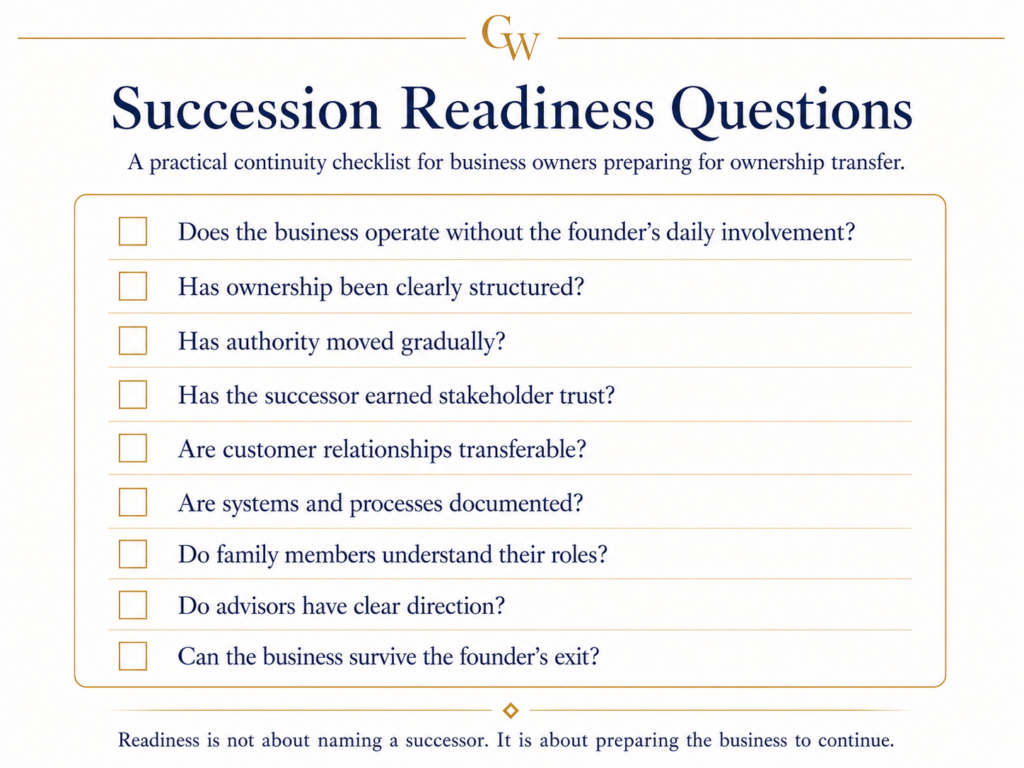
Succession is often treated as a replacement problem because owners naturally think in terms of roles. Who will be the next CEO? Who will manage the company? Which child is most capable? Should the business be sold to a buyer, passed to family, or transferred to management? These questions are important, but they focus too heavily on the next person. A business does not continue simply because a name appears on a document or a successor is announced. The successor must be able to lead within a system that supports them.
Replacement thinking is especially limited in founder-led businesses. A founder often does far more than occupy a formal role. The founder may carry customer trust, vendor relationships, banking relationships, pricing instincts, hiring judgment, culture, family authority, strategic memory, and crisis experience. Replacing the title does not automatically transfer those capacities. The founder’s role may be larger than the job description. That is why succession planning must ask what the founder actually holds, not only who will hold the title after the founder steps away.
A replacement plan also fails when it overlooks the needs of people around the business. Employees need to know whether leadership will remain stable. Customers need confidence that service, quality, and relationships will continue. Lenders need to know whether the business can operate without the founder. Family members need clarity about ownership, distributions, voting rights, employment, and future participation. Advisors need direction from a coordinated ownership system. Naming a successor does not answer all of these questions. Governance, structure, and preparation do.
Ownership Transfer Is Often Overlooked
Ownership transfer is often the missing layer in business succession planning. Many owners spend time thinking about management transition, but less time thinking about ownership transition. Yet management and ownership are not the same thing. A child may manage the business without owning it. A sibling may own shares without working in the business. A nonfamily executive may lead operations while the family retains ownership. A buyer may acquire ownership while the founder remains involved for a period. Each scenario creates different rights, responsibilities, expectations, and risks.
When ownership transfer is unclear, succession becomes fragile. The business may know who runs daily operations, but not who controls major decisions. Family members may know who works in the business but not how decisions about profits, voting rights, compensation, reinvestment, or sale will be handled. A successor may manage employees but lack authority over strategy. Owners may retain economic rights but lack clarity about governance. This is why the transfer of business ownership must be treated as a central part of succession planning, not as a technical matter handled after leadership has been discussed.
The International Finance Corporation’s Family Business Governance Handbook highlights how family business participants can hold overlapping roles as owners, managers, family members, and directors. That overlap is exactly why ownership transfer requires serious attention. When roles are not separated clearly, succession can create conflict because family members may confuse inheritance with leadership, employment with ownership, and family status with business authority.
The Real Question Is Whether the Business Can Survive the Transition
The real question in business succession planning is not only who takes over. The real question is whether the business can survive the transition. Can the company operate without the founder’s daily involvement? Can customers trust the next leader? Can employees remain confident? Can ownership transfer without confusion? Can the authority move clearly? Can the family make decisions after the founder steps back? Can lenders, suppliers, advisors, and partners continue to rely on the business?
This question changes the standard for succession. It moves the owner from replacement thinking to continuity thinking. A business that survives transition has more than a named successor. It has a prepared successor, a clear ownership structure, an operating system, documented knowledge, governance processes, stakeholder confidence, and a realistic transition path. KPMG’s 2025 Global Family Business Report notes that family businesses are increasingly expanding their view of success beyond succession toward the meaningful transition of capital across generations, which aligns with the Institute’s view that succession must include continuity, not only replacement.
This is why succession planning should begin before the owner feels ready to exit. Transition readiness is not built quickly. It requires time to prepare successors, reduce founder dependence, clarify ownership, document knowledge, develop leadership, communicate with family members, and strengthen governance. An owner who waits until illness, fatigue, conflict, market pressure, or a buyer’s offer forces the issue may discover that the business was never truly prepared to transfer. The business may have been operating, but not transferable.
Succession is not the naming of a replacement. Succession is the transfer of responsibility.
Replacement Focuses on the Person
Replacement thinking begins with a name. The owner asks who will become the next CEO, manager, president, buyer, child successor, operating partner, or outside executive. That question matters because a business needs leadership. Someone must make decisions, guide employees, communicate with customers, manage risk, and carry responsibility. But choosing a person does not automatically create a succession plan. It only identifies who may stand in the role after the current owner leaves. Deloitte’s succession guidance emphasizes that a family business transition requires planning ahead and preparing successors before the transition occurs, meaning succession depends on more than naming the next leader.
The limitation of replacement thinking is that it often treats the business as if the current owner only holds a title. In reality, many owners hold far more than a title. They may hold customer trust, employee loyalty, lender confidence, vendor relationships, pricing judgment, hiring instincts, cultural authority, family influence, and years of operating memory. The successor is not simply replacing a person in an organizational chart. The successor is being asked to inherit a working system of relationships, decisions, habits, knowledge, and authority. The IFC Family Business Governance Handbook shows why this is especially complex in family enterprises, where one person may simultaneously be an owner, manager, family member, and director.
This is why succession planning becomes weak when it stops at successor selection. A founder may say, “My son will run it,” “My daughter will take over,” “My general manager will operate the company,” or “We will sell to the right buyer.” Those statements may be directionally useful, but they do not answer the deeper questions. Has authority been transferred? Has ownership been structured? Does the successor understand the financial model? Do employees trust the next leader? Do customers believe the business will remain stable? Has the family agreed on its role after transfer? PwC’s 2025 Family Business Survey shows succession planning has affected 44 percent of United States family firms in the past year, which reinforces how central this issue has become for family-owned businesses.
Replacement focuses on who comes next. Succession requires a more serious question. What must be transferred so the business can continue? A named successor may be necessary, but the successor alone cannot carry a transition if the business remains dependent on the current owner’s relationships, authority, memory, and daily judgment. This is where business succession planning must move from the person to the system.
Transfer Focuses on the System
Transfer thinking begins with a different premise. It does not ask only who comes next. It asks what must move for the business to remain strong after the current owner is no longer in control. Ownership must move clearly. Authority must move intentionally. Institutional knowledge must move before it disappears. Customer trust must be transferred through exposure and relationship continuity. Employee confidence must be protected through communication and leadership readiness. Governance must support the transition so decisions do not become unclear once the founder steps back. KPMG’s Global Family Business Report identifies clear governance frameworks and effective succession planning as characteristics associated with stronger family business performance.
A business succession plan must therefore address ownership, authority, knowledge, governance, relationships, and operating capacity together. Ownership determines who holds economic, voting, control, sale, and distribution rights. Authority defines who can make decisions. Knowledge defines what the next generation or next owner must understand to operate effectively. Governance defines how decisions are made before, during, and after transition. Relationships define whether customers, employees, lenders, vendors, family members, and advisors remain confident. Operating capacity defines whether the business can function without the founder’s daily involvement. Deloitte describes family enterprises as complex because business growth, ownership issues, family relationships, and increasing wealth create the need for structured governance and succession frameworks.
This is why the transfer of business ownership cannot be treated as an administrative step after leadership selection. If shares transfer without authority, the new owner may have rights but no practical control. If authority transfers without knowledge, the successor may have power but not judgment. If leadership transfers without customer trust, revenue may become vulnerable. If management transfers occur without governance, employees may not know who truly makes the decision. If a buyer acquires the company without operating continuity, the business may lose value after closing. Transfer planning protects the business from these gaps.
Transfer also requires the owner to be honest about what the business currently depends on. Does the business depend on documented systems or on the founder’s memory? Does revenue depend on the company’s brand or on the owner’s personal relationships? Does the leadership team make decisions independently or wait for the founder? Does the family understand ownership rights, or are expectations unspoken? Does the successor have authority, or only a future possibility? These questions determine whether a succession plan is real or merely assumed.
A Successor Without Transfer Is Not a Succession Plan
A successor without transfer is not a succession plan. It is an announcement. The title may move, but the business may not. A successor can be named while the founder still controls every major decision, customers still call the founder directly, employees still seek the founder’s approval, family members still challenge the successor’s authority, and advisors still wait for the founder’s direction. In that situation, the successor may appear to be in charge, while the real decision-making authority remains with the prior owner. Deloitte’s succession planning resources emphasize that transition requires deliberate preparation rather than a last-minute leadership handoff.
This gap poses a risk to the successor and the business. The successor may be blamed for weak leadership when the deeper issue is incomplete transfer. They may be expected to lead without authority, make decisions without information, manage employees without trust, and protect ownership without governance support. The business may begin to experience uncertainty because stakeholders do not know whether the successor is truly empowered. Employees may hesitate. Customers may test the transition. Family members may question decisions. Lenders and advisors may worry about continuity. The problem is not only the successor’s readiness. It is the design of the transfer.
A serious business succession plan must be prepared for the transfer before the public transition. It must identify what the founder holds, what the successor needs, what the business must document, which relationships must be transitioned, which ownership rights must be clarified, and which governance structures must support the next stage. KPMG’s family business research notes that good governance establishes clear decision-making processes, reduces conflict, and supports long-term sustainability, which is exactly what succession requires during ownership transition.
The strongest succession plans do not only ask whether a successor has been selected. They ask whether the successor has been prepared, authorized, trusted, informed, supported, and embedded into a governance system that allows the business to continue. Naming someone without transferring responsibility creates the appearance of succession while leaving the business exposed. Succession is not the naming of a replacement. Succession is the transfer of responsibility.
What Business Succession Planning Actually Requires
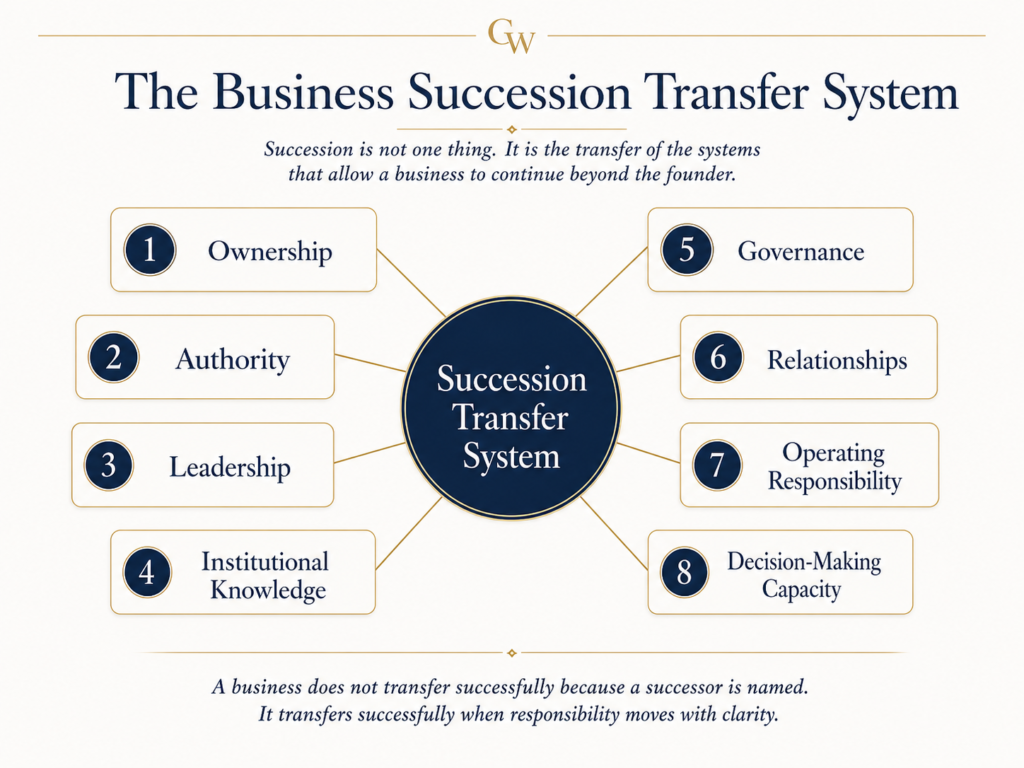
Business succession planning should be understood as a system. It prepares the business, the owner, the successor, the family, the ownership structure, and the governance system for transition. A real succession plan must address ownership structure, leadership readiness, governance, operating continuity, family communication, successor preparation, financial planning, tax and estate planning, institutional knowledge transfer, board or advisor oversight, transition timing, and the owner’s exit or continuity strategy. Deloitte’s family office enterprise governance and succession work treats governance frameworks, family agreements, shareholder agreements, board effectiveness, next-generation preparation, and family office transformation as interconnected parts of long-term continuity.
The reason these components must be connected is that succession does not occur in a single place. It affects ownership, leadership, operations, family expectations, employees, customers, advisors, financing, taxes, estate structures, and long-term business value. A plan that addresses only one layer leaves the other layers exposed. For example, a leadership plan without clarity on ownership can create conflict. An ownership plan without leadership readiness can weaken operations. A tax plan without governance can move value into confusion. An exit plan without operating continuity can reduce buyer confidence. Succession planning for business owners must therefore be coordinated rather than fragmented.
Succession Requires Ownership Structure
Succession requires an ownership structure because someone must understand what is being transferred, how it is being transferred, and what rights come with it. Ownership structure may include shares, membership interests, partnership interests, operating agreements, shareholder agreements, buy-sell provisions, trusts, holding companies, family entities, voting rights, transfer restrictions, and distribution rules. These structures define who owns, who controls, who benefits, who can sell, who can vote, who can inherit, and how ownership disputes may be handled. The IFC handbook’s discussion of overlapping ownership, management, family, and director roles shows why clarity around ownership is essential in family business succession.
Ownership structure matters because leadership can change while ownership remains unclear. A child may operate the business but not own it. Siblings may own equal shares but contribute unequally. A nonfamily executive may lead the company while the family retains control. A buyer may acquire ownership while the founder remains involved temporarily. Each arrangement needs a different structure. The goal is not legal complexity for its own sake. The goal is to reduce confusion when ownership, control, economics, and responsibility begin to separate.
Succession Requires Leadership Readiness
Succession requires leadership readiness because a successor cannot become prepared at the moment the owner exits. Leadership readiness develops through exposure, responsibility, decision-making practice, financial understanding, stakeholder trust, and authority that increases over time. A successor must understand the company’s customers, employees, margins, risks, systems, vendors, culture, cash flow, and strategic choices. They must also understand the owner’s judgment, not only the owner’s instructions. Deloitte’s succession planning guidance stresses the importance of preparing successors and planning ahead for a smooth transition.
Leadership readiness also requires the current owner to make room for leadership to develop. This can be difficult because founders often remain emotionally and operationally attached to the business. They may want the successor to be ready while continuing to make every major decision themselves. That approach delays readiness. The successor needs opportunities to lead while the owner is still available to coach, correct, and transfer judgment. Leadership transfer works best when authority is gradually practiced before control fully moves.
Succession Requires Governance
Succession requires governance because transition creates decision-making pressure. Before the transition, the founder may decide most things directly. During transition, authority may become shared, contested, or unclear. After the transition, the business needs a reliable way to make decisions without depending on the founder’s presence. Governance clarifies who decides, how decisions are made, what roles owners and managers play, how family members participate, and how disagreements are resolved. This connects directly to What Is Family Governance? The Missing Layer in Most Wealth Plans.
Governance becomes especially important when ownership and management separate. Some family members may own the business but not work in it. Some executives may manage but not own. Some heirs may expect distributions but not carry operating responsibility. Some owners may want growth while others want liquidity. Governance provides the structure for these differences to be discussed without allowing every disagreement to become a business crisis. KPMG’s global family business research describes governance as crucial because it establishes clear decision-making processes, reduces conflicts, and supports long-term sustainability.
Succession Requires Operating Continuity
Succession requires operating continuity because a business must continue serving customers, paying employees, managing suppliers, producing revenue, and making decisions while ownership and leadership change. The company cannot pause because the owner is transitioning. Customers still expect service. Employees still need direction. Vendors still need communication. Lenders still need confidence. Systems still need to function. Cash flow still needs to be managed. If operations depend too heavily on the founder, succession can expose weaknesses that were hidden during normal business activity.
Operating continuity requires documented processes, management depth, reporting systems, customer transition plans, employee communication, vendor continuity, financial controls, and clear decision-making authority. It also requires the business to become less dependent on informal memory. Many businesses operate for years through habits known only to the owner. That can work until the owner is no longer available. A serious succession plan asks what must be documented, delegated, automated, professionalized, or transferred so the business can continue without disruption.
Succession Requires Family Communication
Succession requires family communication because business transition often affects more than the person who runs the company. It may affect spouses, children, siblings, inactive owners, future heirs, key employees, and family members who depend on the business economically. Silence creates risk because different people may carry different assumptions. One child may assume they will inherit leadership. Another may assume ownership will be equal. A spouse may assume the business will be sold. A sibling may assume distributions will continue. A founder may assume everyone understands the plan even when no one does.
Family communication protects both the business and the relationships around it. It gives the family a way to discuss ownership, employment, compensation, distributions, fairness, competence, leadership, sale possibilities, and future participation before transition forces those questions into conflict. PwC’s family business survey emphasizes family vision, succession planning, and leadership development as key issues for family firms, which reinforces the importance of communication before transfer becomes urgent.
Succession Requires Successor Preparation
Successor preparation is broader than leadership readiness. Leadership readiness focuses on the ability to lead the business. Successor preparation includes the broader readiness to carry responsibility inside the ownership system. The successor must understand the company, but also the family, the ownership structure, the governance process, the financial model, the tax and estate implications, the advisory team, and the expectations of stakeholders. A successor who can operate the business but cannot navigate ownership dynamics may still struggle after transition.
Successor preparation should include mentoring, education, exposure to advisors, participation in major decisions, financial training, governance education, and increasing responsibility over time. It should also include honest assessment. Not every family member who wants leadership is prepared for it. Not every capable manager understands ownership. Not every buyer can protect continuity. Preparation helps the owner distinguish desire from readiness.
Succession Requires Financial Planning
Succession requires financial planning because ownership transfer affects value, income, liquidity, taxes, debt, compensation, distributions, and the owner’s personal financial future. An owner may depend on the business for retirement income. A successor may need capital to buy in. A family may need liquidity to treat heirs fairly. A business may need cash for growth while also supporting distributions. A sale may require valuation, financing, earnouts, or seller transition terms. These issues cannot be left until the final stage of succession.
Financial planning also protects the business from being drained by transition. If the outgoing owner needs too much cash too quickly, the business may become overleveraged. If inactive owners expect distributions that the business cannot support, reinvestment may suffer. If successor compensation is unclear, resentment may build. If valuation is disputed, ownership transfer may stall. A serious succession plan must connect business value, owner needs, successor capacity, and company continuity.
Succession Requires Tax and Estate Planning
Succession requires tax and estate planning because business ownership is often one of the owner’s largest assets. The transfer of shares, membership interests, partnership interests, voting rights, estate value, insurance policies, trusts, and family entities can have legal and tax consequences. Estate planning can help address death, incapacity, liquidity, beneficiary treatment, tax exposure, and asset transfer. But tax and estate planning should not be isolated from succession. If the documents move ownership without preparing leadership and governance, the transfer may work technically while the business remains fragile.
This is one of the central lessons from Family Wealth Transfer: Why Continuity Matters More Than Inheritance. Documents can move ownership rights, but they cannot automatically transfer judgment. Tax and estate planning matter, but they become stronger when aligned with governance, leadership readiness, operating continuity, and successor preparation.
Succession Requires Institutional Knowledge Transfer
Succession requires institutional knowledge transfer because much of a business lives outside formal documents. The founder may know which customers require special handling, which vendors can be trusted, which employees are informal leaders, how pricing decisions are made, when cash flow tightens, which risks are hidden, and which opportunities are worth pursuing. If that knowledge remains trapped in the owner’s memory, the business becomes vulnerable when the owner exits.
Institutional knowledge transfer should be intentional. It may include documenting processes, creating operating manuals, building customer records, explaining pricing logic, introducing successors to lenders and vendors, recording decision principles, and helping future leaders understand why certain choices were made. The goal is not to remove judgment from the business. The goal is to make judgment transferable.
Succession Requires Board or Advisor Oversight
Succession requires board or advisor oversight when the business has grown beyond what informal founder control can safely manage. A board, advisory board, ownership council, family council, trustee group, CPA, attorney, banker, consultant, or outside advisor can help bring discipline to the process. Oversight helps owners ask better questions, evaluate successor readiness, prepare governance structures, and protect the business from emotional or reactive decisions. KPMG’s family business research identifies formal boards and governance as important contributors to stronger decision-making and long-term sustainability.
Outside advisors can be valuable, but they need clear direction. Advisors cannot replace ownership governance. If the family is divided, advisors may receive conflicting instructions. If the owner has not clarified goals, advisors may optimize technical pieces without supporting the larger continuity plan. Advisor oversight works best when the business and family have a clear governance framework.
Succession Requires a Transition Timeline
Succession requires a transition timeline because transfer rarely happens well as a single, sudden event. The owner may need time to reduce involvement. The successor may need time to build authority. Employees may need time to adjust. Customers may need repeated exposure to the next leader. Lenders and vendors may need confidence in continuity. Family members may need time to understand the ownership structure. A timeline helps move succession from intention to execution.
The timeline should identify stages. What happens now? What responsibilities move first? When does the successor begin leading meetings? When are customer relationships transitioned? When does ownership transfer? When does the founder stop making daily decisions? When does the board or advisory group begin oversight? Without a timeline, succession remains vague. With a timeline, the business can prepare deliberately.
Succession Requires an Exit or Continuity Strategy
Succession requires an exit or continuity strategy because not every owner wants the same outcome. Some owners want the business to remain in the family. Some want to sell to children, employees, management, partners, strategic buyers, private buyers, or investors. Some want to stay involved as chair, advisor, landlord, shareholder, or mentor. Some want a full exit. Each path requires different planning. Exit planning and succession planning are connected because both involve the transfer of ownership, authority, and responsibility.
A continuity strategy asks how the business will survive beyond the current owner. An exit strategy asks how the owner will step away while protecting value, relationships, and future stability. The best plans often address both. They prepare the business to continue and prepare the owner to transition. A business that can continue without the owner is usually stronger, whether the owner transfers it to family, sells it to management, or exits through an outside sale.
Replacement Focuses on the Person
Replacement thinking begins with a name. The owner asks who should become the next CEO, president, general manager, buyer, child successor, operating partner, or outside executive. That question matters because every business needs leadership. Someone must make decisions, guide employees, manage customers, protect cash flow, and carry responsibility. But naming one person does not automatically create a business succession plan. It only identifies a possible successor. Deloitte’s succession guidance emphasizes that a smooth transition requires planning ahead, selecting the right candidates, and preparing successors before the transition occurs.
The weakness of replacement thinking is that it treats the owner’s role as merely a formal position. In many founder-led businesses, the owner holds far more than a title. The founder may hold customer trust, employee loyalty, vendor relationships, lender confidence, hiring judgment, pricing logic, strategic memory, family authority, and the ability to resolve problems that were never written down. The successor is not simply stepping into a job description. The successor is being asked to inherit a network of relationships, habits, decisions, and operating knowledge that may still live inside the founder. The IFC Family Business Governance Handbook explains that family business participants often hold overlapping roles as owner, manager, family member, and director, which is why succession is rarely a simple personnel change.
A replacement plan can create the appearance of progress while leaving the business exposed. The owner may say that a child will run the company, a general manager will take over, a buyer will eventually acquire the business, or a professional operator will be hired. Those statements may point in a useful direction, but they do not answer the harder succession questions. Has authority moved? Has ownership been structured? Has the successor earned trust? Do employees know who decides? Do customers believe the business will remain stable? Does the family understand its role after transition? PwC’s 2025 Family Business Survey reports that succession planning affected 44 percent of United States family firms in the past year, which reflects how central this issue has become for family-owned companies.
Replacement focuses on who comes next. Succession requires a more serious question: what must be transferred so the business can continue? A named successor may be necessary, but the successor alone cannot carry a transition if the business still depends on the current owner’s relationships, authority, judgment, memory, and daily involvement. This is why business succession planning must move from the person to the system.
Transfer Focuses on the System
Transfer thinking begins with the whole business, not only the next leader. It asks what must move for the company to remain strong after the current owner is no longer the center of control. Ownership must move clearly. Authority must move intentionally. Institutional knowledge must move before it disappears. Customer trust must be transitioned through exposure and relationship continuity. Employee confidence must be protected through communication and leadership readiness. Governance must support the transition so decision-making does not become unclear once the founder steps back. KPMG’s Global Family Business Report states that good governance supports growth by creating clear decision-making processes, reducing conflict, and strengthening long-term sustainability.
A serious succession plan must address ownership, authority, knowledge, governance, relationships, and operating capacity together. Ownership defines economic rights, voting rights, control rights, distribution rights, sale rights, and transfer restrictions. Authority defines who can make decisions and where the limits sit. Knowledge defines what the next leader or ownership group must understand to operate wisely. Governance defines how decisions are made before, during, and after transition. Relationships determine whether customers, employees, lenders, vendors, advisors, and family stakeholders remain confident. Operating capacity determines whether the business can function without the founder’s daily involvement. Deloitte’s family enterprise work connects business growth, ownership issues, family relationships, and increasing wealth with the need for structured governance and succession frameworks.
This is why the transfer of business ownership cannot be treated as a technical step after leadership selection. If shares transfer without authority, the new owner may have rights but no practical control. If authority transfers without knowledge, the successor may have power but not judgment. If leadership transfers without customer trust, revenue may become vulnerable. If management transfers occur without governance, employees may not know who truly makes the decision. If a buyer acquires the company without operating continuity, the business may lose value after closing. Transfer planning protects the business from these gaps.
Transfer also requires the owner to be honest about what the business currently depends on. Does the business depend on documented systems or on the founder’s memory? Does revenue depend on the company’s brand or on the owner’s personal relationships? Does the leadership team make decisions independently or wait for the founder? Does the family understand ownership rights, or are expectations still unspoken? Does the successor have authority now, or is it only a future possibility? These questions determine whether a succession plan is real or merely assumed.
A Successor Without Transfer Is Not a Succession Plan
A successor without transfer is not a succession plan. It is an announcement. The title may move, but the business may not move with it. A successor can be named while the founder still controls every major decision, customers still call the founder directly, employees still seek the founder’s approval, family members still question the successor’s authority, and advisors still wait for the founder’s direction. In that situation, the successor may appear to be in charge while the real decision-making system remains attached to the prior owner. Deloitte warns that when the older generation expects continuity without giving the next generation room to lead, it can reduce authority and weaken the desire to take leadership roles.
This gap creates risk for both the successor and the business. The successor may be blamed for weak leadership when the deeper issue is incomplete transfer. They may be expected to lead without authority, make decisions without information, manage employees without trust, and protect ownership without governance support. The business may begin to experience uncertainty because stakeholders do not know whether the successor is truly empowered. Employees may hesitate. Customers may test the transition. Family members may challenge decisions. Lenders and advisors may question continuity. The problem is not only the successor’s readiness. It is the design of the transfer.
A serious business succession plan must prepare the transfer before the public transition. It must identify what the founder holds, what the successor needs, what the business must document, what relationships must be transitioned, what ownership rights must be clarified, and what governance structures must support the next stage. Naming someone without transferring responsibility creates the appearance of succession while leaving the business exposed. Succession is not the naming of a replacement. Succession is the transfer of responsibility.
What Business Succession Planning Actually Requires
Business succession planning should be understood as a system. It prepares the business, the owner, the successor, the family, the ownership structure, and the governance system for transition. A real succession plan addresses ownership structure, leadership readiness, governance, operating continuity, family communication, successor preparation, financial planning, tax and estate planning, institutional knowledge transfer, board or advisor oversight, a transition timeline, and a clear exit or continuity strategy. Deloitte’s global succession guidance states that a well-run family enterprise is grounded by governance that guides the business, family, and ownership through generational succession.
The reason these components must be connected is that succession does not happen in one place. It affects ownership, leadership, operations, family expectations, employees, customers, suppliers, lenders, advisors, taxes, estate structures, and long-term business value. A plan that addresses only one layer leaves the other layers exposed. A leadership plan without ownership clarity can create conflict. An ownership plan without leadership readiness can weaken operations. A tax plan without governance can move value into confusion. An exit plan without operating continuity can reduce buyer confidence. Business succession planning must therefore be coordinated, not fragmented.
Succession Requires Ownership Structure
Succession requires ownership structure because someone must understand what is being transferred, how it is being transferred, and what rights come with it. Ownership structure may include shares, membership interests, partnership interests, operating agreements, shareholder agreements, buy-sell provisions, trusts, holding companies, family entities, voting rights, transfer restrictions, and distribution rules. These structures help define who owns, who controls, who benefits, who can sell, who can vote, who can inherit, and how ownership disputes may be handled. The IFC handbook shows why this matters by describing the overlapping roles family business participants may hold as owners, managers, family members, and directors.
Ownership structure matters because leadership can change while ownership remains unclear. A child may operate the business but not own it. Siblings may own equal shares but contribute unequally. A nonfamily executive may lead the company while the family retains control. A buyer may acquire ownership while the founder remains involved for a transition period. Each arrangement needs a different structure. The goal is not legal complexity for its own sake. The goal is to reduce confusion when ownership, control, economics, and responsibility begin to separate.
Poor ownership structure creates succession risk because business authority and economic rights can move in different directions. One person may be responsible for performance while another controls voting rights. One family branch may rely on distributions while another wants reinvestment. One successor may lead operations while inactive owners expect influence. These are not only legal questions. They are ownership continuity questions. A business succession plan must make ownership clear enough for the company to continue after the founder is no longer available to interpret everyone’s role.
Succession Requires Leadership Readiness
Succession requires leadership readiness because the next leader cannot become prepared at the moment authority moves. Leadership readiness develops through exposure, responsibility, decision-making practice, financial understanding, stakeholder trust, and gradual authority. A successor must understand the company’s customers, employees, margins, risks, systems, vendors, culture, cash flow, and strategic choices. They must also understand the owner’s judgment, not only the owner’s instructions. Deloitte’s succession guidance stresses the importance of preparing successors before the transition occurs.
Leadership readiness also requires the current owner to make room for leadership to develop. This is often difficult because founders are emotionally and operationally attached to the business. They may want the successor to be ready while continuing to make every major decision themselves. That approach delays readiness. The successor needs opportunities to lead while the owner is still available to coach, correct, and transfer judgment. Leadership transfer works best when authority is practiced before full control moves.
A business should therefore assess readiness before transition, not after. Can the successor lead meetings? Can they handle difficult employees? Can they speak with customers? Can they understand financial reports? Can they make tradeoffs between growth, risk, cash flow, and reinvestment? Can they work with advisors? Can they earn the confidence of lenders and suppliers? These questions should not be answered by hope. They should be answered through repeated exposure to real responsibility.
Succession Requires Governance
Succession requires governance because transition creates decision-making pressure. Before the transition, the founder may decide most things directly. During transition, authority may become shared, contested, or unclear. After the transition, the business needs a reliable way to make decisions without depending on the founder’s presence. Governance clarifies who decides, how decisions are made, what roles owners and managers play, how family members participate, and how disagreements are resolved. This connects directly to What Is Family Governance? The Missing Layer in Most Wealth Plans. KPMG’s 2025 family business research states that governance is crucial because it establishes clear decision-making processes, reduces conflict, and supports long-term sustainability.
Governance becomes especially important when ownership and management separate. Some family members may own but not work in the business. Some executives may manage but not own. Some heirs may expect distributions without carrying operating responsibility. Some owners may want growth while others want liquidity. Governance provides the structure for these differences to be discussed without allowing every disagreement to become a business crisis. In this sense, governance is not bureaucracy. It is the decision-making infrastructure that allows succession to hold.
Governance also protects the successor. A successor who steps into a business without governance may become trapped between founder expectations, family emotions, employee uncertainty, and ownership confusion. A successor who steps into a governed system has clearer authority, clearer reporting, clearer decision rights, and a better chance of leading with legitimacy. The transition is still difficult, but it is no longer dependent only on personality.
Succession Requires Operating Continuity
Succession requires operating continuity because the business must continue serving customers, paying employees, managing suppliers, producing revenue, and making decisions while ownership and leadership change. The company cannot pause while the owner transitions. Customers still expect service. Employees still need direction. Suppliers still need communication. Lenders still need confidence. Systems still need to function. Cash flow still needs to be managed. If operations depend too heavily on the founder, succession can expose weaknesses that were hidden during normal business activity.
Operating continuity requires documented processes, management depth, reporting systems, customer transition plans, employee communication, vendor continuity, financial controls, and clear decision-making authority. It also requires the business to become less dependent on informal memory. Many businesses operate for years through habits known only to the owner. That can work until the owner is no longer available. A serious succession plan asks what must be documented, delegated, automated, professionalized, or transferred so the business can continue without disruption.
Institutional memory is part of operating continuity. The business needs to preserve why certain customers are handled differently, why certain pricing decisions are made, which vendors can be trusted, which employees have informal influence, what risks typically arise in certain seasons, and how the owner thinks through difficult trade-offs. Without that transfer, the successor may inherit operations without inheriting the logic behind operations.
Succession Requires Family Alignment
Succession requires family alignment when the business is owned, influenced, or expected to benefit multiple family members. This becomes especially important when some family members work in the business and others only own it. Working family members may believe they deserve more compensation, authority, or control because they carry daily responsibility. Nonworking owners may believe they deserve equal economic benefit because they share ownership. Parents may want fairness among children while the business requires competence, discipline, and clear authority. PwC’s 2025 Family Business Survey highlights the importance of family vision, succession planning, and leadership development in family firms, which reflects the need for alignment before transition.
Family alignment does not mean every family member agrees on everything. It means the family has discussed enough to understand the business, ownership structure, leadership plan, and the expectations for each role. It means family members understand the difference between employment, ownership, management, governance, inheritance, compensation, and distributions. Without that clarity, succession can turn business decisions into family disputes.
A family business succession plan must therefore address both the emotional and structural aspects of the transition. The family must know who will lead, who will own, who will work, who will receive distributions, how inactive owners will receive information, and how disagreements will be addressed. If these questions remain unspoken, the transition may not fail because the business is weak. It may fail because the family never aligned around ownership.
The Hidden Risk of Founder Dependence
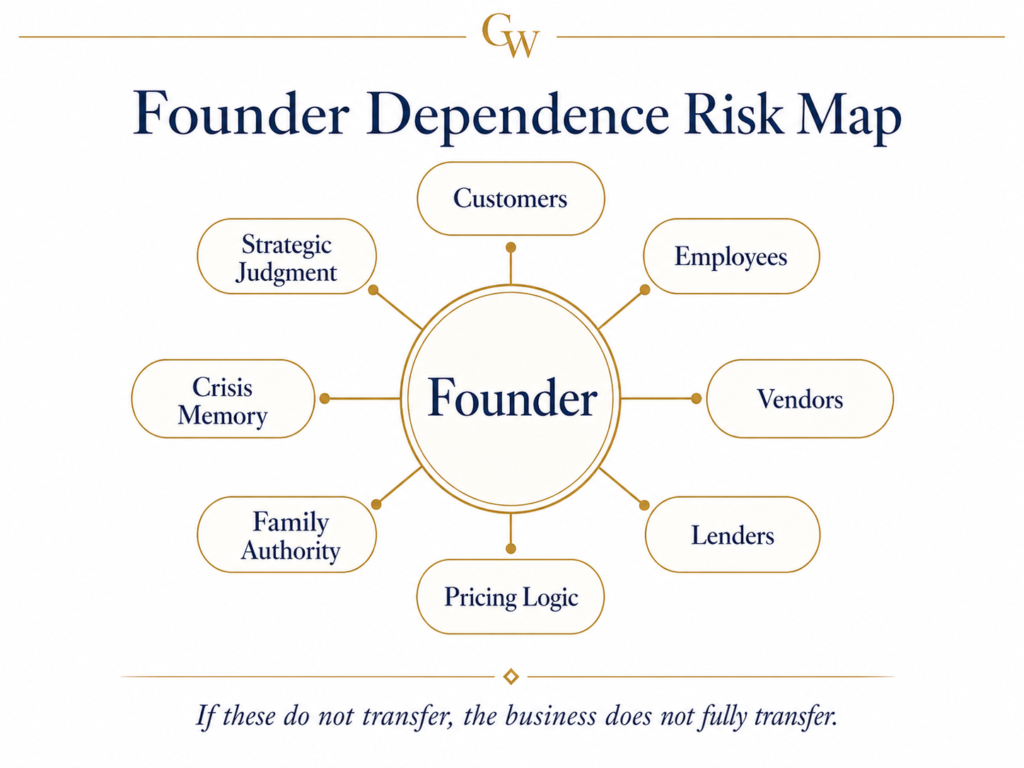
Founder dependence is one of the most serious risks in business succession planning because it often hides inside success. The business may look strong while the founder is active. Revenue may be growing. Customers may be loyal. Employees may be stable. Vendors may be responsive. Banks may be comfortable. The family may believe the company is durable. But beneath that apparent strength, the business may still depend heavily on one person’s relationships, pricing judgment, hiring instincts, banking trust, vendor history, operating memory, family authority, and strategic intuition. When the founder exits, the business may lose more than a leader. It may lose the operating center.
Founder dependence makes a business harder to transfer, value, sell, and continue. Buyers, lenders, successors, employees, and family members all need confidence that the business can operate without the founder. If too much personal value is tied to the owner, the transition becomes more dangerous. The company may still be profitable, but its transferability is weaker than the financial statements suggest. Deloitte’s succession guidance notes that current leaders play a significant role in setting the tone for transition, and that failure to give the next generation real authority can weaken continuity.
Founder Knowledge Is Often Undocumented
Founder knowledge is often undocumented because the founder has carried the business for years through memory, instinct, and experience. The founder may know how to price work, which customers require special handling, which vendors can solve urgent problems, which employees need closer supervision, which risks appear before they show up in reports, and which opportunities are worth pursuing. That knowledge may be essential to the company, but it may not exist in any system the successor can use.
Undocumented knowledge creates transition risk. When the founder is present, the business can function because the knowledge is available within one person. When the founder exits, the successor must recreate what was never transferred. That can lead to slower decisions, weaker customer service, missed risks, operational mistakes, and loss of confidence. A serious succession plan should document processes, decision logic, customer history, vendor relationships, pricing principles, reporting systems, and operating rhythms before the founder steps away.
The goal is not to remove judgment from the business. The goal is to make judgment transferable. A company becomes more durable when its knowledge is no longer trapped in one person’s memory. This is one of the most practical ways an owner can increase the transferability of their assets before succession.
Founder Relationships Are Often Nontransferable Unless They Are Intentionally Transitioned
Founder relationships can be one of the most valuable and fragile parts of a business. Customers may buy because they trust the founder. Lenders may extend credit because they know the founder’s character. Vendors may provide flexibility because of years of relationship. Employees may stay because of personal loyalty. Advisors may understand the company mainly through the founder’s explanations. These relationships often feel stable until the founder leaves.
Relationships do not transfer automatically. The successor must be introduced, trusted, tested, and gradually accepted. Customers need to see the successor in meaningful conversations before the founder exits. Employees need to experience the successor making decisions. Lenders and vendors need confidence that the business remains competent. Advisors need to know who will provide direction after the transition. If these relationships are not transitioned intentionally, succession may weaken the very trust that kept the business stable.
A strong succession plan treats relationship transfer as part of operating continuity. It creates a deliberate process for introducing the successor to customers, employees, vendors, lenders, community partners, advisors, and family stakeholders. The founder’s credibility becomes a bridge, not a permanent dependency.
Founder Authority Often Masks Weak Governance
Founder authority often masks weak governance because a single strong owner can make unclear systems appear functional. The founder decides. The founder resolves conflict. The founder communicates with advisors. The founder approves spending. The founder handles family tension. The founder interprets ownership rights. The founder tells employees what matters. While the founder is active, this can appear efficient. After the founder exits, the weakness becomes visible.
The problem is not that the founder had authority. Founder authority is often necessary in the early stages of a business. The problem is when the business never develops a decision-making system beyond the founder. If no one knows who decides after the founder, governance was never built. If family members do not understand ownership roles, governance was never built. If managers wait for the founder before acting, governance was never built. If advisors receive conflicting directions after the transition, governance was never built.
This is why succession must include governance before the founder leaves. Governance turns personal authority into organizational clarity. It helps the business and family know who decides, how decisions are made, what requires approval, and how conflict is handled. Without governance, the founder’s exit does not simply remove a person. It removes the decision-making system.
Founder Dependence Can Reduce Business Value
Founder dependence can reduce business value because transferable businesses are generally stronger than owner-dependent businesses. A buyer wants to know whether revenue will continue after the founder leaves. A lender wants confidence that management can operate without disruption. Employees want stability. Customers want continuity. Family successors need systems they can inherit. If the business depends too heavily on the founder’s personal relationships, memory, and daily control, the company may be riskier than its financial performance suggests.
This matters whether the owner plans to sell, transfer to family, promote management, or retain ownership while stepping back. In every scenario, the business must prove it can function beyond the founder. If it cannot, succession becomes harder. Sale value may decline. Transition risk may increase. Successors may struggle. Family conflict may rise. Employees may leave. Customers may become uncertain. The issue is not only continuity. It is valuable.
Reducing founder dependence is therefore one of the most important acts of ownership maturity. The owner must build management depth, document knowledge, transition relationships, clarify authority, strengthen governance, and prepare successors before the business is forced into transition. A business that can operate without the founder is more transferable, more valuable, and more likely to survive succession.
The Hidden Risk of Founder Dependence
Founder dependence is one of the most serious risks in business succession planning because it often hides inside success. The business may look strong while the founder remains active. Revenue may be stable. Customers may be loyal. Employees may trust the company. Vendors may respond quickly. Banks may feel comfortable. The family may believe the business is durable. But beneath that surface, the business may still depend heavily on one person’s customer relationships, pricing logic, hiring judgment, banking trust, vendor history, operating memory, family authority, and strategic instincts.
When the founder exits, the business may lose more than a leader. It may lose the operating center. That is the real danger. The founder may not simply be the person at the top. The founder may be the person who explains the numbers, calms customers, negotiates terms, reads employee dynamics, remembers every exception, handles family tension, and makes decisions no one else has been trained to make. Deloitte’s family business succession guidance emphasizes that a smooth transition requires planning ahead and preparing successors in advance, because leadership continuity cannot be improvised at the moment of transfer.
Founder dependence makes a business harder to transfer, value, sell, and continue. A business that cannot operate without the founder may be profitable, but it is not fully transferable. Buyers want confidence that revenue, employees, customers, and operations will remain stable after the owner exits. Lenders want confidence that the company can repay its debt without relying on a single person’s judgment. Successors need systems they can inherit. Employees need clarity about who leads next. BDC describes succession and exit planning as a way to support continuity and enhance business value, whether ownership is sold externally or transferred to family or management.
Founder Knowledge Is Often Undocumented
Founder knowledge is often undocumented because many owners build businesses through experience before they build formal systems. They know how the business works because they have lived inside it for years. They know which customers need careful handling, which vendors can be trusted, which employees are informal leaders, which numbers require attention, which risks appear before they become visible, and which decisions require patience. The business may have accounting records, customer lists, contracts, and operational tools, but the real operating judgment may still live inside the founder’s memory.
This includes unwritten systems, pricing logic, customer history, vendor habits, operating judgment, and crisis memory. The founder may know why one customer receives different terms, why one supplier gets priority, why one product line is more fragile than it looks, why certain expenses should not be cut, or why a specific employee should not be promoted too quickly. These details may not appear in the financial statements, but they often shape how the business actually survives. The IFC Family Business Governance Handbook emphasizes that family businesses must plan for succession and begin grooming the next leaders if the business is to survive into the next stage.
When this knowledge is not transferred, the successor inherits operations without inheriting the logic behind operations. That can lead to weaker pricing, slower decisions, damaged customer relationships, vendor confusion, employee instability, and avoidable mistakes. The issue is not that the successor lacks intelligence. The issue is that the business failed to transfer the founder’s accumulated judgment before the founder stepped back.
A serious succession plan should convert founder memory into institutional knowledge. This may include documented processes, customer notes, pricing principles, vendor records, decision histories, risk explanations, operating manuals, financial dashboards, and repeated conversations about why the founder makes certain decisions. The goal is not to remove human judgment from the business. The goal is to make enough judgment transferable that the business can continue without depending on one person’s memory.
Founder Relationships Are Often Nontransferable
Founder relationships are often nontransferable unless they are intentionally transitioned. Customers may trust the founder personally. Lenders may extend confidence because they know the founder’s character. Suppliers may offer flexibility because the relationship has been built over the years. Employees may remain loyal because of personal history. Advisors may understand the company mainly through the founder’s interpretation. Community trust may be tied more closely to the owner’s reputation than to the business as an institution.
These relationships may feel stable while the founder is present. They become fragile when the founder leaves without preparing others to carry them. A customer may stay loyal to the founder but hesitate with the successor. A lender may become cautious when the person they trusted is no longer involved. A vendor may stop offering informal flexibility. Employees may begin questioning whether the business is still the same company. Advisors may become uncertain about who has the authority to speak for ownership. Harvard Business Review has noted that failed CEO succession can disrupt employees, damage reputation, erase value, and weaken the legacies of the outgoing leader, the board, and the successor.
Relationship transfer must therefore be part of succession planning. A successor should not meet key customers only after the founder exits. Lenders should not learn about the next leader only when a financing issue arises. Employees should not be introduced to the successor’s authority only after the founder disappears. Suppliers, advisors, partners, and community stakeholders need gradual exposure to the next leadership system.
The founder’s credibility should become a bridge, not a permanent dependency. The strongest founders use their authority to transfer trust. They bring successors into customer meetings. They allow the next leader to speak. They introduce lenders and suppliers to their successors. They let employees experience the successor making real decisions. This process does not diminish the founder. It strengthens the business by institutionalizing relationships rather than personalizing them.
Founder Authority Often Masks Weak Governance
Founder authority often masks weak governance because one strong owner can make unclear systems appear functional. The founder decides. The founder resolves disputes. The founder approves spending. The founder handles difficult employees. The founder negotiates with banks. The founder interprets family expectations. The founder communicates with advisors. The founder decides what the business can afford, who gets promoted, what gets reinvested, and which risks matter. While the founder remains active, this can look efficient.
The weakness appears when the founder is no longer available. If no one knows who decides after the founder, governance was never fully built. If employees wait for the founder before acting, authority was never truly distributed. If family members disagree about ownership rights, expectations were never clarified. If advisors received conflicting instructions, decision-making was never coordinated. KPMG’s family business research finds that strong governance leads to clearer decision-making, reduces conflict, and supports long-term sustainability.
The problem is not that the founder had authority. Founder authority is often necessary in the early stages of a business. The problem is when the business never matures beyond the founder’s authority. A business cannot rely forever on one person’s ability to interpret every conflict, approve every major decision, and hold every relationship together. At some point, personal authority must become governance.
Governance turns founder control into decision-making continuity. It clarifies who decides, what requires approval, how owners participate, how managers are evaluated, how family members receive information, and how disagreement is handled. Without governance, the founder’s exit does not simply remove a person. It removes the system that the business has been using to make decisions.
Founder Dependence Can Reduce Business Value
Founder dependence can reduce business value because a buyer, lender, successor, or investor must ask whether the business can continue without the owner. A business that depends too heavily on one person may look profitable but still carry transfer risk. Revenue may be tied to the founder’s relationships. Margins may depend on the founder’s pricing instincts. Employee retention may depend on personal loyalty. Financing may depend on a bank’s confidence in the founder. Operations may depend on habits no one else understands. The more the business depends on the founder, the less transferable it becomes.
This affects buyer confidence. A buyer does not only purchase past performance. A buyer evaluates whether future performance can continue after the change in ownership. If the business has weak management depth, undocumented systems, customer relationships tied to the founder, unclear governance, or unstable leadership succession, the buyer may view the business as riskier. Exit Planning Institute materials similarly emphasize that reducing owner dependency improves a company’s value, scalability, longevity, and attractiveness to potential buyers.
Founder dependence also affects lender confidence and employee stability. Lenders want to know that cash flow and management discipline can survive the transition. Employees want to know that the business has a real future. Successors want authority, information, and systems that allow them to lead. Family members want confidence that the business will not weaken because one person stepped away. If these stakeholders do not believe the company can function beyond the founder, the succession plan becomes fragile.
Reducing founder dependence is one of the most important acts of ownership maturity. It requires management depth, documented knowledge, transferable relationships, clear authority, governance structures, financial reporting, and successor development. A business that can operate without the founder is usually stronger, more transferable, and more likely to survive an ownership transition.
Ownership Transfer Is Not the Same as Management Transfer
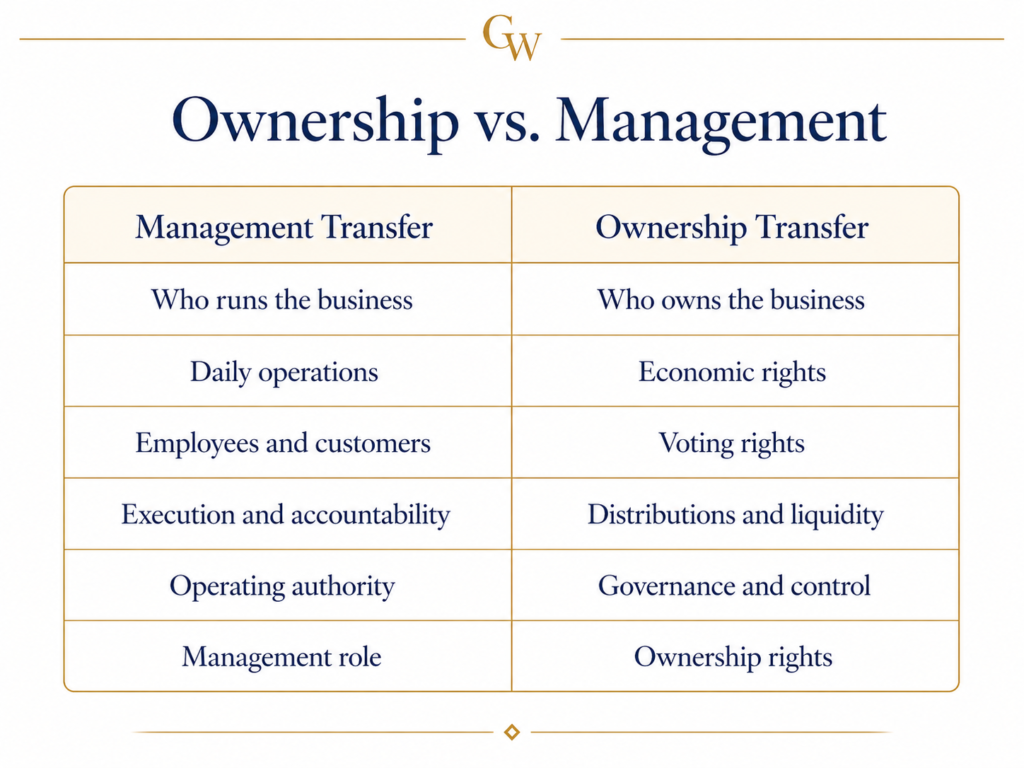
Ownership transfer is not the same as management transfer. This distinction is essential because many business succession plans become fragile when owners confuse management responsibility with ownership rights. A child may manage the business but not own it. A sibling may own shares but not work in the business. A nonfamily executive may run operations while the family retains ownership. A buyer may acquire ownership while the founder remains involved for a temporary transition period. These are different transitions, and each one requires a different structure.
Management transfer moves operating responsibility. Ownership transfer moves economic rights, control rights, voting rights, distribution rights, sale rights, and long-term ownership authority. These two transitions can happen together, but they do not have to. In some businesses, the next manager becomes the next owner. In others, the next manager is a professional executive while ownership remains with the family. In some cases, ownership transfers to children who do not work in the company. In others, ownership transfers to a buyer while management remains in place. CIBC describes business succession planning as determining how business ownership will transfer and how the owner will transition out of a management role, which reinforces that ownership and management are connected but distinct issues.
Confusing these roles creates conflict. A child who manages the business may assume they deserve control because they carry daily responsibility. A sibling who does not work in the business may still expect equal ownership benefits. A nonfamily executive may need authority to lead but may not have ownership rights. A founder may transfer management but continue influencing decisions informally. A buyer may own the business but still rely on the founder’s relationships during transition. Without clarity, succession can lead to resentment, uncertainty, and poor decision-making.
Management Transfer Moves Operating Responsibility
Management transfer concerns who runs the business. It includes responsibility for employees, customers, vendors, operations, sales, service delivery, execution, reporting, hiring, culture, systems, and day-to-day accountability. A management successor must understand how the business works operationally. They must know how revenue is produced, how employees are led, how customer issues are handled, how cash flow is protected, and how decisions are made under pressure.
Management transfer can occur within the family, within the existing leadership team, or through an external executive. A daughter may become president. A long-time general manager may become chief executive. A professional operator may be hired. A management team may buy the company or run it under family ownership. In each case, the central question is whether the person leading operations has the capability, authority, and trust needed to manage the business.
But management responsibility alone does not answer ownership questions. The manager may not control shares. They may not decide on distributions. They may not determine whether the company is sold. They may not have final authority over capital allocation, ownership structure, or major governance decisions. That is why management transfer must be coordinated with ownership transfer. Otherwise, the person responsible for performance may lack the authority required to lead.
Ownership Transfer Moves Economic Rights and Control
Ownership transfer concerns who owns the business and what rights come with that ownership. These rights may include voting control, economic benefit, distributions, sale rights, transfer rights, governance participation, board appointment rights, and authority over major decisions. Ownership may transfer through sale, gift, inheritance, trust structures, family entities, shareholder agreements, buy-sell agreements, holding companies, or internal transactions.
Ownership transfer becomes complex when the people who own the business are not the same people who manage it. A sibling group may inherit equal ownership, but only one sibling works in the company. A founder may transfer voting control to one child while giving economic interests to others. A family may retain ownership but hire a professional CEO. A buyer may purchase the company while retaining the founder as an advisor for a limited period. RBC’s business succession guidance recognizes that one possible transition path is to pass ownership to the next generation while limiting the management role, which reflects the practical difference between owning and operating a business.
The risk appears when ownership rights are unclear or assumed. Who gets distributions? Who can vote? Who approves debt? Who decides whether to sell? Who appoints management? Who can transfer shares? Who represents inactive owners? Who receives information? If these questions are not answered before succession, ownership can become a source of conflict instead of continuity.
Governance Connects Management and Ownership
Governance connects management and ownership by clarifying how the business makes decisions when these roles are separated. Governance defines what management can decide, what owners must approve, how information flows, how performance is reviewed, how family owners participate, and how major decisions are made. This is especially important in family businesses because family members may hold different combinations of roles as owners, employees, directors, beneficiaries, or future heirs. The IFC handbook highlights the complexity created by overlapping family, ownership, management, and board roles in family enterprises.
Without governance, management and ownership can work against each other. Managers may feel responsible but powerless. Owners may feel entitled but uninformed. Family members may confuse inheritance with authority. Employees may not know whose direction matters. Advisors may receive conflicting instructions. Governance prevents these tensions from becoming a constant source of business disruption.
A strong succession plan should clarify the relationship between ownership and management before transition. It should define who leads operations, who owns economic rights, who controls major decisions, how inactive owners receive information, how family members enter the business, how leaders are evaluated, and how disputes are handled. This does not eliminate disagreement, but it gives disagreement a structure.
Confusing These Roles Creates Conflict
Succession becomes fragile when owners confuse management responsibility with ownership rights. The working child may believe daily responsibility should result in greater control. The nonworking sibling may believe equal ownership should create equal influence. The founder may expect the successor to lead but still reserve the right to overrule decisions. The nonfamily executive may be accountable for performance but lack enough authority to execute. A buyer may own the company but still rely on the founder’s informal authority. These conflicts are predictable when roles are not clarified.
The conflict often appears as a personality problem, but the deeper issue is structural. The family did not define ownership. The business did not clarify management authority. The succession plan did not separate economic rights from operating responsibility. The governance system did not explain who decides what. When roles remain vague, every decision can become a test of fairness, loyalty, competence, and control.
A mature business succession plan separates these questions. Who owns? Who manages? Who governs? Who benefits economically? Who has voting control? Who receives information? Who has authority over strategy, hiring, distributions, debt, sales decisions, and reinvestment? When these questions are answered clearly, succession becomes more durable. When they are ignored, the business may transfer legally while remaining operationally fragile.
Ownership Transfer Is Not the Same as Management Transfer
Ownership transfer is not the same as management transfer. This distinction is essential because many business succession plans become fragile when owners confuse management responsibility with ownership rights. A child may manage the business but not own it. A sibling may own shares but not work in the business. A nonfamily executive may run operations while the family retains ownership. A buyer may acquire ownership while the founder remains temporarily involved. These are different transitions, and each one carries different responsibilities, risks, and decision-making requirements.
Management transfer asks who will run the business. Ownership transfer asks who will control, benefit from, govern, sell, retain, or transfer the business. These questions may overlap, but they should not be treated as the same question. A person can manage without owning. A person can own without managing. A person can inherit economic rights without having leadership authority. A person can lead operations while remaining accountable to owners who are not involved in the business day to day. Succession becomes fragile when these roles are assumed instead of clarified.
The core problem is that many owners think succession is solved when someone is chosen to operate the business. But a business can have a capable operator and still face ownership confusion. Who holds voting rights? Who receives distributions? Who decides whether the business should be sold? Who approves major debt? Who appoints or removes leadership? Who communicates with advisors? Who represents inactive owners? Who resolves conflict between family members who work in the business and those who do not? These are ownership and governance questions, not only management questions.
A serious business succession plan must separate management, ownership, governance, and family participation. It must clarify who leads the company, who owns the company, who controls major decisions, who benefits economically, and how owners and managers relate to one another after the transition. Without that clarity, succession can produce confusion even when everyone believes a plan exists.
Management Transfer Moves Operating Responsibility
Management transfer moves operating responsibility. It concerns the person or team responsible for day-to-day leadership, employees, customers, systems, execution, reporting, culture, problem-solving, and accountability. The management successor must understand how the business actually works. They must know how revenue is generated, how customers are retained, how employees are led, how suppliers are managed, how cash flow is protected, and how execution happens under pressure.
This kind of transfer requires more than a title. A successor who manages the business must be prepared to make decisions, solve problems, handle conflict, maintain quality, review performance, manage risk, and lead people who may have been loyal to the founder for years. The successor must also understand the company’s operating rhythm. That includes customer expectations, employee dynamics, supplier dependencies, sales cycles, service standards, reporting habits, and the informal practices that often hold a business together.
Management transfer can happen in several ways. A child may become president. A long-time employee may become general manager. A professional operator may be hired. A management team may take over operations. A buyer may retain existing management after acquisition. In each case, the management transition must answer a practical question: can the business continue to operate well under new leadership?
But management responsibility alone does not equal ownership authority. A successor may manage employees but not control shares. They may lead operations but not decide distributions. They may be accountable for performance but unable to approve major investments. They may carry daily pressure without having control over ownership-level decisions. This is why management transfer must be coordinated with ownership transfer. If not, the person responsible for performance may lack the authority needed to lead effectively.
Ownership Transfer Moves Economic Rights and Control
Ownership transfer involves the transfer of economic rights and control. It concerns shares, membership interests, partnership interests, voting rights, distributions, liquidity rights, sale rights, governance rights, transfer restrictions, and long-term control. Ownership determines who benefits from the business’s value and who has authority over major ownership decisions.
This layer is often where succession becomes most complicated. A founder may want one child to run the company while all children inherit ownership equally. A sibling who does not work in the business may still expect distributions. A working family member may believe they deserve more control because they carry daily responsibility. A nonfamily executive may lead the company but have no ownership rights. A buyer may acquire control while the founder remains involved during a transition period. Each structure can work, but only if the rights, roles, and expectations are clear.
Ownership transfer should answer specific questions. Who owns the company now? Who will own it after transition? Who has voting control? Who receives economic benefit? Who can sell? Who can transfer shares? Who approves major debt? Who decides whether profits are distributed or reinvested? Who appoints leadership? Who receives information? Who participates in governance? Who has authority during conflict?
When these questions are left vague, ownership can become a source of instability. The business may continue operating, but the ownership system may weaken. Family members may disagree over fairness. Managers may feel constrained by inactive owners. Inactive owners may feel excluded from information. Successors may carry responsibility without control. The business may become trapped between those who operate it and those who own it.
A strong succession plan treats ownership transfer as a central issue, not a secondary legal detail. It organizes ownership clearly enough that the business can survive transition without depending on informal assumptions.
Governance Connects Management and Ownership
Governance connects management and ownership. It clarifies how decisions are made when the people who run the business are not always the same people who own it. This becomes especially important in family business succession because family members may hold different roles at the same time. One person may be an employee, owner, sibling, child, director, beneficiary, or future heir. Those roles can overlap, but they should not be confused.
Governance explains what management can decide, what owners must approve, how information flows, how performance is reviewed, how distributions are determined, how family members participate, and how conflict is handled. It protects the business from becoming dependent on informal authority. It also protects relationships by giving people a structure for disagreement.
Without governance, owners and managers can work against each other unintentionally. Managers may feel responsible for results but blocked by owners who do not understand operations. Owners may feel economically exposed but excluded from information. Family members may confuse inheritance with authority. Employees may not know whose direction matters. Advisors may receive conflicting instructions. The successor may be asked to lead but remain trapped between founder influence, family expectations, and unclear ownership rights.
A governed succession plan creates clarity. It defines who leads the business, who owns the business, who appoints leadership, who reviews performance, who receives financial reports, who approves major decisions, and how inactive owners remain informed. This connects directly to What Is Family Governance? The Missing Layer in Most Wealth Plans, because family governance provides the decision-making system that helps ownership remain coordinated during and after transition.
Governance does not eliminate disagreement. It gives disagreement a place to go. That is what makes it essential during succession.
Confusing These Roles Creates Conflict
Confusing ownership and management creates conflict because people begin to attach different meanings to the same business. The working child may see the company as an operating responsibility. The nonworking sibling may see it as an inherited asset. The founder may see it as a life’s work. The successor may see it as a leadership assignment. The spouse may see it as a matter of family security. Employees may see it as their livelihood. Advisors may see it through legal, financial, or tax structures. All of these perspectives can matter, but without governance, they can collide.
Family members who own but do not manage may want distributions, liquidity, information, and influence. Managers who lead but do not own may want authority, compensation, trust, and freedom to execute. Successors who operate without authority may become frustrated because they carry responsibility without control. Founders who transfer management but not authority may unintentionally weaken the next leader. Buyers who acquire ownership while relying on the founder may struggle to establish independence. Each of these tensions comes from unclear role separation.
The conflict often appears personal. A sibling is accused of being selfish. A successor is accused of being unprepared. A founder is accused of refusing to let go. An inactive owner is accused of not understanding the business. A manager is accused of overstepping. But beneath the personal tension is usually a structural problem. The business did not clearly separate ownership rights, management responsibility, governance authority, and family expectations.
A mature business succession plan names these distinctions before transition. Who owns? Who manages? Who governs? Who benefits economically? Who has voting control? Who receives information? Who can approve major decisions? Who can enter the business? Who can exit ownership? Who resolves disputes? These questions may be uncomfortable, but avoiding them creates greater risk.
Succession becomes durable when management responsibility and ownership rights are both clear. It becomes fragile when families assume everyone understands the difference.
Family Business Succession Creates Unique Governance Challenges
Family business succession creates unique governance challenges because it is never only technical. It is emotional, relational, financial, and structural all at once. A family business is not just an operating company. It may also be a family asset, a source of identity and income, a legacy vehicle, an employer for relatives, a retirement plan for the founder, and a future inheritance for children or siblings. That complexity makes family business succession planning different from ordinary leadership transition.
The family must address fairness, competence, compensation, ownership, leadership, authority, and future participation. These issues cannot be solved by sentiment alone. They also cannot be solved by legal documents alone. A parent may want to be fair to all children, but the business may require unequal roles. A working child may deserve compensation for labor, but that does not automatically determine ownership. A nonworking child may inherit shares, but that does not mean they should make operating decisions. A founder may want continuity, but continuity requires governance.
The core problem in family business succession is not simply choosing a successor. The deeper problem is whether the family is willing to answer the governance questions underneath the business transition. Who should lead? Who should own? Who should work in the business? Who should receive economic benefit? Who has authority? Who is accountable? How should family members communicate? How should conflict be handled? How should the business balance reinvestment, distributions, compensation, and liquidity?
Family business succession fails when the family avoids these questions. Avoidance may preserve temporary peace, but it creates long-term fragility. The business may move into the next generation with unresolved expectations. Siblings may discover too late that they assumed different outcomes. Working and nonworking family members may begin to resent one another. The successor may struggle to lead because family authority remains unclear. Advisors may be asked to implement technical plans without a coordinated family direction.
A family business succession plan must therefore do more than identify the next leader. It must create a governance structure that helps the family make decisions before, during, and after the transition. This includes clarity around ownership roles, employment rules, leadership selection, compensation, distributions, board or advisor oversight, communication, conflict resolution, and future participation.
Family business succession is not only about preserving the company. It is also about preserving the family’s ability to own together without allowing the business to become a source of permanent conflict.
Equal Ownership May Not Mean Equal Responsibility
Equal ownership may feel fair inside a family, but it does not always reflect equal responsibility inside a business. A parent may want to treat children equally. Siblings may expect equal inheritance. Family branches may want equal economic participation. But the business may not be carried equally by everyone. One child may work in the company every day. Another may have no operating role. One sibling may carry leadership pressure, employee decisions, customer relationships, and financial accountability. Another may hold shares but remain entirely outside the business.
This distinction can become one of the most sensitive issues in family business succession planning. Equal ownership can create unity when roles are clear, but it can create conflict when responsibilities are unequal and expectations are unspoken. A working family member may believe that daily contribution should result in more authority, more compensation, or greater control. A nonworking owner may believe that equal ownership should result in equal voice, equal distributions, and equal access to information. Both perspectives may seem reasonable from their respective positions. The problem begins when the family has not clarified how ownership, labor, authority, compensation, and governance relate to one another.
Family branches can make this even more complex. In the first generation, ownership may be concentrated in one founder. In the second generation, ownership may spread among siblings. In the third generation, ownership may spread across cousins, spouses, trusts, family entities, and inactive owners. As ownership spreads, responsibility often becomes uneven. Some family members may remain close to the business. Others may only inherit economic interests. Without governance, the business can become trapped between those who carry responsibility and those who hold ownership rights.
Equal ownership is not automatically wrong. Unequal ownership is not automatically better. The real issue is whether the family has built a clear system for responsibility, authority, compensation, voting rights, distributions, communication, and long-term decision-making. In family business succession, fairness cannot be reduced to equal shares alone. Fairness must also consider contribution, competence, accountability, risk, and the future needs of the business.
Working Family Members and Nonworking Owners Need Clarity
Working family members and nonworking owners need clarity because employment, ownership, governance, and inheritance are not the same thing. A family member may work in the business and receive salary without owning shares. Another may own shares and receive distributions without working in the company. Another may serve on a board or family council without being involved in daily operations. Another may inherit an economic interest through a trust without having direct management authority. These roles can overlap, but they should not be confused.
Employment means a person has a role in the business and should be evaluated based on performance, responsibility, competence, and compensation standards. Ownership means a person holds economic or control rights in the business. Governance means a person participates in decision-making structures, oversight, voting, board service, family council input, or ownership-level decisions. Inheritance means a person may receive ownership or economic value through family transfer. Each role carries different rights and responsibilities.
When families confuse these roles, succession becomes unstable. A working family member may believe employment gives them ownership authority. A nonworking owner may believe ownership gives them operational influence. A future heir may assume inheritance guarantees leadership. A founder may avoid clarifying the difference because the conversation feels uncomfortable. Over time, those assumptions become conflict.
A serious family business succession plan must define these roles before transition. Who can work in the business? What qualifications are required? How are family employees compensated? Who owns shares? Who votes? Who receives distributions? Who participates in governance? Who has access to financial information? Who can become a future leader? Who can represent the family to advisors? These questions protect the business from confusion and protect the family from resentment.
The strongest family businesses do not rely on vague expectations. They define the difference between being a family member, an employee, an owner, a leader, a beneficiary, and a governor of the enterprise. That clarity allows the business to operate with discipline while still honoring the family’s long-term ownership.
Compensation and Distributions Must Be Separated
Compensation and distributions must be separated because they serve different purposes. Compensation is payment for work performed in the business. Distributions or dividends are returns connected to ownership. Profit distributions may reflect ownership rights, available cash, tax planning, reinvestment needs, or shareholder agreements. Salary should not be used as a disguised inheritance. Distributions should not be used as a substitute for fair compensation. When families mix these categories, conflict becomes predictable.
A working family member may be eligible for salary, bonuses, benefits, or incentive compensation based on their role, performance, and market value. A nonworking owner may receive distributions if ownership agreements and business performance support them. Those two forms of economic benefit should be discussed separately. If they are not, the family may begin comparing unlike things. A sibling working full-time in the business may appear to receive more because they are paid a salary. A nonworking sibling may feel excluded if they do not understand the difference between employment income and ownership return. The working sibling may feel burdened if inactive owners expect distributions without understanding business needs.
Reinvestment adds another layer. A business may need to retain earnings for growth, debt reduction, equipment, hiring, acquisitions, technology, or working capital. Owners may want distributions, but the business may need capital. This tension is not only financial. It is governance-related. Who decides how much profit is distributed? Who decides how much is reinvested? Are distributions expected every year? Do working owners and nonworking owners understand the company’s capital needs? What happens when family members need liquidity but the business needs retention?
Fairness in family business succession requires clearly separating these categories. Compensation should reflect work. Distributions should reflect ownership and available business capacity. Reinvestment should reflect the long-term health of the business. Governance should provide the process for balancing these interests. Without that separation, family members may experience normal business decisions as personal favoritism, neglect, or unfairness.
Family Relationships Can Complicate Business Decisions
Family relationships can complicate business decisions because the business carries emotional meaning beyond its financial value. A leadership decision may feel like a judgment about worth. A compensation decision may feel like a statement about love or respect. A distribution decision may feel like fairness or exclusion. A succession decision may reopen old sibling dynamics, parental expectations, birth-order assumptions, or unresolved disappointments. This is why family business succession is not only technical. It is emotional, relational, financial, and structural at the same time.
Unresolved family dynamics can affect business continuity. A founder may delay succession because they do not want to disappoint one child. Siblings may avoid honest conversations because they fear conflict. A working family member may feel unsupported. A nonworking owner may feel ignored. A spouse may influence expectations from outside the business. Cousins may inherit ownership without shared history or trust. These dynamics can quietly shape decisions about leadership, ownership, compensation, distributions, sale, reinvestment, and future participation.
The business may suffer when family issues remain unnamed. Decisions may be delayed. Strong successors may not receive authority. Weak successors may be protected. Employees may sense uncertainty. Advisors may receive mixed direction. Customers may wonder who truly leads. Over time, the business can become less stable because the family has not created a governance process for handling tension.
Governance does not remove emotion from family business succession. It gives emotion a structure. It allows the family to discuss difficult issues with clearer roles, defined processes, and agreed decision rights. That matters because family relationships will always influence family enterprise. The goal is not to pretend the family is separate from the business. The goal is to ensure the family’s unresolved dynamics do not quietly weaken the business.
The Board and Governance Role in Succession
The board and governance role in succession should be understood as a discipline layer, not as bureaucracy. Succession becomes stronger when there is oversight beyond founder preference and family emotion. A founder may have deep wisdom, but the founder may also have blind spots. Family members may care deeply about the business, but family emotions can make difficult decisions harder. Successors may need support, but they also need accountability. Boards, advisory boards, ownership councils, family councils, and governance bodies can help prepare the business for transition with more structure.
This does not mean every business needs a formal corporate board immediately. The governance structure should match the size, complexity, ownership stage, and risk level of the business. A smaller founder-led company may begin with an advisory board. A larger family enterprise may need a formal board with independent directors. A family-owned company may need both a business board and a family governance structure. A business with multiple owners may need shareholder agreements, voting processes, reporting expectations, and advisor coordination.
The core argument is simple. Succession should not depend entirely on one founder’s private decision or one family’s emotional negotiation. Transition requires disciplined oversight. Someone must ask whether the successor is prepared, whether the business can operate without the founder, whether ownership roles are clear, whether family expectations are aligned, whether management depth exists, whether key relationships have been transitioned, and whether the business has a realistic timeline for change.
Boards and governance bodies help owners move succession from intention to execution. They create accountability. They help define authority. They help evaluate readiness. They help separate business needs from family preference. They help advisors work from a coordinated direction. Most importantly, they help the business become less dependent on informal founder control.
Boards Help Separate Oversight From Family Dynamics
Boards help separate oversight from family dynamics by creating a structured place for strategy, risk, accountability, leadership evaluation, and succession planning. In a family business, important decisions can become emotionally charged because business roles and family relationships overlap. A board can help move the conversation from personal preference to enterprise responsibility.
A board does not replace ownership. It supports ownership by asking disciplined questions. Is the successor ready? Is the leadership team strong enough? Is the company too dependent on the founder? Are financial reports clear? Are risks being reviewed? Is management accountable? Is the succession timeline realistic? Are family members confusing ownership rights with operating authority? These questions are easier to ask inside a governance structure than inside an informal family conversation.
For family businesses, board oversight can also protect the successor. A successor who reports only to the founder may struggle to establish independent authority. A successor who operates within a clear board or governance framework has a stronger leadership structure. The board can provide guidance, feedback, accountability, and legitimacy during transition.
The goal is not to make the business feel corporate for its own sake. The goal is to make the business less dependent on emotion, assumption, and informal control when succession pressure rises.
Advisory Boards Can Support Earlier Stage Businesses
Advisory boards can support earlier-stage businesses that are not ready for a formal board. Many founder-led businesses need an outside perspective before they need formal governance. An advisory board can include experienced operators, industry experts, financial professionals, legal advisors, succession specialists, or trusted strategic voices who help the owner think more clearly about transition.
An advisory board can help identify founder dependence, evaluate successor readiness, review financial performance, discuss business value, examine operational risk, and prepare the owner for transition. It can also help the successor gain exposure to outside accountability before full leadership transfer. This is especially useful when the business has grown beyond the founder’s personal capacity but has not yet built formal governance.
The advisory board’s role should be clear. It does not usually hold legal control unless specifically structured that way. Its value comes from a disciplined perspective. It can ask questions that the family avoids. It can challenge assumptions. It can help the founder separate emotional attachment from business continuity. It can help the successor prepare for leadership without leaving them alone in the transition.
For many businesses, an advisory board serves as a bridge between founder control and more mature governance.
Governance Bodies Help Prepare Transition
Governance bodies help prepare the transition by creating repeatable decision-making structures before the founder exits. These bodies may include a board of directors, an advisory board, a family council, an ownership council, an investment committee, a trustee group, a management committee, or a shareholder group. The structure depends on the business, but the purpose is consistent: to clarify decision-making before transition creates pressure.
A governance body can help define who participates in succession discussions, who receives information, how leadership readiness is evaluated, how ownership decisions are made, how inactive owners are informed, how family members enter the business, how conflict is addressed, and how advisors are coordinated. These questions should not be answered casually during a crisis. They should be addressed before the transition begins.
Governance bodies also help transfer authority gradually. Instead of the founder making every major decision privately, decisions can begin moving into a structure. The successor can participate. Other owners can be informed. Advisors can provide input. Family members can understand the process. Over time, the business becomes less dependent on one person’s judgment and more capable of operating through a coordinated system.
This is the practical value of governance in succession. It turns the transition from a personal handoff into an organized process.
Outside Advisors Need Clear Direction
Outside advisors can support succession, but they need clear direction from the ownership system. Attorneys can draft agreements. CPAs can advise on tax implications. Bankers can assess financing. Wealth advisors can help with liquidity and personal financial planning. Consultants can support operational transition. Valuation professionals can assess business value. But advisors cannot replace governance. They can only support the direction the owner, family, and business have clarified.
Without governance, advisors may receive conflicting instructions. The founder may want one outcome. A working child may want another. Nonworking owners may expect liquidity. A spouse may want security. A successor may want reinvestment. A buyer may want control. Each advisor may be technically competent, but the overall succession plan may remain fragmented because the ownership direction is unclear.
Clear governance gives advisors a coordinated mandate. It tells them what the family is trying to preserve, what the business needs, who has authority, how decisions are made, what timeline matters, and what risks must be addressed. That does not remove the need for professional advice. It makes professional advice more useful.
Succession becomes stronger when advisors are not asked to compensate for unclear ownership. Advisors can guide the legal, tax, financial, valuation, and operational aspects of transition, but the family and ownership group must still answer the deeper governance questions. Who owns? Who leads? Who decides? Who benefits? Who carries responsibility after the founder steps away?
Boards Help Separate Oversight From Family Dynamics
Boards help separate oversight from family dynamics by creating a structured place for strategy, risk, accountability, compensation, leadership readiness, and succession. In a family business, these issues can become emotionally charged because business roles and family relationships often overlap. A leadership decision may feel like a family judgment. A compensation decision may feel like favoritism. A succession decision may reopen questions of birth order, competence, sacrifice, loyalty, or parental approval. A board helps move these decisions into a more disciplined setting.
The role of the board is not to replace the family or remove ownership authority. The role is to help the business make better decisions. A board can ask whether the company’s strategy is clear, whether risks are being reviewed, whether management is accountable, whether compensation is aligned with role and performance, whether the successor is truly prepared, and whether the business can operate without the founder. These questions are especially important during succession because transition can expose weaknesses that were hidden while the founder remained active.
A board can also help distinguish between family preference and business need. A founder may prefer a child as successor, but the board can help assess whether that child is ready. A family may want equal treatment, but the board can help clarify whether equal ownership, equal compensation, and equal authority are appropriate for the business. A successor may seek control, but the board can help determine whether authority should be transferred gradually. These are not only emotional questions. They are governance questions.
During succession, the board becomes a stabilizing structure. It gives the successor a place to receive feedback. It gives the founder a place to transfer authority without immediately abandoning oversight. It gives nonworking owners confidence that the business is being managed responsibly. It gives employees, lenders, customers, and advisors greater confidence that the transition is not dependent only on private family conversations.
A strong board does not eliminate family complexity. It gives the business a way to make important decisions without letting family emotions control every decision.
Advisory Boards Can Support Earlier Stage Businesses
Advisory boards can support earlier-stage businesses that are not ready for a formal board. Many founder-led and family-owned businesses need an outside perspective before they need formal governance. An advisory board can provide experience, discipline, and strategic challenge without immediately creating a full corporate board structure. For many owners, this is a practical bridge between founder control and more mature governance.
An advisory board may include experienced operators, retired executives, industry experts, financial professionals, succession advisors, legal advisors, accountants, bankers, or trusted strategic voices. Its purpose is not to run the business. Its purpose is to help the owner and leadership team think clearly about risk, growth, transition, successor readiness, management depth, ownership structure, and business value. This can be especially useful when the founder has been making decisions alone for years.
Founder-led businesses often suffer from top-level isolation. The owner may be surrounded by employees who depend on them, family members with emotional stakes, and advisors brought in only for specific technical issues. An advisory board gives the owner a more serious sounding board. It can ask the questions the family avoids. It can challenge assumptions. It can help the founder see where the business remains too dependent on them. It can help the successor develop confidence in the face of outside observation.
Advisory boards can also help prepare the business for future transitions. They can encourage documentation, leadership development, financial reporting, customer relationship transfer, and successor exposure. They can help the owner move from informal control toward a more transferable business model. This is why advisory boards are often valuable before the owner believes a formal board is necessary.
The key is clarity. An advisory board should have a defined role, meeting rhythm, information flow, and purpose. Otherwise, it becomes symbolic. A useful advisory board helps the business prepare for succession with discipline.
Governance Bodies Help Prepare Transition
Governance bodies help prepare for transition by creating repeatable decision-making structures before succession pressure arrives. These bodies may include boards of directors, advisory boards, family councils, ownership groups, trustee groups, management committees, investment committees, or advisor teams. The structure depends on the business’s size, complexity, ownership stage, and risk level. The purpose is the same: to help the business and ownership group make decisions without relying entirely on the founder.
Family councils can help the family discuss expectations, education, communication, employment policies, ownership participation, and next-generation preparation. Ownership groups can clarify voting rights, distributions, liquidity expectations, information rights, and major ownership decisions. Boards can oversee strategy, leadership, risk, compensation, and business performance. Trustees can protect trust-owned interests and fulfill their responsibilities in accordance with the governing documents. Advisory teams can help coordinate legal, tax, financial, valuation, and operational issues.
These structures matter because succession occurs not only within the company. It happens across the ownership system. The business may need new leadership. The family may need new communication habits. The ownership group may need decision rules. Advisors may need direction. Trustees may need clarity. Inactive owners may need information. Working family members may need role definitions. Governance bodies create the channels through which these issues can be addressed before transition becomes a crisis.
A founder may be tempted to delay governance because it feels formal, slow, or unnecessary. But delay can make the transition more fragile. If the business has never used a board, family council, ownership group, or advisor team before succession, it may be difficult to build those systems under pressure. Governance works best when it is practiced before it is urgently needed.
The practical value of governance bodies is that they make transitions less dependent on one person’s memory, authority, and private preferences. They help move the business from personal control to institutional continuity.
Outside Advisors Need Clear Direction
Outside advisors can support succession, but they need clear direction from the ownership system. Attorneys can draft shareholder agreements, operating agreements, buy-sell provisions, trusts, estate documents, and transaction documents. CPAs can advise on taxes, valuation, cash flow, and entity structure. Bankers can assess financing and lender expectations. Consultants can support operational readiness and leadership transition. Wealth advisors can help owners plan liquidity, retirement income, estate coordination, and family wealth continuity.
But outside advisors cannot replace governance. They can only support the direction the owner, family, and ownership group have clarified. If the founder wants one outcome, the successor wants another, inactive owners expect liquidity, working family members want reinvestment, and the family has no governance process, advisors may receive conflicting instructions. Each advisor may be technically competent, but the overall succession plan may remain fragmented because the ownership direction is unclear.
This is a common weakness in business succession planning. The attorney may prepare documents. The CPA may discuss tax strategy. The banker may evaluate financing. The consultant may discuss operations. The wealth advisor may discuss the founder’s financial future. But if those advisors are not working from a coordinated ownership direction, the plan can become a collection of technical pieces rather than a true succession system.
Clear governance gives advisors a mandate. It tells them who has authority, what the family is trying to preserve, whether the business is intended for sale or continuity, how ownership should transfer, what liquidity is needed, what roles family members will play, and what decisions require approval. This makes professional advice more useful because the technical work supports the continuity goal.
The deeper point is simple. Advisors can help structure succession, but they cannot decide what the family refuses to clarify. They need coordinated ownership direction. Without it, succession advice can become technically correct but strategically fragmented.
Succession Planning and Business Value
Succession planning directly affects business value. This is where the issue becomes deeply practical for owners. Poor succession planning can reduce a business’s value because buyers, lenders, investors, employees, customers, and successors all care about transferability. A business that depends too heavily on the owner is harder to sell, transfer, finance, and continue.
A transferable business is usually more valuable than a founder-dependent business. This does not mean every transferable business will receive a higher valuation in every situation. It means that transferability reduces perceived risk. If the business can operate without the founder, maintain customer relationships, retain employees, produce reliable financial information, follow documented systems, and function through a capable leadership team, it becomes easier for others to trust its future. If the business depends on one person’s relationships, memory, judgment, and daily control, the value may be less durable than the financial statements suggest.
This is why succession planning should not be treated as something separate from value creation. Succession planning is part of building a stronger business. It strengthens management depth. It clarifies ownership. It documents systems. It protects customer continuity. It improves governance. It prepares leadership. It reduces uncertainty. These are not only succession benefits. They are valuable benefits.
A business owner may believe the company is valuable because revenue, profit, assets, contracts, or market position are strong. Those things matter. But a potential buyer or successor will ask another question: Can this business continue after the current owner leaves? If the answer is uncertain, the business may be worth less, harder to finance, or harder to transfer than the owner expects.
Buyers Evaluate Transferability
Buyers evaluate transferability because they are not only buying what the business has done. They are buying what the business can continue to do after ownership changes. A buyer wants to know whether customers will stay, whether employees will remain, whether processes are documented, whether financials are reliable, whether management can lead, and whether the founder’s exit will weaken performance.
Founder dependence creates buyer concern. If most customer relationships are personally held by the founder, the buyer may worry that revenue will decline after closing. If pricing logic exists only in the founder’s head, the buyer may worry about margins. If employees are loyal only to the founder, the buyer may worry about retention. If the business lacks documented systems, the buyer may worry about operational continuity. If the founder is still the primary problem-solver, the buyer may wonder exactly what is transferable.
A strong succession plan improves buyer confidence by showing that the business is not merely an extension of the owner. It has systems, leadership, reporting, customer continuity, governance, and operating discipline. Even if the owner does not plan to sell soon, building transferability increases strategic options. The business can be sold more confidently, transferred to family more responsibly, or operated by management with less disruption.
Transferability does not happen automatically. It is built through preparation.
Employees Need Confidence
Employees need confidence during succession because a business transition affects their livelihood, roles, reporting relationships, and sense of stability. When the founder is the center of authority, employees may feel uncertain when leadership begins to change. They may wonder who truly decides, whether the company will be sold, whether their jobs are secure, whether the culture will change, and whether the successor has real authority.
Employee uncertainty can weaken business value. Strong employees may leave if they believe the transition is unclear. Managers may hesitate to make decisions. Teams may wait for the founder rather than follow the successor. Informal leaders may resist change. This can create operational drag precisely when the business needs stability.
A clear succession plan gives employees confidence. It explains the leadership transition, clarifies authority, protects communication, and helps employees understand the business’s future direction. It also allows the successor to earn trust before full control moves. Employees do not need to know every ownership detail, but they do need enough clarity to believe the business has a future beyond the founder.
Leadership transition is not only a family issue or ownership issue. It is also an employee stability issue. The people inside the business must believe the company can continue.
Customers Need Stability
Customers need stability during succession because they often judge a business by trust, consistency, service quality, and relationship continuity. If customers are strongly attached to the founder, a transition can pose a risk. They may wonder whether the next leader understands their needs, whether service will remain reliable, whether pricing will change, whether quality will decline, or whether the business will still value the relationship.
Customer confidence is especially important in service businesses, professional firms, relationship-driven companies, and local or founder-branded businesses. In these companies, the founder may be a major part of the customer relationship. If that relationship is not transitioned intentionally, revenue can become vulnerable when the founder exits.
A strong succession plan prepares customers before the transition becomes abrupt. The founder can introduce the successor to meetings, allow the next leader to handle communication, create shared touchpoints, and gradually shift trust from the founder personally to the business as an institution. Customers should experience continuity before the founder steps away.
Customer stability protects business value. If customers believe the company remains reliable, the business becomes more transferable. If customers hesitate, delay purchases, test competitors, or lose confidence after the transition, value can decline quickly. Succession planning should therefore treat customer trust as an asset that must be transferred.
Lenders and Investors Need Continuity
Lenders and investors need continuity because they evaluate risk. They want to know whether the business can maintain cash flow, repay debt, manage operations, retain leadership, protect customers, and make disciplined decisions after the founder exits. If the company is heavily dependent on one person, lenders and investors may view the business as more fragile.
Lender confidence matters during succession because financing often plays a role in the transfer of ownership. A successor may need financing to buy shares. The business may need capital for growth, working capital, or transition costs. The founder may need liquidity. A buyer may need acquisition financing. If lenders doubt management depth or continuity, succession becomes harder.
Investors also evaluate whether the business has governance, leadership depth, clean reporting, and a credible transition plan. They are not only evaluating past profit. They are evaluating future durability. A business with weak succession planning may appear profitable but still carry hidden transition risk.
This is why business succession planning should strengthen financial reporting, governance, management depth, customer continuity, and authority transfer before financing is needed. A business that can demonstrate continuity is easier to trust. A business that depends too heavily on the founder is harder to finance and harder to value.
Transferability Is a Form of Ownership Strength
Transferability is a form of ownership strength because it demonstrates that the business is not dependent on a single person’s permanent control. A mature business can continue through leadership or ownership changes, family transitions, sales, management transfers, or generational transfers. It may still face difficulty, but it has enough structure to survive the change.
This is one of the clearest differences between a business that generates income and a business that has become a durable ownership interest. A founder-dependent business may generate high income while the founder is active. A transferable business can continue producing value after the founder steps away. That difference matters for generational wealth because ownership only becomes durable when it can survive transition.
Succession planning and business value are therefore connected. The more transferable the business becomes, the stronger its ownership base becomes. The business is less fragile. The founder has more options. The successor has a clearer path. Buyers have more confidence. Lenders see less risk. Employees feel more stable. Customers experience less disruption.
A transferable business is usually more valuable than a founder-dependent business because it carries continuity, not just performance. That is what serious succession planning is meant to build.
Buyers Evaluate Transferability
Buyers evaluate transferability because they are not only buying what the business has done. They are buying what the business can continue to do after ownership changes. A buyer wants to know whether the company can operate without the current owner, whether revenue will remain stable, whether customers will stay, whether employees will continue, whether financial reporting is reliable, whether systems are documented, and whether management can lead without the founder’s constant involvement.
This is why founder dependence can reduce buyer confidence. A business may show strong revenue and profit, but if most of its value depends on the founder’s personal relationships, judgment, memory, and day-to-day control, a buyer may see hidden risks. If customers are loyal to the founder rather than the company, revenue may be vulnerable. If employees wait for the founder before acting, management depth may be weak. If pricing logic is undocumented, margins may be harder to protect. If systems are informal, the buyer may question whether the business can operate cleanly after closing. BDC’s succession planning guidance emphasizes that successors need time to learn the business and build relationships with customers, employees, and suppliers, which reinforces the importance of transferability before ownership changes.
Transferability is therefore a value issue, not only a succession issue. The more the business can operate without the owner, the easier it is for a buyer to trust future performance. A transferable business has management depth, documented processes, stable customer relationships, clear financial reporting, governance discipline, and operating systems that do not depend entirely on one person. A founder-dependent business may still be profitable, but its value may be more fragile than the owner realizes.
Employees Need Confidence
Employees need confidence during succession because the transition affects their work, leadership relationships, career security, and trust in the company’s future. When employees do not understand what is happening, uncertainty spreads quickly. They may wonder who truly leads, whether the business will be sold, whether their jobs are safe, whether the company’s culture will change, whether the successor has real authority, or whether the founder is still the final decision-maker behind the scenes.
Employee uncertainty can weaken the business during the exact period when stability matters most. Strong employees may leave if they believe the transition is poorly planned. Managers may hesitate to make decisions. Teams may become divided between loyalty to the founder and uncertainty about the successor. Employees may continue to escalate decisions to the founder rather than follow the next leader. This creates operational drag and can make the successor appear weaker than they actually are.
A strong business succession plan gives employees enough clarity to trust the transition. They do not need every ownership detail, but they do need a credible sense of direction. Who leads? What changes? What remains stable? What authority does the successor have? What should employees expect? Scotiabank describes succession planning as a process that helps protect the owner’s investment, support future stability, satisfy stakeholders such as family members, employees, and partners, select a successor, and set a timetable for ownership transfer.
Employee confidence is part of business value because people carry out execution. The best succession plan on paper can still fail if the company loses key employees, informal leaders, managers, or technical talent during transition. Employees need to believe that the business has a future beyond the founder. That confidence must be built before the owner exits.
Customers Need Stability
Customers need stability during succession because they often judge a business by trust, consistency, service quality, relationship continuity, and confidence in leadership. If customers are strongly attached to the founder, the transition can create risk. They may wonder whether the next leader understands their needs, whether service will remain reliable, whether quality will decline, whether pricing will change, or whether the business will still value the relationship.
This is especially important in relationship-driven businesses, professional services firms, local businesses, family enterprises, contractor businesses, consulting firms, medical practices, advisory firms, and founder-branded companies. In these businesses, the founder may be a major part of the customer relationship. If that relationship is not transferred intentionally, revenue can become vulnerable when the founder exits.
Customer retention requires relationship transfer. The successor should not be introduced only after the founder leaves. Customers should see the next leader before the transition becomes final. They should experience the successor’s competence, judgment, responsiveness, and authority while the founder is still available to reinforce confidence. BDC notes that successors need time to build relationships with customers, employees, and suppliers, which is why the transition should be prepared before the owner steps away.
Customer stability protects business value because customers are often the foundation of revenue. If customers lose confidence, the business can weaken quickly. If customers remain confident, the transition becomes more credible to buyers, lenders, employees, and successors. Succession planning should therefore treat customer trust as an asset that must be transferred rather than assumed.
Lenders and Investors Need Continuity
Lenders and investors need continuity because they evaluate risk. They want to know whether the business can maintain cash flow, repay debt, retain customers, keep employees, manage operations, produce reliable reporting, and make disciplined decisions after the founder exits. If too much of the company’s stability depends on one owner, lenders and investors may view the business as more fragile.
Lender confidence matters because financing often plays a role in succession. A successor may need financing to buy shares. The business may need working capital during the transition. The founder may need liquidity. A buyer may require acquisition financing. A management team may need support for a buyout. In each case, lenders need confidence that the business can continue to operate and generate cash flow after the transfer. RBC notes that business succession can be complex because family dynamics, tax and legal considerations, business realities, goals, and financial risks are often tightly connected.
Investors also evaluate continuity. They are not only looking at historical profit. They are assessing whether the business has governance, management depth, clean reporting, documented systems, customer stability, and operating discipline. A company with weak reporting, unclear authority, and heavy dependence on the founder may appear profitable yet still carry hidden transition risk.
This is why succession planning should strengthen the business before financing or sale becomes urgent. Reliable reporting, governance structures, operating systems, management depth, and clear authority all increase confidence. A business that can demonstrate continuity is easier to trust. A business that depends too heavily on its founder is harder to finance, value, and transfer.
The Exit Planning Problem
Exit planning must be handled carefully because not all succession is family transfer. Some owners sell to outsiders. Some sell to employees. Some transfer to management teams. Some sell to private buyers, strategic buyers, private equity firms, competitors, or investors. Some transfer ownership to family while stepping out of management. Some retain ownership while hiring professional management. Each path is different, but each path still requires succession thinking.
A sale is also a form of succession because ownership, control, and responsibility still transfer. The buyer may not be a child. The buyer may not be a family member. The buyer may not preserve the founder’s exact culture or operating style. But the same core question remains: can the business survive the transfer of ownership and control? CFIB identifies three common exit options: passing the business to a family member, transferring ownership through a management buyout or employee buy-in, or selling to a third party.
This is where many owners misunderstand exit planning. They assume that selling the business avoids the hard work of succession. In reality, a sale intensifies the need for succession readiness. Buyers will evaluate whether the business can operate without the owner. Employees will watch for stability. Customers will judge whether the company remains reliable. Lenders will assess continuity. Advisors will need clear information. If the business is not transferable, the sale may become harder, slower, less valuable, or less likely to close.
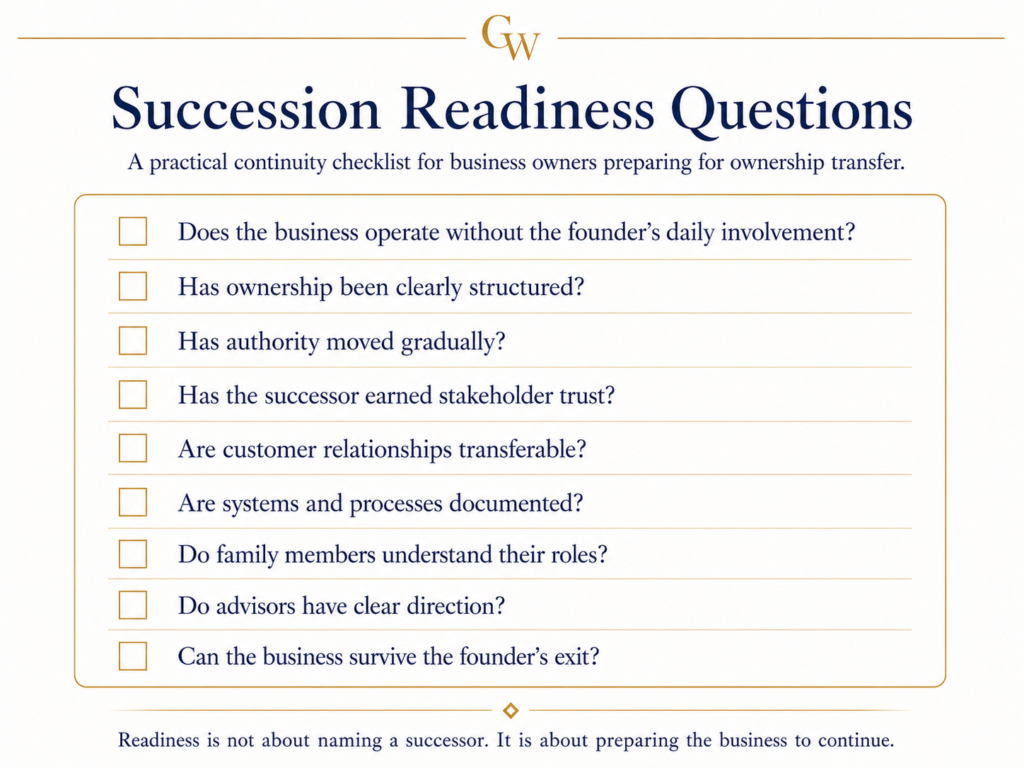
Exit planning without transfer readiness is weak. The owner may want to sell, but the business may not be ready for a buyer. The owner may want maximum value, but the company may still depend too heavily on their personal relationships. The owner may want a clean exit, but the buyer may require a transition period because the business cannot yet stand on its own. BDC’s business transition planning materials describe main transition options as transferring to family, selling to insiders such as managers or employees, or selling to an outside buyer, and note that the chosen option affects the owner’s post-transition goals and role in the company.
The practical lesson is clear. Exit planning and succession planning should not be separated. Exit planning asks how the owner will leave. Succession planning asks how the business will continue. A strong plan must answer both questions. The owner’s exit is successful only if the business, ownership structure, successor, buyer, family, employees, customers, and advisors can navigate the transition without destroying value.
Sales is also a Form of Succession
A sale is also a form of succession because someone still inherits ownership responsibility. The buyer may be a strategic acquirer, a private buyer, an investor group, a management team, an employee group, a competitor, or a family member. But in every case, the business is moving from one ownership system to another. Control changes. Decision-making changes. Risk changes. Accountability changes. The founder’s role changes. That is succession.
When owners think of sale only as an exit, they may underprepare the business for transfer. They may focus on valuation, price, tax planning, and deal terms while overlooking operating continuity, management depth, customer retention, employee communication, and founder dependence. Those issues affect both the buyer’s trust in the business and the business’s stability after the transaction. A sale may provide liquidity for the owner, but the business must still survive an ownership change.
This matters because sales do not erase responsibility. It changes where responsibility goes. If a buyer acquires a business that is too dependent on the founder, the buyer may require the founder to stay longer, reduce valuation, include earnout terms, negotiate stronger protections, or walk away. If the business has management depth, documented systems, transferable relationships, and clean reporting, the sale becomes more credible.
A sale is not the opposite of succession. It is one possible succession path.
Exit Planning Without Transfer Readiness Is Weak
Exit planning without transfer readiness is weak because a business must be prepared to operate beyond the owner. An owner may decide they are ready to step away, but the business may not be ready to continue without them. That gap can reduce value, create buyer hesitation, delay transactions, weaken employee confidence, and place pressure on the owner to remain involved longer than expected.
Transfer readiness includes management depth, financial clarity, customer continuity, documented systems, governance, employee stability, clean contracts, reliable reporting, and a realistic transition plan. It also includes reducing owner dependence. A business that cannot explain how it operates without the founder is difficult to sell well. A business that can demonstrate operating continuity is easier for buyers, lenders, and successors to trust.
Many owners discover this too late. They begin exit planning when they are tired, burned out, ill, approached by a buyer, or ready to retire. But value is built before the exit process begins. Transferability is not created at closing. It is built over the years through systems, leadership, governance, documentation, and relationship transfer.
Exit planning should therefore begin before the owner feels urgent pressure to leave. The stronger the business becomes without the founder, the more options the owner has.
Ownership Transition Must Be Prepared Before the Deal
The ownership transition must be prepared before the deal, as buyers evaluate risk before committing capital. They want to understand financial performance, customer stability, employee retention, supplier relationships, management capability, contracts, systems, governance, and the founder’s role after closing. If these areas are unclear, the deal becomes more difficult.
Preparation may include cleaning up financial records, documenting processes, developing management depth, transitioning customer relationships, clarifying contracts, strengthening reporting, organizing corporate records, resolving shareholder issues, and preparing the leadership team. It may also include deciding what role the founder will play after closing. Will the founder leave immediately, remain for a transition period, serve as advisor, retain minority ownership, or support customer transfer? These decisions affect buyer confidence.
Ownership transition also requires emotional preparation. Many founders underestimate how difficult it can be to step away from a business they built. They may want liquidity but struggle to release control. They may want the buyer to preserve the company exactly as it was. They may delay decisions because the business is tied to identity, status, family security, and legacy. A strong exit plan addresses the owner’s transition as well as the business transition.
The deal is not the beginning of transfer readiness. The deal tests whether transfer readiness already exists. A business that prepares early enters the process with stronger options. A business that waits may discover that the market sees risk the owner had not fully recognized.
Exit Planning Should Still Protect Continuity
Exit planning should still protect continuity because the business remains connected to people, relationships, employees, customers, suppliers, communities, and families. Even when the owner sells, the transition affects more than the owner’s financial outcome. Employees may continue under new ownership. Customers may depend on the company’s service. Suppliers may rely on the relationship. The community may associate the business with the founder’s reputation. Family members may still be affected by the owner’s financial and emotional transition.
This does not mean every owner must preserve the business exactly as it was. Sale can be the right decision. A strategic buyer may help the company grow. A management team may be the right steward. An employee ownership path may preserve culture. A third-party buyer may provide liquidity and reduce family conflict. The point is that even a sale should be planned as a transition of responsibility, not merely a transaction.
This is why exit planning belongs inside business succession planning. Exit planning focuses on how the owner leaves. Succession planning focuses on whether the business can continue. Ownership continuity requires both.
Sales is also a Form of Succession
A sale is also a form of succession because ownership still transfers. The buyer may be an outside individual, an employee group, a management team, a strategic acquirer, a private investor, a competitor, or a family member. The path may look different from family succession, but the underlying issue remains the same. Control moves. Responsibility moves. Decision-making authority moves. Economic rights move. The founder’s role changes. The business must still prove it can continue after the transfer.
This is why selling a business should not be treated as the opposite of succession. It is one possible succession path. A founder who sells to a strategic buyer is still transferring responsibility. A founder who sells to employees is still transferring ownership capacity. A founder who sells to a management team is still transferring authority. A founder who sells to investors is still transferring control into a new ownership system. In every case, the business must be ready to operate beyond the person who built it.
Many owners think a sale allows them to avoid succession complexity. In reality, a sale often exposes succession weakness. If customer relationships are tied to the founder, buyers will notice. If employees depend on the founder for direction, buyers will notice. If financial reporting is unclear, buyers will notice. If the management team is thin, buyers will notice. If processes are undocumented, buyers will notice. If the owner is still the center of every major decision, buyers will see transition risk.
A sale may create liquidity for the owner, but it does not remove the need for continuity. The business still needs leadership, systems, customer stability, employee confidence, financial clarity, and governance. The owner may exit, but the company does not stop needing structure. This is why exit planning and business succession planning should be connected from the beginning.
A sale is not only a transaction. It is a transfer of ownership, control, and responsibility.
Exit Planning Without Transfer Readiness Is Weak
Exit planning without transfer readiness is weak because a business must be prepared to operate beyond the owner. An owner may be ready to leave before the business is ready to continue. That gap creates risk. The founder may want a clean exit, but the buyer may require a long transition. The owner may expect a strong valuation, but the market may discount the business because too much value depends on the founder. The owner may believe the company is stable, but employees, customers, lenders, or buyers may see uncertainty.
Transfer readiness asks whether the business can stand on its own. Can the management team lead without the founder? Can customers remain confident? Can employees follow the next leader? Can vendors and lenders trust the new structure? Can financial reports support serious evaluation? Can systems operate without constant founder intervention? Can the business explain how value is created, protected, and continued?
These questions matter whether the owner sells to family, employees, management, a private buyer, or a strategic acquirer. A business that is not ready to transfer is difficult to exit well. The owner may still find a buyer, but the terms may be weaker, the process may be longer, the transition may be heavier, or the founder may be required to remain involved longer than expected.
Exit planning should therefore begin before the owner is emotionally ready to leave. The stronger the business becomes without the owner, the more options the owner has. A transferable business gives the owner more strategic control. The owner can sell, transition to family, promote management, retain ownership with professional leadership, or step back gradually. A founder-dependent business gives the owner fewer options because the business still needs the founder to remain stable.
The owner’s exit is only as strong as the business’s ability to continue.
Ownership Transition Must Be Prepared Before the Deal
Ownership transition must be prepared before the deal because the transaction process tests the business. Buyers, lenders, investors, attorneys, accountants, and advisors will look for evidence that the company can continue after ownership changes. They will examine financial records, customer concentration, employee stability, management depth, contracts, systems, margins, debt, legal structure, tax issues, and the founder’s role. If those areas are unclear, the deal becomes harder.
Preparation begins with documentation. The business should have organized financial statements, customer records, supplier agreements, employee records, operating procedures, contracts, ownership documents, corporate records, tax information, and clear reporting. Poor documentation creates doubt. Clear documentation builds confidence. It shows that the business is not operating solely on memory, habit, and founder control.
Systems also matter. A buyer or successor wants to know how the business produces results. How are customers acquired? How is pricing determined? How are employees trained? How is quality maintained? How is cash flow managed? How are vendors selected? How are risks monitored? How are major decisions made? If the answers live only inside the founder’s head, the business is not ready for a clean transition.
Management depth is another key part of preparation. A business with a capable leadership team is easier to transfer than a business where every decision flows through the owner. The successor, buyer, or investor needs confidence that the company’s internal team can manage operations after the founder leaves. This includes day-to-day leadership, financial management, customer service, sales, operations, HR, compliance, and strategic execution.
Customer continuity must also be prepared before the deal. Customers should not experience an ownership transition as sudden instability. If the founder holds the primary customer relationships, the next leader or buyer should be introduced before the transition becomes final. Customer trust should be transferred gradually. Revenue continuity depends on this.
Financial clarity is equally important. The business must be able to explain revenue, profit, margins, cash flow, debt, working capital, capital needs, owner compensation, distributions, and normalized earnings. Without financial clarity, buyers and lenders may struggle to understand value. Succession planning and exit planning both depend on credible financial information.
The deal is not the beginning of transfer readiness. The deal reveals whether transfer readiness already exists.
Succession Requires Prepared Successors
Succession requires prepared successors because no one becomes ready to lead simply because the founder exits. A title can be given quickly. Capability cannot. Authority can be announced. Trust must be earned. Ownership can transfer legally. Responsibility must be developed. Prepared successors are not created at the moment of transition. They are developed over time through exposure, mentoring, decision-making practice, financial understanding, operational responsibility, and increasing authority.
This section parallels the earlier Institute argument that prepared heirs matter in family wealth transfer. In business succession, prepared successors matter just as much. A successor may be a child, sibling, employee, member of the management team, outside executive, buyer, or operating partner. The form may vary, but the principle remains the same. A successor needs more than a title. A successor needs capability, authority, trust, exposure, and preparation.
A successor without preparation can inherit pressure without readiness. They may be expected to lead employees who have never trusted them, manage customers they barely know, interpret financials they have not studied, make decisions they have never practiced, and carry ownership responsibilities they do not understand. When that happens, the successor’s struggle may be blamed on personality or competence, when the deeper problem is that the founder never built a transfer process.
Prepared successors are developed before the handoff. They learn the business while the founder is still available. They observe decisions before they are required to make them themselves. They build relationships before those relationships become their responsibility. They gain authority gradually. They learn how the business makes money, where it is vulnerable, what risks matter, what customers expect, how employees respond, how advisors think, and how ownership decisions are made.
Successors Need Operating Exposure
Successors need operating exposure to understand how the business actually works. They need to see customers, employees, suppliers, systems, cash flow, sales, service delivery, production, reporting, hiring, problem-solving, and crisis management. A successor who only understands the business from a distance may know the company’s story, but not its operating reality.
Operating exposure should be intentional. The successor should spend time inside different parts of the business. They should understand how revenue is produced, how costs are controlled, how customer issues are resolved, how employees are managed, how vendors are selected, and how quality is maintained. They should see both the visible systems and the informal habits that keep the business functioning.
This exposure matters because leadership requires context. A successor cannot make good decisions if they do not understand the consequences of those decisions. They need to know how one decision affects customers, employees, cash flow, margins, operations, and long-term value. Operating exposure turns succession from an abstract plan into practical preparation.
Successors Need Decision-Making Practice
Successors need decision-making practice before full authority moves. They need opportunities to make real decisions, face consequences, receive feedback, and improve judgment while the founder is still available. Reading reports is not enough. Observing meetings is not enough. Future leaders need practice with tradeoffs, risk, hiring, capital allocation, customer problems, employee conflict, pricing, vendor issues, and strategic choices.
Decision-making practice helps the successor build judgment. It also helps the founder see readiness more clearly. Some successors may be strong in operations but weak in finance. Some may be good with people but hesitant with difficult decisions. Some may understand strategy but lack the discipline to execute. Some may need more exposure to customers, lenders, or advisors. Succession planning should reveal these gaps early enough to address them.
This is also how authority becomes credible. Employees and customers do not trust a successor merely because the founder names them. They trust the successor because they have seen the successor make decisions, solve problems, communicate clearly, and carry responsibility. Practice creates legitimacy.
Successors Need Financial Understanding
Successors need financial understanding because business leadership requires more than operational energy. A successor must understand revenue, margins, cash flow, debt, working capital, taxes, capital expenditures, payroll, pricing, distributions, reinvestment, valuation, and owner compensation. Without financial understanding, the successor may run the business without understanding what makes it economically durable.
Financial understanding is especially important when ownership and management overlap. A family successor may need to understand the difference between salary and distributions. A management successor may need to understand cash flow before making growth decisions. A buyer may need to understand normalized earnings and working capital. A next-generation owner may need to understand the difference between reinvestment and liquidity. These financial questions shape succession by determining whether the business can support both continuity and ownership expectations.
Financial preparation should begin before control transfers. Successors should review financial statements, understand key performance indicators, analyze cash flow patterns, learn pricing logic, assess debt obligations, and participate in budget discussions. They should understand not only what the numbers are but also what they mean.
Successors Need Authority Before Full Control
Successors need authority before full control because leadership cannot be tested if authority is never transferred. A founder may want the successor to demonstrate readiness, but if every major decision still requires the founder’s approval, the successor cannot fully develop. Authority must move gradually enough to build competence, but clearly enough to create legitimacy.
This may begin with limited decision rights. The successor may lead a department, manage a customer segment, oversee a project, handle vendor negotiations, participate in hiring, lead management meetings, or take responsibility for financial reporting. Over time, the scope of authority can increase. The founder remains available, but the successor begins to carry real responsibility.
Gradual authority transfer also helps the organization adjust. Employees begin to see the successor as a real leader. Customers begin to build trust. Advisors begin to direct questions to the next leader. Family members begin to understand that authority is moving. This reduces the shock of transition.
Authority that never moves is not succession. It is delayed.
Successors Need Trust From Stakeholders
Successors need stakeholders’ trust because business continuity depends on it. Employees must believe the successor can lead. Customers must believe the business will remain reliable. Lenders must believe cash flow and discipline will continue. Vendors must believe commitments will be honored. Advisors must believe the successor can provide direction. Family owners must believe the successor understands both the business and the ownership system.
Trust cannot be demanded at the moment of transfer. It must be built through exposure, communication, consistency, competence, and responsibility. Stakeholders need to see the successor before the founder exits. They need to experience the successor’s judgment. They need to know where authority sits. They need to understand what will change and what will remain stable.
The founder plays an important role in the transfer of trust. The founder can introduce the successor, create shared decision-making moments, allow the successor to speak, redirect questions to the successor, and publicly support the successor’s authority. If the founder withholds trust, others will often withhold trust as well.
Prepared successors are not prepared only inside the founder’s mind. They are prepared in the eyes of the business. They become credible when employees, customers, lenders, vendors, advisors, and family stakeholders can see that the next leader has the capability, authority, and support to carry responsibility forward.
Successors Need Operating Exposure
Successors need operating exposure because a business cannot be understood only from reports, ownership documents, or family conversations. A successor must see how the company actually works. They need exposure to daily operations, customers, employees, vendors, systems, recurring problems, cash flow pressure, service issues, quality expectations, and the informal routines that keep the business functioning. Without that exposure, the successor may understand the idea of the business without understanding the operating reality of the business.
Operating exposure helps future leaders see what the founder has carried for years. They begin to understand which customers require careful attention, which employees influence culture, which vendors are reliable, which systems are fragile, which processes depend too heavily on habit, and which problems appear again and again. They also begin to see where the business is strong and where it is more vulnerable than it looks from the outside.
This exposure should not begin after the founder exits. It should happen while the founder is still available to explain decisions, correct assumptions, and transfer judgment. A successor should have time to observe customer conversations, employee challenges, vendor negotiations, pricing decisions, service failures, cash flow pressures, hiring issues, and operational bottlenecks before those responsibilities become fully theirs.
Operating exposure also helps the business test the successor. It reveals whether the successor understands people, details, systems, pressure, and execution. It shows whether they can listen, learn, ask good questions, solve problems, and earn trust. The goal is not to throw the successor into full control too early. The goal is to prepare them through real exposure before the full weight of leadership transfers.
A successor who lacks operating exposure may inherit a title without understanding the business underneath it. A successor who has been properly exposed has a better chance of carrying the company forward with confidence and discipline.
Successors Need Decision-Making Practice
Successors need decision-making practice because leadership is not developed through observation alone. A future leader must practice making real decisions before they are expected to carry full authority. This includes decisions about customers, employees, pricing, hiring, firing, vendors, capital allocation, debt, risk, conflict, growth, reinvestment, and operational tradeoffs. Succession becomes stronger when successors learn how decisions are made while the founder is still available to teach, question, and correct.
Decision-making practice reveals judgment. A successor may understand the business intellectually but struggle when decisions require tradeoffs. Should the company preserve cash or invest in growth? Should it retain a difficult but profitable customer? Should it promote a loyal employee who may not be ready? Should it take on debt to expand? Should profits be distributed or reinvested? Should a vendor relationship be ended? Should a family member be hired, removed, or held accountable? These are not abstract questions. They are the kinds of decisions that shape business continuity.
Practice also allows successors to build confidence with others. Employees need to see the successor handle pressure. Customers need to see competence. Vendors need to see reliability. Advisors need to see clarity. Family owners need to take responsibility. The successor earns legitimacy by making decisions, learning from consequences, and demonstrating that they can carry the business without constant founder intervention.
Without decision-making practice, the successor may be placed into authority without having developed the judgment that authority requires. That can lead to avoidable mistakes, hesitation, overconfidence, or dependence on the founder. A serious business succession plan gives successors real decisions before full control moves.
Successors Need Financial Understanding
Successors need financial understanding because business leadership requires more than operational energy or family loyalty. A successor must understand cash flow, margins, debt, working capital, taxes, valuation, owner compensation, distributions, reinvestment, payroll, capital expenditures, financing, and the financial tradeoffs that shape the company’s future. Without financial understanding, the successor may be able to run the activity without understanding value.
Cash flow is especially important. A business can be profitable and still experience pressure if cash is poorly managed. A successor must understand when cash enters, when expenses are due, how receivables affect operations, how debt obligations shape decisions, and how reinvestment affects liquidity. They must also understand margins because revenue alone does not tell the full story. A business can grow and still weaken if margins decline, debt rises, or working capital becomes strained.
Successors also need to understand valuation. If the business may be sold, transferred, financed, gifted, inherited, or used as part of a family wealth strategy, valuation matters. The successor should understand what makes the business valuable and what makes it risky. Customer concentration, founder dependence, weak systems, unclear contracts, unstable margins, and poor reporting can all affect value. Financial understanding helps the successor see the business as an ownership asset, not only an operating job.
Distributions and reinvestment also require discipline. Family owners may want cash. The business may need capital. Employees may need investment. The founder may need retirement income. The successor may need room to grow the company. These competing needs cannot be handled well without financial clarity. A successor must understand the difference between the money the business earns and the money the business can safely distribute.
Financial preparation should begin long before full control transfers. Successors should review financial statements, cash flow reports, budgets, debt schedules, tax considerations, compensation structures, distribution policies, and reinvestment plans. They should not only know the numbers. They should understand what the numbers mean for continuity.
Successors Need Authority Before Full Control
Successors need authority before full control because leadership cannot be tested if real authority never moves. A founder may want the successor to prove readiness, but if the founder retains all meaningful decision-making, the successor cannot fully develop. Authority must move gradually, clearly, and intentionally. The successor needs sufficient authority to lead while the founder is still present to guide the transition.
Gradual authority transfer may begin with defined responsibilities. The successor may lead a department, manage a customer group, oversee hiring for a specific team, negotiate with vendors, review financial reports, run leadership meetings, handle a project, or make decisions within an agreed budget. Over time, the scope of authority can increase. The successor moves from observation to participation, from participation to responsibility, and from responsibility to leadership.
This gradual process helps the successor build competence and credibility. Employees begin to understand that the successor has real authority. Customers begin to build direct trust. Advisors begin directing questions to the next leader. Family owners begin to see how the successor makes decisions. The founder also gains a clearer view of where the successor is ready and where more preparation is needed.
Authority transfer must be clear. If the founder says the successor is leading but continues to override every decision, the organization will keep looking to the founder. If the successor carries responsibility without actual authority, frustration builds. If employees are unsure whose direction matters, confusion spreads. Gradual authority only works when people understand what has moved and what has not yet moved.
Full control should not arrive suddenly. It should be the result of a prepared transition. The strongest business succession plans allow successors to grow into authority before they are required to carry the entire business.
Successors Need Trust From Stakeholders
Successors need stakeholders’ trust because business continuity depends on it. Employees must believe the successor can lead. Customers must believe the company will remain reliable. Lenders must believe cash flow and discipline will continue. Vendors must believe commitments will be honored. Family owners must believe the successor understands both the business and the ownership system. Advisors must believe the successor can provide clear direction.
Trust cannot be created by announcement alone. The founder may name a successor, but employees, customers, lenders, vendors, family owners, and advisors still need to see evidence of readiness. They need to experience the successor’s judgment, communication, consistency, competence, and authority. They need to know that the successor is not only a symbolic choice but a prepared leader with real responsibility.
The founder plays a major role in the transfer of trust. The founder can bring the successor into customer meetings, lender conversations, vendor negotiations, employee discussions, advisor reviews, and family governance conversations. The founder can redirect questions to the successor. The founder can allow the successor to speak and decide. The founder can publicly support the successor’s authority. These actions communicate that trust is moving.
If the founder does not transfer trust, stakeholders may hesitate. Employees may keep waiting for the founder. Customers may keep calling the founder. Vendors may test the successor. Lenders may become cautious. Family owners may challenge decisions. Advisors may remain uncertain about who truly speaks for the business. This is why stakeholder trust must be built before full succession occurs.
A prepared successor is not prepared only because the founder believes in them. A prepared successor is prepared when the business can see, test, and trust their ability to carry responsibility.
Succession Requires Institutional Knowledge Transfer
Succession requires institutional knowledge transfer, as many owners transfer shares without passing on knowledge. They may prepare legal documents, update ownership structures, name successors, create estate plans, or begin exit conversations, yet still leave the most important operating knowledge inside the founder’s head. That knowledge may include customer history, pricing logic, vendor relationships, employee dynamics, operating habits, unwritten risks, informal exceptions, crisis memory, and strategic judgment.
A business cannot transfer well if the knowledge required to operate it remains trapped in the founder. Ownership can move legally while the business remains practically dependent on knowledge that was never documented, explained, practiced, or transferred. This is one reason why succession plans can look complete on paper yet remain fragile in practice.
Institutional knowledge is not only information. It is the accumulated judgment that explains how the business works, why certain decisions are made, where the risks are, which relationships matter, and what patterns the founder has learned through experience. It may include things that never appear in formal reports. Why does one customer receive special handling? Why is one supplier trusted more than another? Why does the business avoid certain types of contracts? Why does a certain employee influence morale? Why does cash flow tighten at specific times? Why does the founder say no to opportunities that look attractive from the outside?
If this knowledge is not transferred, the successor may inherit the business’s structure without its operating intelligence. That creates risk. The successor may repeat old mistakes, misread customers, misunderstand margins, damage vendor relationships, overlook hidden risks, or make decisions without context. The issue is not only whether the successor is capable. The issue is whether the business has made its knowledge transferable.
Institutional knowledge transfer should be treated as a core responsibility of business succession planning. The founder must help convert private memory into shared organizational capacity. That does not mean every detail can be documented perfectly. Some judgment will always be learned through experience. But the business should not remain so dependent on the founder that the successor must rebuild the operating logic upon the founder’s exit.
Knowledge Must Be Documented
Knowledge must be documented because a business cannot rely forever on what one person remembers. Documentation turns founder memory into organizational capacity. It helps successors, managers, employees, buyers, advisors, and future owners understand how the business operates, how decisions are made, and where the risks sit.
This documentation may include operating procedures, customer records, vendor agreements, pricing models, sales processes, service standards, employee roles, financial dashboards, debt schedules, contract terms, compliance requirements, ownership documents, insurance records, technology systems, passwords, reporting rhythms, and decision histories. It may also include less formal but equally important information, such as why certain customers are handled differently, which vendors respond during emergencies, which employees need coaching, and which risks have damaged the business in the past.
Documentation is not busywork. It is a transfer infrastructure. It allows the business to continue when the founder is absent, unavailable, retired, incapacitated, or no longer involved. It also improves buyer confidence, successor readiness, employee stability, and advisor coordination. A business that cannot explain how it operates is harder to transfer.
The goal is not to turn every human decision into a manual. The goal is to reduce unnecessary dependency on founder memory. Strong documentation gives the successor a base of understanding. It does not replace judgment, but it gives judgment a place to begin.
Relationships Must Be Transitioned
Relationships must be transitioned because many businesses depend on trust that was built personally by the founder. Customers may stay because of the founder. Vendors may cooperate because of the founder. Lenders may extend confidence because of the founder. Employees may remain loyal because of the founder. Advisors may understand the business mainly through the founder’s explanations. If these relationships are not transitioned intentionally, succession can weaken the trust that supports the business.
The relationship transition should happen before the founder exits. The successor should be introduced to key customers, suppliers, lenders, advisors, employees, community partners, and strategic contacts. They should participate in conversations, attend meetings, handle follow-up, and gradually become a recognized authority. The founder’s role is to transfer confidence, not simply announce a handoff.
Some relationships will not transfer easily. A customer may prefer the founder. A vendor may test the successor. A lender may want evidence of financial discipline. Employees may hesitate to trust a new leader. That is why the relationship transfer must be gradual. Trust is not moved by title. Trust is moved by repeated exposure, reliability, competence, and founder endorsement.
A business succession plan that ignores the transfer of relationships leaves value at risk. The business may have contracts, but contracts do not always carry trust. The successor needs time to become known before the founder steps away.
Decision Logic Must Be Explained
Decision logic must be explained because successors need to understand why decisions are made, not only what decisions were made. A founder may have developed judgment through years of mistakes, pressure, customer feedback, financial cycles, hiring successes, failed partnerships, and market shifts. If that judgment is not explained, the successor may inherit actions without understanding principles.
Decision logic includes the founder’s way of thinking about risk, pricing, customer selection, debt, hiring, reinvestment, conflict, growth, acquisitions, vendor relationships, and difficult tradeoffs. Why does the business avoid certain customers? Why does it reinvest instead of distribute? Why does it maintain conservative debt levels? Why does it tolerate certain inefficiencies but not others? Why does it protect some relationships even when short-term economics are not ideal? These answers help the successor understand the business’s operating philosophy.
Without decision logic, the successor may copy the founder without understanding them, or reject founder habits without knowing why they existed. Both can be dangerous. Succession should not require the successor to become the founder. But it should give the successor enough context to know what to preserve, what to change, and what to handle carefully.
Explaining decision logic is one of the deepest forms of mentorship. It transfers judgment, not just information. It helps the successor develop the ability to think like an owner, not only act like a manager.
The Business Must Become Less Dependent on Memory
The business must become less dependent on memory because it does not scale or transfer reliably. A founder may remember every customer exception, every vendor issue, every pricing rule, every employee history, every past crisis, and every reason for certain decisions. But if that memory remains private, the business remains fragile.
Memory dependence becomes dangerous during succession. If the founder becomes ill, retires, sells, burns out, dies, or steps away suddenly, the business may lose knowledge it never realized was undocumented. Employees may not know what to do. Successors may not understand why systems work the way they do. Advisors may lack context. Buyers may see risk. Customers may experience inconsistency. The company may continue, but with avoidable confusion.
A mature business turns memory into systems. It documents what can be documented. It trains others. It builds reporting. It creates management depth. It introduces successors to relationships. It explains decision principles. It strengthens governance. It reduces the number of questions only the founder can answer.
This is not only an operational improvement. It is a succession discipline. A business that depends less on the founder’s memory becomes more transferable, more valuable, more resilient, and more capable of continuity. Ownership transfer becomes stronger when the knowledge required to operate the business has already begun to move.
Knowledge Must Be Documented
Knowledge must be documented because a business cannot rely forever on what one person remembers. In many founder-led companies, the most important knowledge is not fully captured in formal systems. The founder may understand the operating rhythm, customer expectations, vendor habits, pricing logic, employee history, seasonal cash flow patterns, and recurring risks because they have carried those details for years. That may work while the founder remains active. It becomes dangerous when the business must transfer.
Documentation turns private founder memory into shared operating capacity. It gives successors, managers, employees, buyers, lenders, advisors, and future owners a clearer understanding of how the business works. This may include systems, processes, records, reporting structures, customer data, vendor terms, employee roles, financial dashboards, operating manuals, contracts, compliance records, technology access, pricing models, and decision histories. The goal is not to make the business mechanical. The goal is to make the business transferable.
Customer data is especially important. A successor should not have to guess which customers are profitable, which require special handling, which have long histories with the company, which depend on the founder’s personal trust, or which are vulnerable during the transition. Vendor terms also matter. If the founder knows which suppliers offer flexibility, which vendors respond during emergencies, which terms are negotiable, and which relationships require special care, that knowledge must become part of the business system.
Financial and operating reporting must also be clear. A successor needs to understand revenue, margins, cash flow, debt, working capital, customer concentration, vendor exposure, payroll, operating costs, and capital needs. If the business cannot explain its numbers, it cannot transfer well. If the business cannot explain its operations, it cannot transfer cleanly. Documentation gives continuity a foundation.
Documentation is not simply administrative work. It is a succession infrastructure. A business that documents its systems, processes, records, reports, customer data, vendor terms, and operating manuals becomes less dependent on memory. It becomes easier to manage, evaluate, finance, sell, transfer, and for a successor to lead.
Relationships Must Be Transitioned
Relationships must be transitioned because many businesses depend on trust that was built personally by the founder. Customers may stay because they trust the founder. Employees may remain loyal because of the founder’s leadership. Lenders may extend confidence because they know the founder’s character. Suppliers may offer flexibility because of their long history. Advisors may understand the business mainly through the founder’s explanations. Strategic partners may remain engaged because of personal credibility. These relationships can be valuable, but they are fragile if they do not move beyond the founder.
Succession planning must treat the transfer of relationships as a deliberate process. A successor should not meet key customers only after the founder exits. Employees should not experience the successor’s authority for the first time after the founder steps away. Lenders should not learn about the next leader when financing is already needed. Suppliers should not be introduced to the successor during a disruption. Advisors should not be left guessing who speaks for the company after the transition.
Relationship transfer requires exposure. The founder should bring the successor into customer meetings, lender conversations, supplier negotiations, employee discussions, advisor reviews, and strategic partner conversations before the transition becomes final. The successor should begin communicating, making decisions, following up, and demonstrating competence while the founder is still available to reinforce confidence.
This process matters because trust does not transfer automatically. A customer may respect the founder but still need time to trust the successor. A lender may like the company but still want evidence that the next leader understands cash flow and risk. Employees may appreciate the founder’s endorsement but still need to see the successor lead under pressure. Suppliers may continue the relationship but still test whether the new authority is reliable.
The founder’s credibility should become a bridge. It should help shift trust from a person-centered business to an institutionally stable one. When relationships are transitioned well, the business becomes less vulnerable to the founder’s exit. When relationships remain trapped around the founder, succession risk increases.
Decision Logic Must Be Explained
Decision logic must be explained because successors need judgment, not just instructions. A founder can tell a successor what to do, but that is not enough. The successor must understand why certain decisions are made, why certain risks are avoided, why certain customers are prioritized, why certain vendor relationships are protected, why certain investments are delayed, and why certain opportunities are declined. Succession requires the transfer of reasoning, not only the transfer of tasks.
Founders often make decisions based on years of pattern recognition. They know when a customer issue is ordinary and when it signals a bigger risk. They know when a growth opportunity is attractive and when it may strain cash flow. They know when a vendor is being flexible and when a relationship is weakening. They know when an employee needs support and when performance accountability is necessary. They know which problems can wait and which require immediate attention. That judgment is part of the business’s institutional knowledge.
If the founder only gives instructions, the successor may follow the old method without understanding the principle. That can create rigidity. If the successor rejects the founder’s habits without understanding why they existed, it can create unnecessary risk. The goal is not to make the successor a copy of the founder. The goal is to transfer enough decision logic so the successor knows what should be preserved, what can be changed, and what must be handled carefully.
Decision logic should be discussed through real examples. Why did the founder structure pricing a certain way? Why did the business avoid certain types of contracts? Why did it reinvest instead of distribute profits during certain years? Why did it maintain a conservative debt position? Why did it preserve some relationships even when short-term economics were not ideal? These explanations help the successor develop ownership judgment.
Instructions tell a successor what happened. Decision logic teaches the successor how to think. That is what business succession planning must protect.
The Business Must Become Less Dependent on Memory
The business must become less dependent on memory because it does not scale or transfer reliably. A founder may remember customer exceptions, vendor terms, employee histories, pricing rules, past mistakes, financing conversations, family expectations, and operating patterns. But if those memories remain private, the business remains fragile. When the founder exits, becomes ill, burns out, sells, retires, or dies, the business may lose knowledge it never formally captured.
Documentation and process create continuity. They give the business a way to function when the founder is unavailable. They allow successors to learn faster. They help employees make decisions without waiting for the founder. They help advisors understand the business without relying on a single person’s interpretation. They help buyers evaluate the company with more confidence. They help lenders assess continuity. They help family owners understand what they own.
A business becomes more transferable when it turns memory into structure. That may mean documenting processes, building financial dashboards, organizing customer records, clarifying vendor terms, formalizing reporting, creating operating manuals, defining roles, training managers, building governance rhythms, and explaining decision principles. None of this removes the need for leadership. It strengthens leadership by giving future leaders something solid to inherit.
Founder memory can be powerful, but it should not be the business’s only operating system. If the company depends on one person to remember everything, explain everything, approve everything, and resolve everything, succession remains vulnerable. A mature business builds processes that ensure knowledge survives the founder’s exit.
This is not only an operational improvement. It is ownership continuity. A business that depends less on memory becomes more durable, more valuable, more financeable, more transferable, and more capable of surviving transition.
Succession Requires Family Communication
Succession requires family communication because families often avoid the very conversations that determine whether the transition will succeed. Business succession is emotionally charged. It touches identity, control, fairness, money, competence, legacy, mortality, sibling dynamics, parental expectations, family history, and the future of the enterprise. Because these conversations are difficult, many families postpone them. But silence does not remove risk. Silence often stores risk for later.
Unspoken expectations become succession conflicts. A founder may assume everyone knows the plan. A child may assume they will lead. A sibling may assume ownership will be equal. A spouse may assume the business will be sold. A nonworking family member may assume distributions will continue. A working family member may assume their labor will be recognized through greater authority. A successor may assume the founder will step back. The founder may assume the successor will simply follow the existing way of doing things. None of these assumptions may be discussed directly.
When expectations remain unspoken, succession can become a collision of private beliefs. Family members may discover too late that they were imagining different futures. The business may become the place where old tensions surface. Decisions about leadership, compensation, ownership, sale, reinvestment, distributions, and authority may become emotionally loaded because the family never created a structured process for discussing them.
Family communication does not mean that every family member has the same role, authority, or outcome. It means the family has enough clarity to reduce confusion. Who is expected to lead? Who will own? Who will work in the business? Who will receive economic benefit? How will nonworking owners receive information? How will family employees be evaluated? How will compensation be set? How will disagreements be handled? What does the founder want? What does the business need? What does continuity require?
These conversations are not always easy, but avoiding them can be more damaging than having them. A family business can survive difficult conversations when they are structured, honest, and tied to the enterprise’s future. It may not survive years of assumption, silence, resentment, and delayed clarity.
Family communication protects both the business and the family. It gives succession a relational foundation. It allows governance to work. It helps successors understand expectations. It helps nonworking owners understand their roles. It helps the founder move from private control to shared continuity. Most importantly, it prevents succession from becoming a crisis created by things the family never said out loud.
Assumptions Create Conflict
Assumptions create conflict because family members often enter succession conversations carrying private expectations that have never been tested, clarified, or agreed upon. One heir may assume they will inherit ownership because they worked in the business. Another may assume ownership will be divided equally because they are part of the family. A founder may assume the business will remain in the family. A spouse may assume the business will eventually be sold. A successor may assume they will receive control. A nonworking family member may assume they will receive liquidity. These assumptions may sit quietly for years until succession forces them into the open.
The danger is that each person may believe their expectation is obvious. The working child may believe leadership should follow contribution. The nonworking child may believe inheritance should follow equality. The founder may believe everyone understands the difference between management and ownership. The family may believe fairness means equal treatment, while the business may require unequal responsibility. When these assumptions are not discussed, they eventually become a source of conflict.
Succession conflict often appears suddenly, but it usually grows slowly. It grows through conversations that never happened, questions that were avoided, expectations that remained private, and roles that were never defined. The family may not have argued openly because the founder was still in control. But once the founder steps back, becomes ill, dies, sells, or transfers authority, the unresolved assumptions surface. The business then becomes the place where the family discovers it did not share the same succession story.
A serious business succession plan must make assumptions visible before transition. Who expects to own? Who expects to lead? Who expects to sell? Who expects equal treatment? Who expects liquidity? Who expects control? Who expects employment? Who expects distributions? These questions may be uncomfortable, but they are far less damaging than allowing private expectations to become public conflict during succession.
Siblings May Expect Different Outcomes
Siblings may expect different outcomes because their relationship to the business is rarely identical. One sibling may work in the company every day. Another may live elsewhere and have no operating role. One may have sacrificed other career opportunities to support the family business. Another may have built a separate career and still expect an ownership interest. One may want to preserve the business. Another may want liquidity. One may believe leadership should follow competence. Another may believe ownership should follow family equality.
These differences can become especially difficult when working and nonworking family members view the business through different lenses. The working family member may see the business as a responsibility, a source of pressure, payroll, customer problems, vendor issues, and daily execution. The nonworking owner may see the business as a family asset, an inheritance, an investment, or a source of distributions. Neither perspective is automatically wrong. But if the family does not clarify roles, both perspectives can become resentful.
A working sibling may feel exploited if nonworking owners receive equal economic benefits without sharing daily responsibilities. A nonworking sibling may feel excluded if the working sibling controls information, compensation, decisions, or distributions without transparency. The founder may try to preserve family harmony by avoiding the issue, but avoidance usually stores conflict for the next stage. The business may then inherit a sibling problem that should have been addressed before the transition.
This is why family business succession must separate ownership, employment, compensation, leadership, governance, and inheritance. Siblings may be equal as family members without having identical roles in the business. They may receive equal economic ownership while holding different levels of authority. They may receive different ownership interests because their responsibilities differ. They may participate through governance rather than operations. The specific structure depends on the family and the business, but the roles must be clear.
Founders May Avoid Hard Conversations
Founders may avoid hard conversations because succession touches sensitive parts of identity, control, mortality, conflict, and disappointment. For many owners, the business is not only an asset. It is the work of a lifetime. It may represent sacrifice, survival, reputation, family security, community standing, personal competence, and legacy. Talking about succession can feel like talking about aging, letting go, losing relevance, or facing the possibility that the next generation may not want or preserve what the founder built.
Founders may also fear conflict. They may not want to disappoint a child who expects leadership. They may not want to tell a family member they are not ready. They may not want to explain why equal ownership may not be best for the business. They may not want to discuss whether the company should be sold. They may not want to confront the possibility that no family member is prepared to lead. Avoidance may feel protective in the moment, but it usually creates greater risk later.
Control is another reason founders delay communication. A founder who has made decisions for decades may struggle to share authority before they feel completely ready. They may say they want the successor to lead, but continue making the real decisions. They may say they want the family to understand the plan, but they avoid giving them enough information. They may want continuity, but not yet want to release control. This creates confusion for successors, employees, family members, and advisors.
Hard conversations are part of ownership maturity. A founder does not protect the business by avoiding the realities that will eventually shape its future. The founder protects the business by naming those realities early enough for the family and company to prepare. Succession communication is not a sign of weakness. It is one of the clearest signs that the founder is thinking beyond personal control and toward continuity.
Communication Protects Both the Family and the Business
Communication protects both the family and the business because succession affects relationships and operations simultaneously. The family needs clarity about ownership, leadership, compensation, distributions, fairness, liquidity, future participation, and governance. The business needs clarity about authority, management, employees, customers, systems, financing, and continuity. When communication is structured, the family and business are less likely to be destabilized by surprise.
Structured communication does not mean every conversation is easy. It means the family creates a process for discussing difficult issues before transition creates pressure. The founder can explain intentions. Successors can ask questions. Working and nonworking family members can understand their roles. Inactive owners can receive information. Advisors can support the plan with clearer direction. Employees and customers can receive appropriate communication when the time is right.
Communication also reduces the emotional burden on the successor. A successor who enters leadership without family clarity may be forced to carry unresolved family expectations while also running the business. That is a heavy and avoidable burden. When the family has already discussed roles, authority, ownership, and governance, the successor has a stronger foundation. They can lead the business without constantly defending the legitimacy of the transition.
The purpose of communication is not to eliminate disagreement. Families may still disagree about leadership, sale, ownership, compensation, or distributions. The purpose is to prevent silence from turning disagreement into a crisis. A family that communicates can build governance. A family that avoids communication often leaves the business exposed to assumptions.
Succession conversations protect continuity by moving expectations from private imagination into shared structure.
The Cost of Delaying Succession Planning
The cost of delaying succession planning can be severe because transition does not wait for the owner to feel ready. Illness, death, burnout, divorce, family conflict, disability, market pressure, financial stress, employee departure, lender concern, or an unexpected buyer offer can force decisions before the business is prepared. When that happens, the family and company may be pushed into succession under pressure rather than through design.
Delay does not preserve control. Delay increases transition risk. An owner may believe that postponing succession keeps options open, but delay often does the opposite. It keeps the business dependent on the founder. It delays successor development. It leaves family expectations unspoken. It prevents employees from understanding the future. It keeps customer relationships tied to one person. It leaves the ownership structure unresolved. It makes the business harder to sell, transfer, finance, and continue.
Delaying succession can turn a planned transition into a crisis. If the founder becomes unavailable before the authority has moved, the business may not know who to decide. If ownership documents are incomplete, the family may argue under pressure. If the successor has not been prepared, employees may become uncertain. If customer relationships have not been transitioned, revenue may become vulnerable. If financial reporting is weak, buyers or lenders may lose confidence. If the family has never discussed expectations, succession may become the moment when every buried assumption surfaces at once.
Succession planning should begin before urgency. The strongest transitions are built while the founder is still healthy, active, respected, and able to transfer judgment. The founder can mentor successors, document knowledge, transition relationships, clarify ownership, build governance, communicate with family, and gradually prepare the business. Waiting until the business is forced into transition reduces choice.
The owner who delays succession may think they are avoiding conflict, preserving authority, or protecting the business from disruption. In reality, delay often moves disruption into the future and makes it harder to manage. A business that prepares early has options. A business that waits may only have reactions.
Delay Increases Founder Dependence
Delay increases founder dependence because the business remains tied to one person for longer than it should. The founder continues to hold the relationships, knowledge, authority, memory, judgment, and decision-making power that should gradually be transferred into the business. Customers keep calling the founder. Employees keep waiting for the founder. Vendors keep relying on the founder. Lenders keep trusting the founder personally. Family members continue to look to the founder for guidance on the future.
This may feel efficient while the founder is active, but it weakens succession readiness. Every year succession is delayed, the business becomes more accustomed to one person as the operating center. The founder may become more necessary, not less. The successor may remain underdeveloped. The leadership team may remain dependent. The family may remain uninformed. The business may continue producing results, but those results may still depend too heavily on the founder’s presence.
Delay can also create a false sense of stability. The business may appear strong because the founder is still solving problems before others see them. The founder may continue to manage customers, calm employees, negotiate with vendors, make pricing decisions, resolve family tensions, and handle emergencies. The company looks stable, but the stability is personal, not institutional.
A succession plan should reduce founder dependence over time. It should move authority, knowledge, relationships, and decision-making capacity into systems, people, and governance. When succession planning is delayed, that transfer does not happen. The business remains attached to the founder, and the eventual transition becomes more dangerous.
Delay Weakens Successor Readiness
Delay weakens successor readiness because the next leader does not get enough time to prepare. Successors are not made ready by title, inheritance, or announcement. They become ready through exposure, decision-making practice, financial understanding, operational responsibility, relationship-building, mentoring, and gradual authority. When succession planning is delayed, the successor loses the time needed to develop these capacities before the business depends on them.
A successor may be intelligent, loyal, educated, or interested and still be unprepared. They may not understand cash flow. They may not have led employees through conflict. They may not have built trust with customers. They may not have handled vendor negotiations. They may not have reviewed debt, margins, taxes, working capital, or reinvestment decisions. They may not have practiced making hard calls while the founder is still available to guide them.
Delay also prevents the founder from observing readiness. A founder may assume a child, manager, buyer, or future operator is ready because they appear capable from a distance. But readiness must be tested. How does the successor make decisions under pressure? How do employees respond to them? Can they communicate with lenders? Can they manage conflict? Can they understand ownership responsibilities? Can they carry authority without relying on the founder?
When succession is delayed, the business may discover these answers too late. The next leader may be forced into responsibility without enough preparation. That is not fair to the successor, and it is not safe for the business.
Delay Creates Family Confusion
Delay creates confusion within the family because family members do not know what to expect. They may not know whether the business will be sold, transferred to children, retained by the family, passed to a single successor, divided among siblings, managed by professionals, or eventually placed in a trust, holding company, or family entity. In the absence of clarity, family members create their own expectations.
This confusion can remain quiet while the founder is in control. But it becomes dangerous during transition. One child may believe they will lead because they work in the business. Another may believe ownership will be equal because they are also an heir. A spouse may believe the business will provide retirement security. A nonworking family member may expect liquidity. A founder may believe everyone understands the plan, even though nothing has been clearly communicated.
Delay allows these assumptions to grow. The longer the family avoids succession conversations, the more attached people may become to expectations that were never agreed upon. When the founder finally acts, or when illness, death, conflict, burnout, divorce, market pressure, or an unexpected offer forces action, the family may discover that everyone was operating from a different story.
Family confusion not only hurts relationships. It can hurt the business. Disagreements over leadership, ownership, control, compensation, distributions, sale, and fairness can distract management, unsettle employees, delay decisions, confuse advisors, and reduce confidence. Succession planning protects the family by creating clarity before pressure arrives.
Delay Can Reduce Business Value
Delay can reduce business value because a business that cannot transfer cleanly becomes less attractive and more fragile. Buyers, lenders, investors, employees, customers, and successors all want confidence that the company can continue without the founder. If succession planning has been delayed, the business may appear riskier than the owner expects.
A buyer may see founder dependence. A lender may see leadership uncertainty. Employees may see unclear direction. Customers may worry about stability. A successor may lack preparation. Advisors may see incomplete ownership documents, weak reporting, unresolved family expectations, or poor transition structure. These issues can reduce confidence even when the business has strong revenue or profit.
Value is not only what the business has earned in the past. Value also depends on whether the business can continue producing results in the future. A business that depends heavily on a single owner may be harder to sell, finance, transfer, or sustain. The founder may believe they are preserving value by delaying succession, but delay can quietly weaken the very value they are trying to protect.
Succession planning strengthens value by making the business more transferable. It builds management depth. It documents systems. It clarifies ownership. It prepares successors. It transitions customer relationships. It improves governance. It strengthens financial reporting. It gives buyers, lenders, employees, and family members more confidence in the future.
Delay does not preserve control. Delay increases transition risk.
A Different Way to Think About Business Succession
Business succession is not about stepping away. It is about building something capable of continuing.
That distinction matters. Many owners view succession as a loss of control, a sign of aging, a forced exit, or a painful conversation about what happens when they are no longer in charge. But succession can also be understood as one of the highest expressions of ownership maturity. The founder’s greatest achievement is not only building the business. It is preparing the business to survive without them.
A business that can only function while the founder is present remains fragile, even if it is profitable. A business that can continue through leadership transition, ownership transfer, management change, family transition, or sale has become something stronger. It has moved from personal control toward institutional continuity.
The highest form of ownership is not control. It is continuity.
Succession Is a Test of Ownership Maturity
Succession is a test of ownership maturity because it reveals whether the business has become more than the founder’s personal operating system. A founder may build revenue, reputation, employee base, customer base, assets, and market presence. But succession asks a deeper question: has the business become durable enough to continue when the founder is no longer the center?
This test is not only financial. It is structural. Does the business have leadership depth? Does it have documented systems? Does it have governance? Does it have customer continuity? Does it have a clear ownership structure? Does it have prepared successors? Does it have employees who trust the future? Does it have financial reporting strong enough to support decisions? Does it have the ability to transfer knowledge, authority, and responsibility?
A mature ownership system does not depend forever on one person’s memory, instinct, and control. It builds capacity around the founder before the founder must leave. It prepares people, systems, governance, and relationships early enough to make transition possible.
Succession not only reveals who the next leader is. It reveals what the business has become.
The Founder Must Move From Control to Continuity
The founder must eventually move from control to continuity. In the beginning, control may be necessary. The founder may need to make fast decisions, protect cash flow, win customers, hire employees, build systems, manage risk, and hold the business together through effort and judgment. But what is necessary in the early stage can become dangerous if it never evolves.
If the founder remains the only person who decides, the only person customers trust, the only person employees follow, the only person lenders believe in, and the only person who understands how the business works, the business remains founder-dependent. That dependence may feel like control, but it creates succession risk.
Moving from control to continuity does not mean the founder becomes irrelevant. It means the founder begins transferring what they have built into structures that can outlast them. Authority becomes shared and then transferred. Knowledge becomes documented. Relationships become institutional. Successors become prepared. Governance becomes clearer. The business becomes less dependent on personal presence and more capable of continuity.
This may be one of the hardest transitions for an owner. It requires humility, trust, communication, and the willingness to build beyond oneself. But it is also one of the strongest acts of stewardship.
A Business That Cannot Transfer Is More Fragile Than It Appears
A business that cannot transfer is more fragile than it appears. It may generate profit. It may employ people. It may have loyal customers. It may support the founder’s family. It may have a strong local reputation. But if it cannot survive the transfer of ownership, authority, knowledge, leadership, and responsibility, then its strength is incomplete.
This is why succession planning belongs inside the larger Generational Wealth Institute™ ownership framework. Ownership is not only about building value. It is about making value durable enough to survive the transition. A business that cannot be transferred may generate income for one generation, but it may not become generational ownership. A business that can transfer has a better chance of becoming lasting family wealth, institutional value, or durable enterprise continuity.
The goal is not for every founder to stay forever. The goal is not for every family to keep the business forever. The goal is for the business to become strong enough that the owner has real options. The business may be transferred to the family. It may transfer to management. It may sell to a buyer. It may professionalize leadership while the family retains ownership. It may become part of a holding company. It may become a long-term family enterprise. None of those paths can be handled well if the business cannot transfer.
Business succession is not about disappearing from the business. It is about preparing the business to stand without the founder at the center.
The highest form of ownership is not control. It is continuity.
Succession Is a Test of Ownership Maturity
Succession is a test of ownership maturity because it reveals whether the business has become strong enough to survive a leadership and ownership transition. A business may be profitable, respected, and active in the market, yet still remain fragile if it cannot operate without the founder. Profitability shows that the business can produce value while the current owner is present. Succession shows whether that value can continue as authority, responsibility, leadership, and ownership shift.
A mature business is not mature simply because it has revenue, employees, customers, or assets. It becomes mature when the business has leadership depth, documented systems, clear governance, transferable relationships, reliable reporting, prepared successors, and an ownership structure that can survive transition. These are the features that allow a business to continue when the founder is no longer the center of operations.
This is why succession planning should not be treated as a late-stage administrative task. It is part of ownership discipline. The owner is not only building an income-producing enterprise. The owner is building something that must eventually face change: leadership change, ownership change, family change, market change, health change, or sale. A business that cannot survive those changes may be more dependent on the founder than the owner realizes.
Succession tests whether the business has become an institution or remains an extension of one person. If the company can continue through the transition, ownership has matured. If the company weakens as soon as the founder steps back, the succession plan has exposed a deeper ownership problem.
The Founder Must Move From Control to Continuity
The founder must eventually move from control to continuity. In the beginning, control may be necessary. The founder may need to make fast decisions, win customers, manage cash, hire employees, solve problems, build a reputation, and protect the business from failure. Early ownership often requires direct involvement because the business is still being formed. But what helps a founder build the company can later prevent the company from becoming transferable.
Personal control becomes a risk when every major decision, relationship, system, and source of judgment remains attached to the founder. Employees wait for the founder. Customers trust only the founder. Lenders rely on the founder’s personal credibility. Family members expect the founder to resolve tension. Advisors look to the founder for direction. Successors remain underdeveloped because the founder still holds the real authority.
Moving from control to continuity means the founder begins transferring responsibility before transition becomes urgent. Knowledge becomes documented. Relationships are transitioned. Successors are prepared. Governance becomes clearer. Managers receive authority. Family members understand their roles. Advisors receive coordinated direction. The business becomes less dependent on the founder’s daily presence and more capable of operating through systems, people, and structure.
This shift can be difficult because control is personal. The founder may feel that releasing authority means losing relevance, risking quality, or watching others make decisions differently. But continuity does not erase the founder’s contribution. It extends it. The founder’s work becomes stronger when the business can survive beyond the founder’s direct control.
A Business That Cannot Transfer Is More Fragile Than It Appears
A business that cannot transfer is more fragile than it appears. It may have strong revenue, loyal customers, committed employees, valuable assets, and a respected name. But if it cannot survive the transfer of ownership, authority, leadership, knowledge, and responsibility, then its strength is incomplete. The business may be operating, but it is not yet durable.
This fragility affects owner risk. If the owner becomes ill, burns out, dies, divorces, receives an unexpected offer, faces family conflict, or needs liquidity, the business may be forced into transition before it is ready. Without a succession system, the owner’s personal risk becomes business risk. The company’s future remains tied too closely to one person’s availability.
This fragility also affects business value. A buyer may hesitate if the business depends too much on the founder. A lender may become cautious if management depth is weak. Employees may leave if the transition is unclear. Customers may lose confidence if relationships have not been transferred. Family members may disagree if ownership roles remain vague. The business may have financial value, but that value becomes less secure when transferability is weak.
For family wealth and generational continuity, this point matters deeply. A business that cannot be transferred may generate income for one generation but fail to create lasting ownership. It may support the founder’s household, but never become a durable family enterprise. It may build wealth, but not continuity. That is why succession falls within the broader ownership framework of the Generational Wealth Institute™.
The highest form of ownership is not control. It is continuity.
Key Observations
Business succession is not simply leadership replacement. Naming the next CEO, manager, child, buyer, operator, or executive does not mean the business is prepared to transfer. Succession requires more than identifying who comes next.
Ownership transfer is often the missing layer in succession planning. Management can move while ownership remains unclear, disputed, or poorly structured. A serious succession plan must clarify economic rights, voting rights, control rights, distribution rights, sale rights, governance rights, and transfer restrictions.
Founder dependence creates hidden risk. A business may appear strong while the founder remains active, but if customer relationships, pricing logic, banking trust, vendor history, operating memory, family authority, and strategic judgment remain attached to one person, the business may be harder to transfer than it appears.
Family business succession requires governance. Family business transition is emotional, relational, financial, and structural. The family must address fairness, competence, compensation, ownership, leadership, authority, and future participation before transition forces those questions into conflict.
Management transfer and ownership transfer are not the same. Management transfer moves operating responsibility. Ownership transfer involves the transfer of economic rights and control. Confusing these roles creates conflict between working family members, nonworking owners, managers, successors, buyers, and advisors.
Prepared successors matter as much as legal documents. A successor needs more than a title. A successor needs capability, authority, trust, exposure, financial understanding, decision-making practice, operating experience, and preparation before assuming full responsibility.
Institutional knowledge must be transferred intentionally. Many owners transfer shares without transferring customer history, pricing logic, vendor relationships, employee dynamics, operating habits, unwritten risks, and strategic judgment. A business cannot transfer well if the knowledge required to operate it remains trapped in the founder.
Family communication protects both relationships and business value. Unspoken expectations become succession conflicts. Families must discuss ownership, leadership, sale, equality, liquidity, control, compensation, distributions, and future participation before assumptions become disputes.
Delay weakens continuity. Delaying succession planning does not preserve control. It increases transition risk by deepening founder dependence, weakening successor readiness, creating family confusion, and reducing transferability.
A business that cannot transfer is more fragile than it appears. Strong revenue, loyal customers, and active operations do not guarantee continuity. The real test is whether the business can survive ownership, authority, leadership, and responsibility moving away from the founder.
Succession is the leadership dimension of ownership continuity. Family wealth transfer asks whether assets can survive the inheritance process. Business succession asks whether enterprise ownership can survive the transition of leadership, authority, knowledge, and responsibility.
Conclusion
Business succession planning is incomplete when it only names a successor or prepares an exit. A business can have a future leader identified, legal documents drafted, a possible buyer in mind, or a family transfer discussed, and still remain succession-fragile. The deeper issue is not simply who comes next. The deeper issue is whether the business can survive the transfer of ownership, authority, leadership, institutional knowledge, operating responsibility, and decision-making capacity.
A serious succession plan must ask better questions. Can the business operate without the founder? Can ownership transfer without confusion? Can authority move clearly? Can successors lead with trust? Can family members understand their roles? Can employees, customers, lenders, and advisors remain confident? Can the business survive beyond the person who built it?
These questions matter because business succession is not only a personal transition for the owner. It is an ownership transition for the enterprise. The business must continue serving customers, retaining employees, managing cash flow, honoring obligations, preserving relationships, communicating with advisors, and making decisions after the founder is no longer the center of control. If the company cannot do that, then the business may be more dependent on the owner than its financial statements suggest.
Succession planning is also not the same as estate planning, exit planning, or leadership replacement. Estate planning can move business interests. Exit planning can prepare the owner to leave. Leadership replacement can name the next person in charge. But business succession requires all of those pieces to work inside a larger continuity system. Ownership must be structured. Leadership must be prepared. Governance must be clear. Knowledge must be transferred. Relationships must be transitioned. The family must communicate. The business must become strong enough to operate beyond one person.
This is why succession belongs inside the larger ownership framework of the Generational Wealth Institute™. Business ownership only becomes durable when it can survive transition. A founder may build revenue, reputation, jobs, assets, and opportunity. But if the business cannot transfer, the ownership remains fragile. The founder’s greatest achievement is not only building the business. It is preparing the business to continue without them.
Succession is not the naming of a replacement. Succession is the transfer of responsibility.
Frequently Asked Questions
What is business succession planning?
Business succession planning is the process of preparing a business to continue when ownership, leadership, authority, or control changes. It may involve family transfer, sale to a buyer, management transition, employee ownership, partner buyout, estate planning, governance planning, leadership development, and operational preparation. A serious succession plan does not only ask who will take over. It asks whether the business can survive the transfer of ownership, authority, responsibility, knowledge, and decision-making capacity.
Why is business succession planning important?
Business succession planning is important because every business eventually faces transition. The founder may retire, sell, become ill, die, burn out, transfer ownership, bring in management, or step back from daily operations. Without a succession plan, the business may become vulnerable to leadership confusion, employee uncertainty, customer loss, family conflict, weak governance, poor transferability, and reduced business value. Succession planning protects continuity.
What is the difference between succession planning and exit planning?
Succession planning focuses on whether the business can continue after ownership, leadership, or authority changes. Exit planning focuses on how the owner leaves the business, financially, legally, operationally, and personally. Exit planning is important, but it is not enough by itself. A successful exit depends on the business being transferable. Succession planning asks whether the company can operate beyond the owner.
What is the difference between ownership transfer and management transfer?
Ownership transfer moves economic rights and control. It concerns shares, voting rights, distributions, sale rights, liquidity rights, governance rights, and ownership authority. Management transfer moves operating responsibility. It concerns day-to-day leadership, employees, customers, systems, execution, and accountability. A person can manage without owning, and a person can own without managing. Succession becomes fragile when these roles are confused.
Why do many business succession plans fail?
Many business succession plans fail because they focus too narrowly on naming a successor or preparing documents. They often overlook founder dependence, ownership structure, governance, operating continuity, family communication, leadership readiness, financial clarity, and institutional knowledge transfer. A plan can look complete on paper while the business remains practically dependent on the founder.
When should a business owner start succession planning?
A business owner should start succession planning long before transition becomes urgent. The best time to begin is while the founder is still active, respected, healthy, and able to transfer knowledge, relationships, authority, and judgment. Waiting until illness, burnout, family conflict, market pressure, or a buyer offer appears can force decisions before the business is ready.
How does succession planning affect business value?
Succession planning affects business value because buyers, lenders, investors, employees, customers, and successors all evaluate whether the business can continue without the founder. A transferable business is usually stronger than a founder-dependent business. Strong succession planning can improve management depth, documentation, customer continuity, governance, financial clarity, and operating discipline. These factors can strengthen confidence in the business.
What role does governance play in business succession?
Governance clarifies who decides, how decisions are made, what owners control, what managers control, how information flows, how conflict is handled, and how authority moves during transition. Governance is especially important when family members, managers, trustees, advisors, and inactive owners all have different roles. Without governance, succession can create confusion because ownership may change while decision-making remains unclear.
What is family business succession planning?
Family business succession planning prepares a family-owned business for transitions in leadership, ownership, and governance. It addresses who will lead, who will own, who will work in the business, how family members will be compensated, how distributions will be handled, how nonworking owners will receive information, and how the family will make decisions after the founder steps back. Family business succession is emotional, relational, financial, and structural all at once.
How should family businesses choose a successor?
Family businesses should choose a successor based on capability, preparation, trust, leadership maturity, operating exposure, financial understanding, decision-making ability, and the needs of the business. Family status alone should not determine leadership. A successor may be a child, sibling, employee, nonfamily executive, member of the management team, buyer, or outside operator. The key question is not only who wants the role but also who is prepared to take responsibility.
Should ownership and leadership transfer at the same time?
Ownership and leadership do not always need to transfer at the same time. In some cases, leadership moves before ownership. In others, ownership transfers while professional management remains in place. A family may retain ownership while hiring a nonfamily executive. A buyer may acquire ownership while the founder remains temporarily involved. The important issue is clarity. The business must know who owns, who leads, who decides, and how authority is structured.
What happens when some children work in the business, and others do not?
When some children work in the business, and others do not, the family must clarify employment, ownership, compensation, distributions, governance, and inheritance. Working family members may carry daily responsibility, while nonworking owners may still hold economic interests. This can work, but only when roles are clear. Without clarity, resentment can grow over fairness, control, liquidity, compensation, and decision-making authority.
What is founder dependence?
Founder dependence occurs when a business relies too heavily on the founder’s personal relationships, memory, judgment, authority, reputation, customer trust, vendor relationships, employee loyalty, banking relationships, pricing logic, and operating instincts. A founder-dependent business may appear strong while the founder is present, but it becomes fragile when the founder exits. Founder dependence is one of the hidden risks succession planning must address.
How can owners reduce founder dependence?
Owners can reduce founder dependence by documenting systems, developing managers, preparing successors, transferring customer relationships, strengthening financial reporting, clarifying governance, delegating authority, building advisory support, and creating operating processes that do not depend entirely on the founder’s memory. The goal is not to erase the founder’s contribution. The goal is to make the business capable of continuing beyond the founder.
What role does a board play in succession planning?
A board can help bring discipline to succession planning by overseeing strategy, risk, accountability, compensation, leadership readiness, governance, and transition planning. In a family business, a board can help separate business oversight from family emotion. Smaller businesses may begin with an advisory board before creating a formal board. The purpose is to support continuity, not add bureaucracy.
Shareholder agreements can support succession by clarifying ownership rights, voting rights, transfer restrictions, buy-sell provisions, sale rights, governance rules, liquidity options, and what happens when an owner exits, dies, becomes disabled, or wants to sell. They can reduce confusion during transition. However, shareholder agreements are not a complete succession plan on their own. They must be supported by governance, leadership readiness, family communication, and operating continuity.
What is a buy-sell agreement?
A buy-sell agreement defines how ownership interests can be bought, sold, or transferred under certain conditions. These conditions may include death, disability, retirement, disagreement, owner exit, divorce, or a proposed sale. In succession planning, buy-sell provisions can help prevent ownership confusion by establishing a process for transferring or purchasing ownership interests.
How does succession planning connect to estate planning?
Succession planning connects to estate planning because business ownership may be one of the owner’s largest assets. Estate planning can address death, incapacity, taxes, trusts, beneficiaries, liquidity, and ownership transfer. But estate planning alone does not prepare the business to operate after transfer. Succession planning adds leadership readiness, governance, operating continuity, knowledge transfer, family communication, and successor preparation.
How does succession planning connect to family governance?
Succession planning connects to family governance because families need a decision-making system before, during, and after a business transition. Family governance helps clarify ownership roles, employment policies, leadership selection, family communication, distributions, compensation, conflict resolution, and next-generation participation. This connects directly to What Is Family Governance? The Missing Layer in Most Wealth Plans.
Can a business be sold as part of succession planning?
Yes. A sale can be part of business succession planning. Not all succession involves family transfer. Some owners sell to outsiders, employees, management teams, private buyers, strategic acquirers, competitors, or investors. A sale is also a form of succession because ownership, control, and responsibility still transfer. Exit planning and succession planning should work together so the business is prepared to operate beyond the founder.
How does business succession support generational wealth?
Business succession supports generational wealth by helping enterprise value survive beyond the founder. A business can produce income for one generation, but it becomes a stronger generational wealth asset when it can transfer ownership, authority, knowledge, governance, and responsibility across time. Succession is the leadership dimension of ownership continuity. It allows business ownership to outlast the person who built it.
Related Institute Papers
Why Most Families Never Build Ownership: The Missing Link Between Income and Generational Wealth
What Is Family Governance? The Missing Layer in Most Wealth Plans
Family Wealth Transfer: Why Continuity Matters More Than Inheritance
What Is a Holding Company? A Framework for Long-Term Ownership
Ownership Continuity: A Framework for Building and Transferring Wealth Across Generations
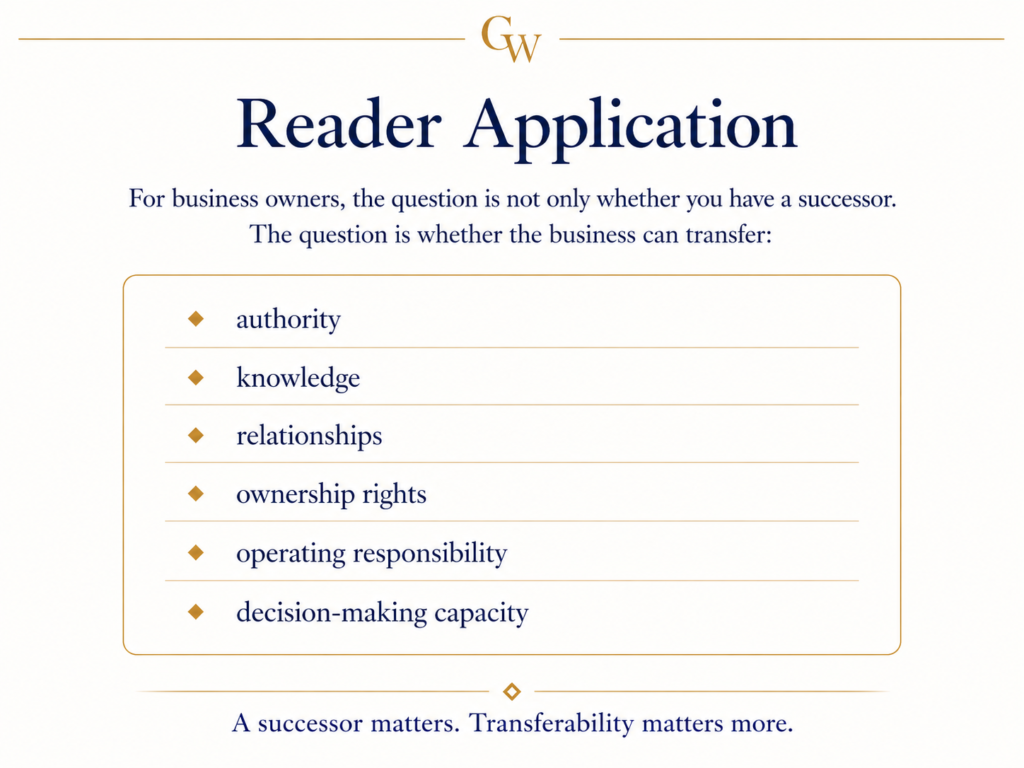
Authoritative Sources Cited in the Paper
International Finance Corporation, Family Business Governance Handbook
KPMG, Global Family Business Report
PwC, Family Business Survey
Deloitte, Family Enterprise, and Succession Planning resources
Family Firm Institute resources on family enterprise governance and continuity
STEP Project Global Consortium family business research
Harvard Business Review family business and succession resources
J.P. Morgan family governance and next-generation preparation resources
RBC and Campden Wealth family office reports
UBS Global Family Office Report.