
Governance
Governance Determines How Ownership Endures.
Ownership creates economic rights.
Governance determines how those rights are exercised.
Who makes the decisions?
Who has authority?
Who is accountable?
How are competing interests resolved?
How is capital allocated?
What happens when leadership changes?
What protects the value that has been created?
Generational Wealth studies governance as a fundamental component of ownership, enterprise value and institutional durability.
Strong ownership without effective governance can become fragile. Strong governance can help turn ownership into an enduring institution.
The Governance Question
Governance is ultimately about how consequential decisions are made.
Every enterprise, asset platform, family enterprise and institution must answer questions of authority and accountability.
Who has the right to decide?
Who has the responsibility to decide?
Who has the information required to decide?
Who is accountable for the outcome?
And what happens when those responsible for making decisions disagree?
These questions become increasingly important as ownership becomes more complex and the value at stake increases.
Governance and Ownership
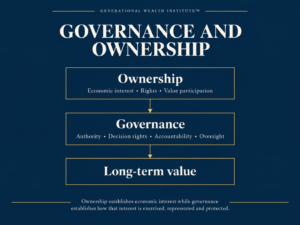
Ownership and governance are closely related, but they are not the same.
Ownership defines an economic interest.
Governance defines how that interest is represented, exercised and protected.
An owner may have economic rights without controlling every decision.
A founder may have significant influence without owning the majority of an enterprise.
An investor may provide capital while relying on a governance structure to protect that investment.
A family may retain ownership while professional management operates the enterprise.
Understanding these relationships is essential to understanding how value is created and preserved.
Governance and Enterprise Value
Governance can influence enterprise value because governance affects the quality and consistency of consequential decisions.
Poor governance can contribute to:
misaligned incentives
unclear authority
weak oversight
concentrated decision risk
capital misallocation
internal conflict
strategic drift
succession instability
Effective governance can create greater clarity around:
decision rights
accountability
capital allocation
risk management
performance
leadership
succession
long-term strategy
Governance is therefore not merely an administrative function.
It can be an economic variable.
Governance Is a Decision System
At its core, governance is a system for making important decisions.
That system determines:
Who decides
What requires approval
What information is required
Who can challenge a decision
Who is accountable
How conflicts are handled
How performance is reviewed
How authority changes over time
The quality of a governance system depends not simply on how many rules exist, but on whether the system produces better decisions.
Governance and Capital
Capital requires governance.
Investors need to know how capital will be allocated.
Owners need clarity around who can commit resources.
Boards and leadership teams need mechanisms for evaluating major investments, acquisitions and strategic initiatives.
Capital governance therefore includes questions such as:
How much can be invested?
Who approves major expenditures?
Who can authorize debt?
Who determines distributions?
Who approves acquisitions?
What happens when an investment thesis changes?
How are conflicts of interest addressed?
These questions become increasingly important as an institution grows.
Governance and Risk
Every ownership system contains risk.
Some risks come from markets.
Others come from operations, leverage, regulation or competition.
Governance is concerned with another category:
decision risk.
Decision risk can emerge when:
- incentives are misaligned
- responsibilities are unclear
- information is incomplete
- authority is concentrated
- oversight is weak
- disagreements cannot be resolved
- short-term interests override long-term objectives
Good governance does not eliminate uncertainty.
It creates structures through which uncertainty can be confronted responsibly.
Governance and Leadership
Leadership and governance are related, but they serve different functions.
Leadership determines direction.
Governance provides the framework within which direction is established, challenged and executed.
A strong leader does not eliminate the need for governance.
In an enduring institution, governance should help ensure that good decisions do not depend entirely on one person’s judgment.
That is especially important as organizations scale.
Founder Governance
Founders often create the original vision, relationships and operating culture of an enterprise.
But founder-led organizations can face unique governance questions as they grow.
What happens when ownership expands?
What happens when outside capital enters?
What happens when new leaders are appointed?
What happens when founders disagree?
What happens when a founder steps away?
What happens when the institution must operate without its original creator?
These are not simply leadership questions.
They are questions of institutional design.
Governance and Institutional Scale
Small organizations can sometimes operate through trust, informal communication and personal relationships.
As an institution grows, that becomes increasingly difficult.
More capital is involved.
More owners participate.
More employees make consequential decisions.
More assets need oversight.
More stakeholders have competing interests.
Governance must therefore evolve with scale.
Structures that work for a small owner-operated enterprise may not be appropriate for a large investment platform or multigenerational institution.
Governance and Succession
Succession is one of the clearest tests of governance.
An organization may appear highly successful while depending heavily on a small number of individuals.
The deeper question is:
Can the institution continue creating value when leadership changes?
That requires clarity around:
ownership
authority
leadership selection
decision rights
capital
accountability
institutional knowledge
continuity
This is where governance intersects directly with succession and stewardship.
Governance and Stewardship
Stewardship asks how value is preserved over time.
Governance provides many of the mechanisms through which that preservation occurs.
Policies can define authority.
Boards can provide oversight.
Ownership agreements can clarify rights.
Succession structures can prepare institutions for leadership transitions.
Investment committees can establish discipline around capital allocation.
Reporting systems can create accountability.
Governance therefore becomes one of the mechanisms through which stewardship becomes possible.
The Governance Architecture
Generational Wealth examines governance across several interconnected layers:
Ownership
Who holds the economic interest?
Authority
Who has the right to make consequential decisions?
Accountability
Who is responsible for outcomes?
Oversight
Who reviews important decisions and performance?
Incentives
How are decision-makers rewarded and aligned?
Continuity
How does the governance system adapt when ownership or leadership changes?
Stewardship
How does the governance structure protect long-term value?
Together, these layers form the architecture through which institutions are governed.
Governance and Decision-Making
Governance cannot be separated from decision-making.
A governance system establishes the environment in which decisions are made.
Decision-making determines what the organization actually does.
This creates a direct relationship:
Governance → Decision-Making → Capital Allocation → Enterprise Performance → Value
The quality of the governance system can therefore influence the quality of the decisions made within it.
Governance and Institutional Memory
Enduring institutions accumulate knowledge.
Investment decisions.
Operating experience.
Relationships.
Mistakes.
Successes.
Strategic principles.
Historical context.
Without systems for preserving institutional knowledge, important lessons can disappear when individuals leave.
Governance can help create the structures through which institutional memory is documented, communicated and preserved.
That can become increasingly valuable across generations.
The Governance Test
We believe important governance questions should include:
Can authority be clearly understood?
Can accountability be assigned?
Can conflicts be managed?
Can decisions be challenged constructively?
Can capital be allocated with discipline?
Can leadership transition occur without institutional disruption?
Can the system function without dependence on one individual?
Can ownership remain aligned with long-term objectives?
The answers provide insight into whether an institution is designed to endure.
The Generational Governance Framework
Our research examines governance through six connected dimensions:
1. Ownership
Who holds the economic interest?
2. Authority
Who makes the decisions?
3. Accountability
Who is responsible for outcomes?
4. Alignment
Do incentives support long-term value creation?
5. Continuity
Can the institution function through leadership and ownership transitions?
6. Stewardship
Does the governance structure protect what has been built?
This framework connects governance directly to the Generational Wealth thesis.
Governance and Long-Term Value
Governance rarely creates value by itself.
Its contribution is more indirect.
Good governance can help an institution:
make better decisions
allocate capital more effectively
manage conflicts
reduce avoidable risk
preserve institutional knowledge
support leadership transitions
maintain alignment
protect long-term objectives
In that sense, governance is part of the infrastructure that allows value creation to continue.What We Study
Generational Wealth research examines:
Ownership and control
Board governance
Decision rights
Capital governance
Founder governance
Investment committees
Incentive alignment
Conflict resolution
Risk oversight
Leadership transitions
Succession governance
Institutional accountability
Family enterprise governance
Organizational continuity
Institutional memory
Our objective is to understand the structures that allow ownership and economic value to remain aligned over time.
From Governance to Stewardship
Our broader institutional framework connects governance to the preservation of ownership:
Research → Intelligence → Capital → Assets → Governance → Stewardship → Generations
Research helps identify how governance systems work.
Intelligence helps interpret their strengths and weaknesses.
Capital places real economic resources under those systems.
Assets and enterprises create value.
Governance establishes decision structures around that value.
Stewardship preserves and compounds it.
Governance Is the Architecture of Endurance.
Ownership may establish the right to value.
Capital can create the capacity to build it.
Enterprise can create economic value.
But institutions require systems through which consequential decisions can continue to be made well.
That is the deeper role of governance.
How do we build systems capable of making good decisions long after the original owners and leaders are gone?
That is the question Generational Wealth seeks to understand.
Building What Generations Can Own.
Research what matters. Build what lasts. Own what compounds. Steward what endures.